

9 Compensation of Signals from Stationary Objects
175
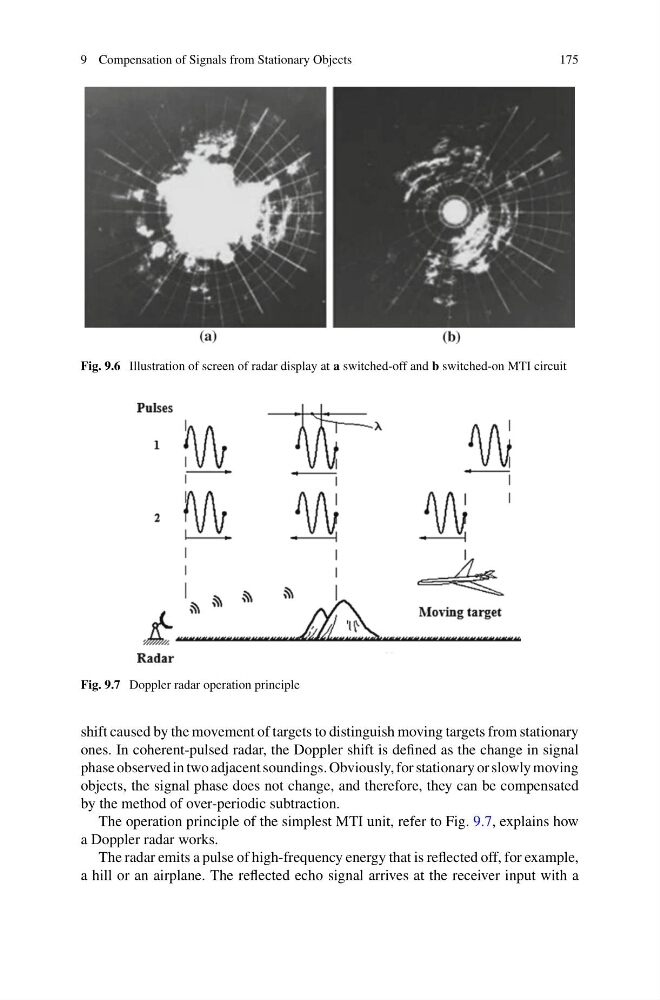
Fig. 9.6 Illustration of screen of radar display at a switched-off and b switched-on MTI circuit
Fig. 9.7 Doppler radar operation principle
shift caused by the movement of targets to distinguish moving targets from stationary
ones. In coherent-pulsed radar, the Doppler shift is defined as the change in signal
phase observed in two adjacent soundings. Obviously, for stationary or slowly moving
objects, the signal phase does not change, and therefore, they can be compensated
by the method of over-periodic subtraction.
The operation principle of the simplest MTI unit, refer to Fig. 9.7, explains how
a Doppler radar works.
The radar emits a pulse of high-frequency energy that is reflected off, for example,
a hill or an airplane. The reflected echo signal arrives at the receiver input with a
175
Fig. 9.6 Illustration of screen of radar display at a switched-off and b switched-on MTI circuit
Fig. 9.7 Doppler radar operation principle
shift caused by the movement of targets to distinguish moving targets from stationary
ones. In coherent-pulsed radar, the Doppler shift is defined as the change in signal
phase observed in two adjacent soundings. Obviously, for stationary or slowly moving
objects, the signal phase does not change, and therefore, they can be compensated
by the method of over-periodic subtraction.
The operation principle of the simplest MTI unit, refer to Fig. 9.7, explains how
a Doppler radar works.
The radar emits a pulse of high-frequency energy that is reflected off, for example,
a hill or an airplane. The reflected echo signal arrives at the receiver input with a