

104
5 Performance Characteristics of Radar Location …
where K =
0.117
sin α M
D 1
d
2 +
D 2
d
2 —coefficient, for finding of which special tables
were drawn up; σ
◦
θ —mean-square value of azimuth measuring error, expressed in
terms of degrees. Equal accuracy curve is defined according to the following formula:
K =
σ r dr
dσ
◦
θ
.
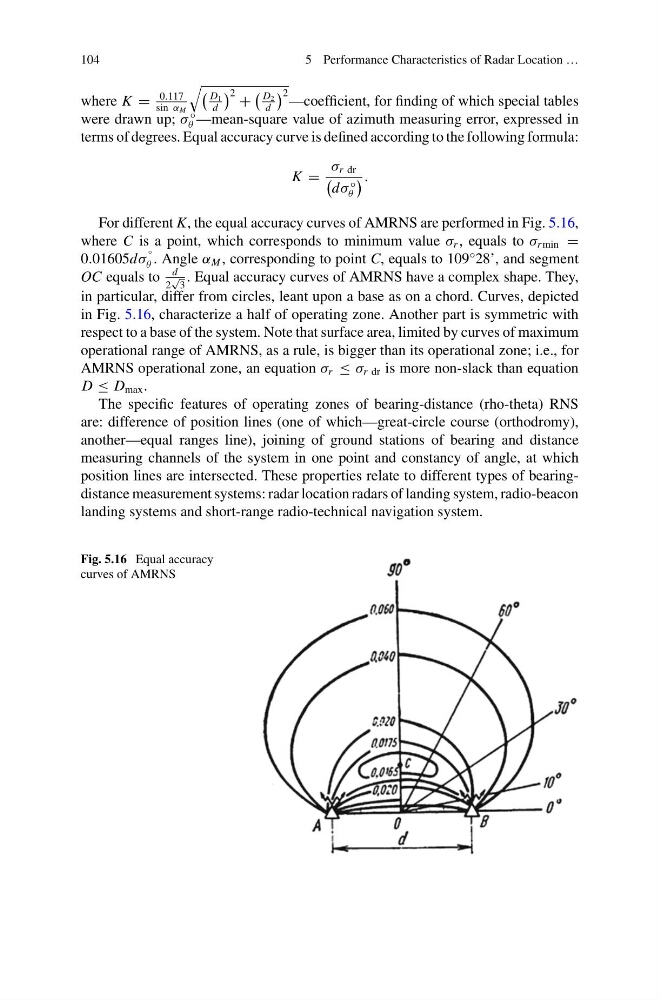
For different K, the equal accuracy curves of AMRNS are performed in Fig. 5.16,
where C is a point, which corresponds to minimum value σ r , equals to σ r min =
0.01605dσ
◦
θ . Angle α M , corresponding to point C, equals to 109°28’, and segment
OC equals to
d
2
√
3
. Equal accuracy curves of AMRNS have a complex shape. They,
in particular, differ from circles, leant upon a base as on a chord. Curves, depicted
in Fig. 5.16, characterize a half of operating zone. Another part is symmetric with
respect to a base of the system. Note that surface area, limited by curves of maximum
operational range of AMRNS, as a rule, is bigger than its operational zone; i.e., for
AMRNS operational zone, an equation σ r ≤ σ r dr is more non-slack than equation
D ≤ D max .
The specific features of operating zones of bearing-distance (rho-theta) RNS
are: difference of position lines (one of which—great-circle course (orthodromy),
another—equal ranges line), joining of ground stations of bearing and distance
measuring channels of the system in one point and constancy of angle, at which
position lines are intersected. These properties relate to different types of bearingdistance measurement systems: radar location radars of landing system, radio-beacon
landing systems and short-range radio-technical navigation system.
Fig. 5.16 Equal accuracy
curves of AMRNS
5 Performance Characteristics of Radar Location …
where K =
0.117
sin α M
D 1
d
2 +
D 2
d
2 —coefficient, for finding of which special tables
were drawn up; σ
◦
θ —mean-square value of azimuth measuring error, expressed in
terms of degrees. Equal accuracy curve is defined according to the following formula:
K =
σ r dr
dσ
◦
θ
.
For different K, the equal accuracy curves of AMRNS are performed in Fig. 5.16,
where C is a point, which corresponds to minimum value σ r , equals to σ r min =
0.01605dσ
◦
θ . Angle α M , corresponding to point C, equals to 109°28’, and segment
OC equals to
d
2
√
3
. Equal accuracy curves of AMRNS have a complex shape. They,
in particular, differ from circles, leant upon a base as on a chord. Curves, depicted
in Fig. 5.16, characterize a half of operating zone. Another part is symmetric with
respect to a base of the system. Note that surface area, limited by curves of maximum
operational range of AMRNS, as a rule, is bigger than its operational zone; i.e., for
AMRNS operational zone, an equation σ r ≤ σ r dr is more non-slack than equation
D ≤ D max .
The specific features of operating zones of bearing-distance (rho-theta) RNS
are: difference of position lines (one of which—great-circle course (orthodromy),
another—equal ranges line), joining of ground stations of bearing and distance
measuring channels of the system in one point and constancy of angle, at which
position lines are intersected. These properties relate to different types of bearingdistance measurement systems: radar location radars of landing system, radio-beacon
landing systems and short-range radio-technical navigation system.
Fig. 5.16 Equal accuracy
curves of AMRNS