

102
5 Performance Characteristics of Radar Location …
directions to responders, located in A and B points, is a constant value according to
(5.59). Such curves are a family of circles, resting upon d base, as upon a chord
(bisecant). Central angle of chord AB equals to 2α M . As it is clear from a triangle
AOC, an equal accuracy curve has a radius:
R acu =
d
(2 sin α M )
.
(5.60)
Consequently, plotting of operating zone of range-finding RNS resolves into the
following:
(1) responders position points A and B are plotted on a map and base d is measured;
(2) by given σ D and σ r dr we define an angle α M ;
(3) in accordance with (5.60), a radius R acu is calculated;
(4) knowing R acu and A and B points position, centers of circles O and O i are
defined on a map and circles, representing an equal accuracy curves, are plotted;
(5) RNS operational ranges D Amax and D Bmax are calculated and plotted on a map.
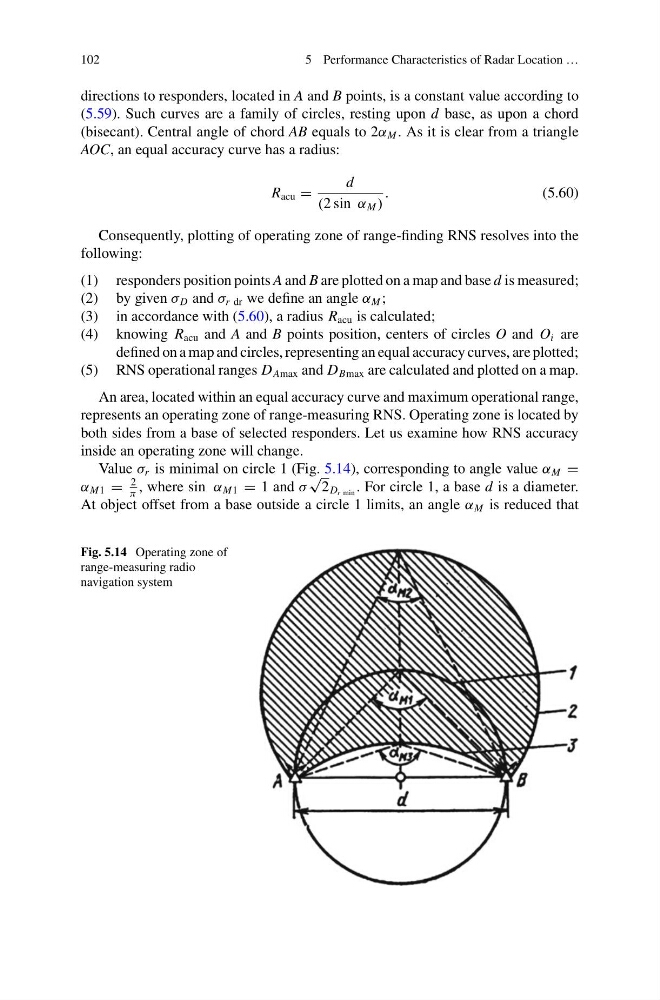
An area, located within an equal accuracy curve and maximum operational range,
represents an operating zone of range-measuring RNS. Operating zone is located by
both sides from a base of selected responders. Let us examine how RNS accuracy
inside an operating zone will change.
Value σ r is minimal on circle 1 (Fig. 5.14), corresponding to angle value α M =
α M1 =
2
π
, where sin α M1 = 1 and σ
√
2 D r min . For circle 1, a base d is a diameter.
At object offset from a base outside a circle 1 limits, an angle α M is reduced that
Fig. 5.14 Operating zone of
range-measuring radio
navigation system
5 Performance Characteristics of Radar Location …
directions to responders, located in A and B points, is a constant value according to
(5.59). Such curves are a family of circles, resting upon d base, as upon a chord
(bisecant). Central angle of chord AB equals to 2α M . As it is clear from a triangle
AOC, an equal accuracy curve has a radius:
R acu =
d
(2 sin α M )
.
(5.60)
Consequently, plotting of operating zone of range-finding RNS resolves into the
following:
(1) responders position points A and B are plotted on a map and base d is measured;
(2) by given σ D and σ r dr we define an angle α M ;
(3) in accordance with (5.60), a radius R acu is calculated;
(4) knowing R acu and A and B points position, centers of circles O and O i are
defined on a map and circles, representing an equal accuracy curves, are plotted;
(5) RNS operational ranges D Amax and D Bmax are calculated and plotted on a map.
An area, located within an equal accuracy curve and maximum operational range,
represents an operating zone of range-measuring RNS. Operating zone is located by
both sides from a base of selected responders. Let us examine how RNS accuracy
inside an operating zone will change.
Value σ r is minimal on circle 1 (Fig. 5.14), corresponding to angle value α M =
α M1 =
2
π
, where sin α M1 = 1 and σ
√
2 D r min . For circle 1, a base d is a diameter.
At object offset from a base outside a circle 1 limits, an angle α M is reduced that
Fig. 5.14 Operating zone of
range-measuring radio
navigation system