

5.2 Accuracy of Radar Location and Radio Navigation Systems
97
l
2
1
σ
2
l 1
+
l
2
2
σ
2
l 2
= c
2
1 .
(5.49)
where c 1 is some constant value.
From (5.49), it is clear that line of constant probability density w(l 1 , l 2 ) represents
an ellipse in oblique coordinate system, axes of which are coincided with normal
to position lines, and origin—with true object position. Ellipse, defined by relation
(5.49), is called an ellipse of errors or dispersion ellipse. At examining of ellipse
of errors, it is usually turned to Cartesian (rectangular) coordinate system with an
origin in the same point, where the new system axes are matching with ellipse axes.
Define semi-axes a and b of ellipse of errors and rotation angle of its axes relatively
to position lines. Let, as it was before, a family of object position lines around its
position can be substituted with segments of parallel straight lines independently on
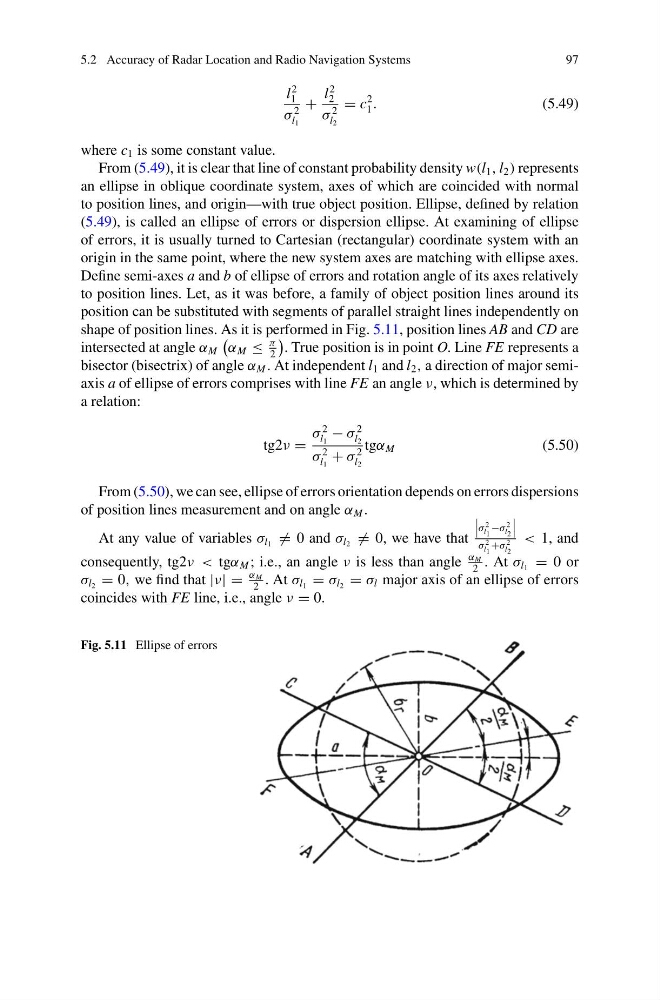
shape of position lines. As it is performed in Fig. 5.11, position lines AB and CD are
intersected at angle α M
α M ≤
π
2
. True position is in point O. Line FE represents a
bisector (bisectrix) of angle α M . At independent l 1 and l 2 , a direction of major semiaxis a of ellipse of errors comprises with line FE an angle ν, which is determined by
a relation:
tg2ν =
σ
2
l 1
− σ
2
l 2
σ
2
l 1
+ σ
2
l 2
tgα M
(5.50)
From (5.50), we can see, ellipse of errors orientation depends on errors dispersions
of position lines measurement and on angle α M .
At any value of variables σ l 1 = 0 and σ l 2 = 0, we have that
σ
2
l 1
−σ
2
l 2
σ
2
l 1
+σ
2
l 2
< 1, and
consequently, tg2ν < tgα M ; i.e., an angle ν is less than angle
α M
2
. At σ l 1 = 0 or
σ l 2 = 0, we find that |ν| =
α M
2
. At σ l 1 = σ l 2 = σ l major axis of an ellipse of errors
coincides with FE line, i.e., angle ν = 0.
Fig. 5.11 Ellipse of errors
97
l
2
1
σ
2
l 1
+
l
2
2
σ
2
l 2
= c
2
1 .
(5.49)
where c 1 is some constant value.
From (5.49), it is clear that line of constant probability density w(l 1 , l 2 ) represents
an ellipse in oblique coordinate system, axes of which are coincided with normal
to position lines, and origin—with true object position. Ellipse, defined by relation
(5.49), is called an ellipse of errors or dispersion ellipse. At examining of ellipse
of errors, it is usually turned to Cartesian (rectangular) coordinate system with an
origin in the same point, where the new system axes are matching with ellipse axes.
Define semi-axes a and b of ellipse of errors and rotation angle of its axes relatively
to position lines. Let, as it was before, a family of object position lines around its
position can be substituted with segments of parallel straight lines independently on
shape of position lines. As it is performed in Fig. 5.11, position lines AB and CD are
intersected at angle α M
α M ≤
π
2
. True position is in point O. Line FE represents a
bisector (bisectrix) of angle α M . At independent l 1 and l 2 , a direction of major semiaxis a of ellipse of errors comprises with line FE an angle ν, which is determined by
a relation:
tg2ν =
σ
2
l 1
− σ
2
l 2
σ
2
l 1
+ σ
2
l 2
tgα M
(5.50)
From (5.50), we can see, ellipse of errors orientation depends on errors dispersions
of position lines measurement and on angle α M .
At any value of variables σ l 1 = 0 and σ l 2 = 0, we have that
σ
2
l 1
−σ
2
l 2
σ
2
l 1
+σ
2
l 2
< 1, and
consequently, tg2ν < tgα M ; i.e., an angle ν is less than angle
α M
2
. At σ l 1 = 0 or
σ l 2 = 0, we find that |ν| =
α M
2
. At σ l 1 = σ l 2 = σ l major axis of an ellipse of errors
coincides with FE line, i.e., angle ν = 0.
Fig. 5.11 Ellipse of errors