

96
5 Performance Characteristics of Radar Location …
σ r =
σ
2
l 1
+ σ
2
l 2
+ 2σ l 1 σ l 2 ρ cos α M
sin α M
(5.46)
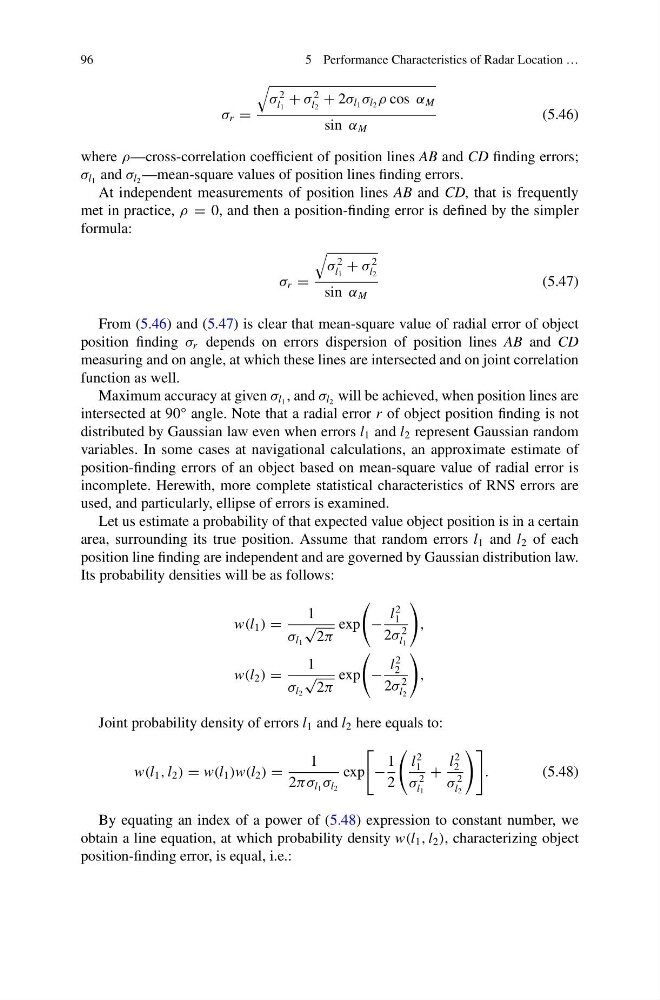
where ρ—cross-correlation coefficient of position lines AB and CD finding errors;
σ l 1 and σ l 2 —mean-square values of position lines finding errors.
At independent measurements of position lines AB and CD, that is frequently
met in practice, ρ = 0, and then a position-finding error is defined by the simpler
formula:
σ r =
σ
2
l 1
+ σ
2
l 2
sin α M
(5.47)
From (5.46) and (5.47) is clear that mean-square value of radial error of object
position finding σ r depends on errors dispersion of position lines AB and CD
measuring and on angle, at which these lines are intersected and on joint correlation
function as well.
Maximum accuracy at given σ l 1 , and σ l 2 will be achieved, when position lines are
intersected at 90° angle. Note that a radial error r of object position finding is not
distributed by Gaussian law even when errors l 1 and l 2 represent Gaussian random
variables. In some cases at navigational calculations, an approximate estimate of
position-finding errors of an object based on mean-square value of radial error is
incomplete. Herewith, more complete statistical characteristics of RNS errors are
used, and particularly, ellipse of errors is examined.
Let us estimate a probability of that expected value object position is in a certain
area, surrounding its true position. Assume that random errors l 1 and l 2 of each
position line finding are independent and are governed by Gaussian distribution law.
Its probability densities will be as follows:
w(l 1 ) =
1
σ l 1
√
2π
exp
−
l
2
1
2σ
2
l 1
,
w(l 2 ) =
1
σ l 2
√
2π
exp
−
l
2
2
2σ
2
l 2
,
Joint probability density of errors l 1 and l 2 here equals to:
w(l 1 , l 2 ) = w(l 1 )w(l 2 ) =
1
2πσ l 1 σ l 2
exp
−
1
2
l
2
1
σ
2
l 1
+
l
2
2
σ
2
l 2
.
(5.48)
By equating an index of a power of (5.48) expression to constant number, we
obtain a line equation, at which probability density w(l 1 , l 2 ), characterizing object
position-finding error, is equal, i.e.:
5 Performance Characteristics of Radar Location …
σ r =
σ
2
l 1
+ σ
2
l 2
+ 2σ l 1 σ l 2 ρ cos α M
sin α M
(5.46)
where ρ—cross-correlation coefficient of position lines AB and CD finding errors;
σ l 1 and σ l 2 —mean-square values of position lines finding errors.
At independent measurements of position lines AB and CD, that is frequently
met in practice, ρ = 0, and then a position-finding error is defined by the simpler
formula:
σ r =
σ
2
l 1
+ σ
2
l 2
sin α M
(5.47)
From (5.46) and (5.47) is clear that mean-square value of radial error of object
position finding σ r depends on errors dispersion of position lines AB and CD
measuring and on angle, at which these lines are intersected and on joint correlation
function as well.
Maximum accuracy at given σ l 1 , and σ l 2 will be achieved, when position lines are
intersected at 90° angle. Note that a radial error r of object position finding is not
distributed by Gaussian law even when errors l 1 and l 2 represent Gaussian random
variables. In some cases at navigational calculations, an approximate estimate of
position-finding errors of an object based on mean-square value of radial error is
incomplete. Herewith, more complete statistical characteristics of RNS errors are
used, and particularly, ellipse of errors is examined.
Let us estimate a probability of that expected value object position is in a certain
area, surrounding its true position. Assume that random errors l 1 and l 2 of each
position line finding are independent and are governed by Gaussian distribution law.
Its probability densities will be as follows:
w(l 1 ) =
1
σ l 1
√
2π
exp
−
l
2
1
2σ
2
l 1
,
w(l 2 ) =
1
σ l 2
√
2π
exp
−
l
2
2
2σ
2
l 2
,
Joint probability density of errors l 1 and l 2 here equals to:
w(l 1 , l 2 ) = w(l 1 )w(l 2 ) =
1
2πσ l 1 σ l 2
exp
−
1
2
l
2
1
σ
2
l 1
+
l
2
2
σ
2
l 2
.
(5.48)
By equating an index of a power of (5.48) expression to constant number, we
obtain a line equation, at which probability density w(l 1 , l 2 ), characterizing object
position-finding error, is equal, i.e.: