

5.2 Accuracy of Radar Location and Radio Navigation Systems
95
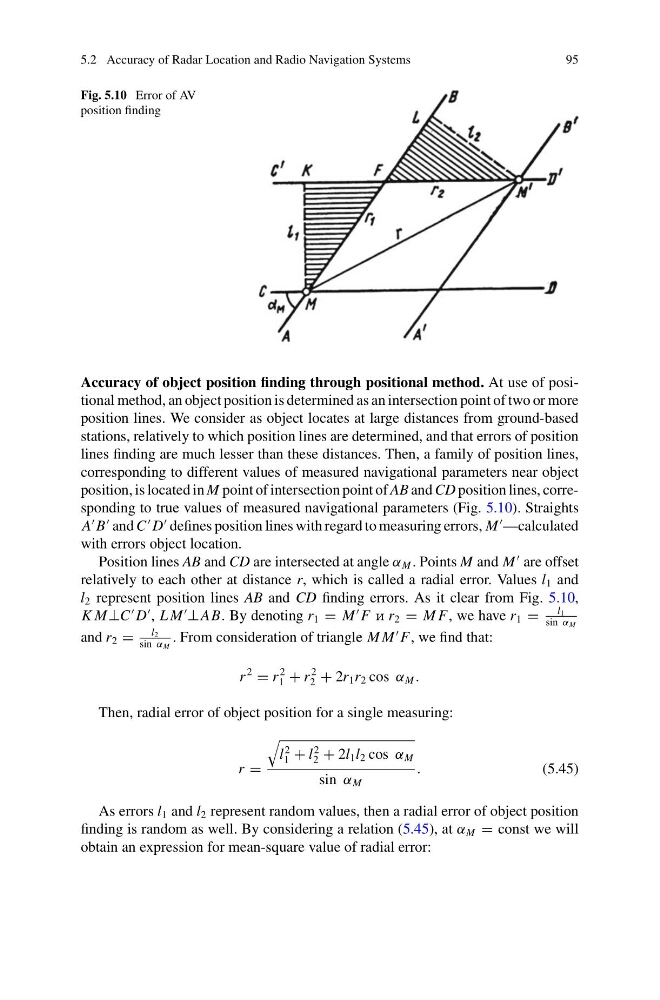
Fig. 5.10 Error of AV
position finding
Accuracy of object position finding through positional method. At use of positional method, an object position is determined as an intersection point of two or more
position lines. We consider as object locates at large distances from ground-based
stations, relatively to which position lines are determined, and that errors of position
lines finding are much lesser than these distances. Then, a family of position lines,
corresponding to different values of measured navigational parameters near object
position, is located in M point of intersection point of AB and CD position lines, corresponding to true values of measured navigational parameters (Fig. 5.10). Straights
A
B
and C
D
defines position lines with regard to measuring errors, M
—calculated
with errors object location.
Position lines AB and CD are intersected at angle α M . Points M and M
are offset
relatively to each other at distance r, which is called a radial error. Values l 1 and
l 2 represent position lines AB and CD finding errors. As it clear from Fig. 5.10,
K M⊥C
D
, L M
⊥AB. By denoting r 1 = M
F i r 2 = M F, we have r 1 =
l 1
sin α M
and r 2 =
l 2
sin α M
. From consideration of triangle M M
F, we find that:
r
2
= r
2
1 + r
2
2 + 2r 1 r 2 cos α M .
Then, radial error of object position for a single measuring:
r =
l
2
1 + l
2
2 + 2l 1 l 2 cos α M
sin α M
.
(5.45)
As errors l 1 and l 2 represent random values, then a radial error of object position
finding is random as well. By considering a relation (5.45), at α M = const we will
obtain an expression for mean-square value of radial error:
95
Fig. 5.10 Error of AV
position finding
Accuracy of object position finding through positional method. At use of positional method, an object position is determined as an intersection point of two or more
position lines. We consider as object locates at large distances from ground-based
stations, relatively to which position lines are determined, and that errors of position
lines finding are much lesser than these distances. Then, a family of position lines,
corresponding to different values of measured navigational parameters near object
position, is located in M point of intersection point of AB and CD position lines, corresponding to true values of measured navigational parameters (Fig. 5.10). Straights
A
B
and C
D
defines position lines with regard to measuring errors, M
—calculated
with errors object location.
Position lines AB and CD are intersected at angle α M . Points M and M
are offset
relatively to each other at distance r, which is called a radial error. Values l 1 and
l 2 represent position lines AB and CD finding errors. As it clear from Fig. 5.10,
K M⊥C
D
, L M
⊥AB. By denoting r 1 = M
F i r 2 = M F, we have r 1 =
l 1
sin α M
and r 2 =
l 2
sin α M
. From consideration of triangle M M
F, we find that:
r
2
= r
2
1 + r
2
2 + 2r 1 r 2 cos α M .
Then, radial error of object position for a single measuring:
r =
l
2
1 + l
2
2 + 2l 1 l 2 cos α M
sin α M
.
(5.45)
As errors l 1 and l 2 represent random values, then a radial error of object position
finding is random as well. By considering a relation (5.45), at α M = const we will
obtain an expression for mean-square value of radial error: