

5.1 Operational Range of Radar Location and Radio Navigation Systems
89
where E (P )—radiated energy (power); E(P)—energy (power), remained after
passing by wave a segment of 1 km.
Then, overall attenuation at path “radar–target–radar” comprises a value:
= 2γ D[d B].
(5.32)
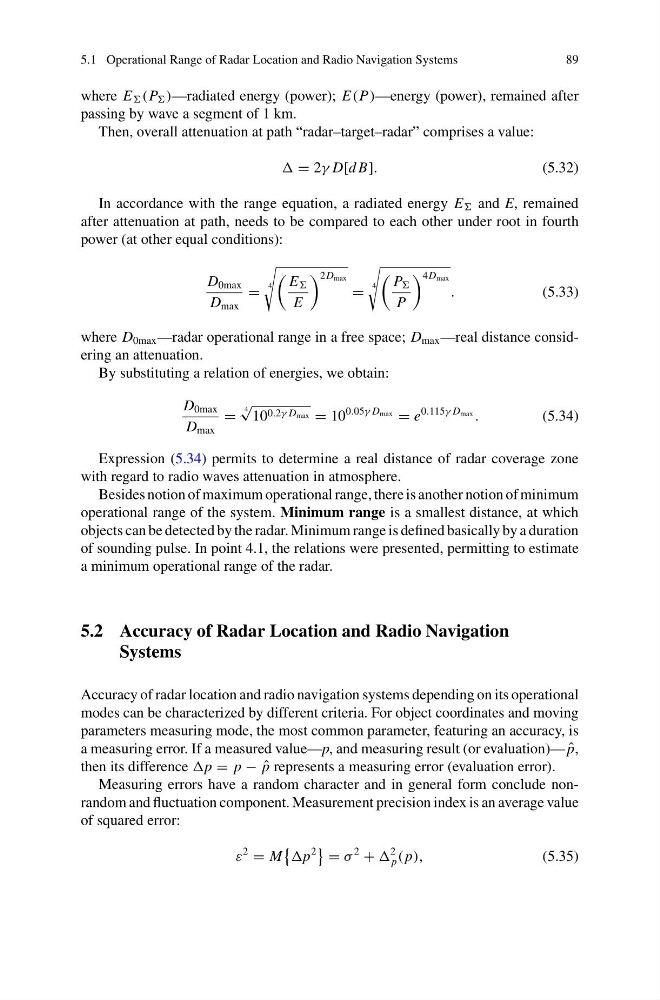
In accordance with the range equation, a radiated energy E and E, remained
after attenuation at path, needs to be compared to each other under root in fourth
power (at other equal conditions):
D 0max
D max
=
4
E
E
2D max
=
4
P
P
4D max
.
(5.33)
where D 0max —radar operational range in a free space; D max —real distance considering an attenuation.
By substituting a relation of energies, we obtain:
D 0max
D max
=
4
√
10 0.2γ D max = 10
0.05γ D max = e
0.115γ D max .
(5.34)
Expression (5.34) permits to determine a real distance of radar coverage zone
with regard to radio waves attenuation in atmosphere.
Besides notion of maximum operational range, there is another notion of minimum
operational range of the system. Minimum range is a smallest distance, at which
objects can be detected by the radar. Minimum range is defined basically by a duration
of sounding pulse. In point 4.1, the relations were presented, permitting to estimate
a minimum operational range of the radar.
5.2 Accuracy of Radar Location and Radio Navigation
Systems
Accuracy of radar location and radio navigation systems depending on its operational
modes can be characterized by different criteria. For object coordinates and moving
parameters measuring mode, the most common parameter, featuring an accuracy, is
a measuring error. If a measured value—p, and measuring result (or evaluation)— ˆ
p,
then its difference p = p − ˆ
p represents a measuring error (evaluation error).
Measuring errors have a random character and in general form conclude nonrandom and fluctuation component. Measurement precision index is an average value
of squared error:
ε
2
= M
p
2
= σ
2
+
2
p ( p),
(5.35)
89
where E (P )—radiated energy (power); E(P)—energy (power), remained after
passing by wave a segment of 1 km.
Then, overall attenuation at path “radar–target–radar” comprises a value:
= 2γ D[d B].
(5.32)
In accordance with the range equation, a radiated energy E and E, remained
after attenuation at path, needs to be compared to each other under root in fourth
power (at other equal conditions):
D 0max
D max
=
4
E
E
2D max
=
4
P
P
4D max
.
(5.33)
where D 0max —radar operational range in a free space; D max —real distance considering an attenuation.
By substituting a relation of energies, we obtain:
D 0max
D max
=
4
√
10 0.2γ D max = 10
0.05γ D max = e
0.115γ D max .
(5.34)
Expression (5.34) permits to determine a real distance of radar coverage zone
with regard to radio waves attenuation in atmosphere.
Besides notion of maximum operational range, there is another notion of minimum
operational range of the system. Minimum range is a smallest distance, at which
objects can be detected by the radar. Minimum range is defined basically by a duration
of sounding pulse. In point 4.1, the relations were presented, permitting to estimate
a minimum operational range of the radar.
5.2 Accuracy of Radar Location and Radio Navigation
Systems
Accuracy of radar location and radio navigation systems depending on its operational
modes can be characterized by different criteria. For object coordinates and moving
parameters measuring mode, the most common parameter, featuring an accuracy, is
a measuring error. If a measured value—p, and measuring result (or evaluation)— ˆ
p,
then its difference p = p − ˆ
p represents a measuring error (evaluation error).
Measuring errors have a random character and in general form conclude nonrandom and fluctuation component. Measurement precision index is an average value
of squared error:
ε
2
= M
p
2
= σ
2
+
2
p ( p),
(5.35)