

88
5 Performance Characteristics of Radar Location …
(b) detection range due to multi-beam directional pattern depends not on product
G, but on its relation G/λ;
(c) dependency of detection range is expressed from lift height of radar antenna
and object altitude.
Horizontal radiation polarization, for which the abovementioned formulas were
derived, should be used when it is necessary to get a longer detection range at small
angles of elevation. For a full-space coverage in vertical plane, a vertical radiation
polarization is preferable when a multi-lobe condition of a pattern is less expressed.
Reducing of radar operational range due to attenuation of radio waves energy
in atmosphere. In radar location a very high frequency (VHF), ultra-high frequency
(UHF, L-band), centimeter wave (S-band) and millimeter wave (extremely high
frequency) bands of ultra-short waves are widely used. Radio waves of all mentioned
bands experience an absorption and scattering by oxygen molecules and water vapors,
hydrometeors (rain, fog, snow), dust particles and other atmospheric inhomogeneity.
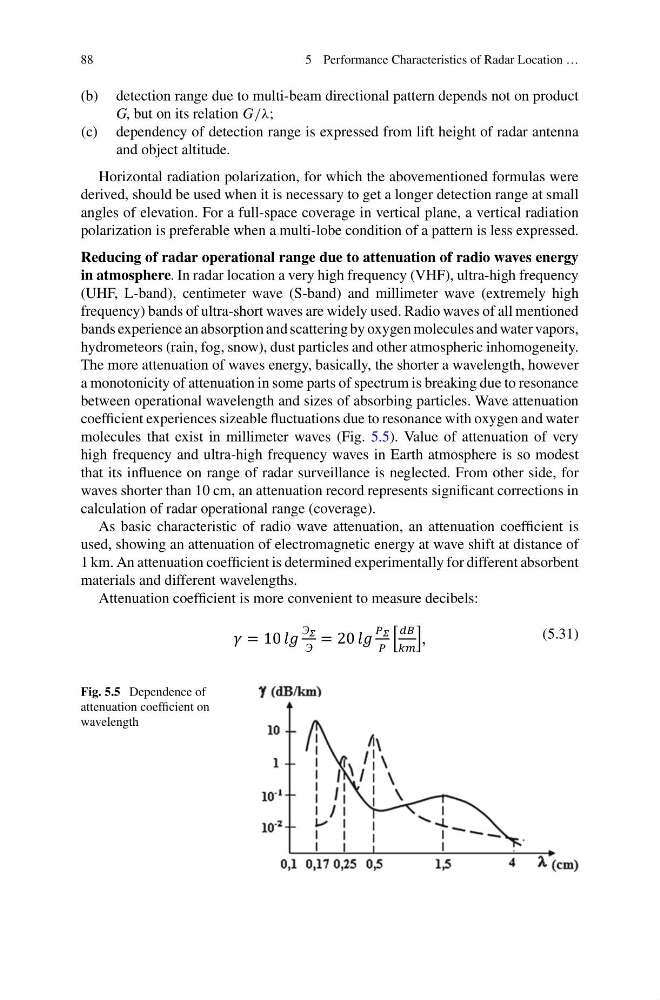
The more attenuation of waves energy, basically, the shorter a wavelength, however
a monotonicity of attenuation in some parts of spectrum is breaking due to resonance
between operational wavelength and sizes of absorbing particles. Wave attenuation
coefficient experiences sizeable fluctuations due to resonance with oxygen and water
molecules that exist in millimeter waves (Fig. 5.5). Value of attenuation of very
high frequency and ultra-high frequency waves in Earth atmosphere is so modest
that its influence on range of radar surveillance is neglected. From other side, for
waves shorter than 10 cm, an attenuation record represents significant corrections in
calculation of radar operational range (coverage).
As basic characteristic of radio wave attenuation, an attenuation coefficient is
used, showing an attenuation of electromagnetic energy at wave shift at distance of
1 km. An attenuation coefficient is determined experimentally for different absorbent
materials and different wavelengths.
Attenuation coefficient is more convenient to measure decibels:
(5.31)
Fig. 5.5 Dependence of
attenuation coefficient on
wavelength
5 Performance Characteristics of Radar Location …
(b) detection range due to multi-beam directional pattern depends not on product
G, but on its relation G/λ;
(c) dependency of detection range is expressed from lift height of radar antenna
and object altitude.
Horizontal radiation polarization, for which the abovementioned formulas were
derived, should be used when it is necessary to get a longer detection range at small
angles of elevation. For a full-space coverage in vertical plane, a vertical radiation
polarization is preferable when a multi-lobe condition of a pattern is less expressed.
Reducing of radar operational range due to attenuation of radio waves energy
in atmosphere. In radar location a very high frequency (VHF), ultra-high frequency
(UHF, L-band), centimeter wave (S-band) and millimeter wave (extremely high
frequency) bands of ultra-short waves are widely used. Radio waves of all mentioned
bands experience an absorption and scattering by oxygen molecules and water vapors,
hydrometeors (rain, fog, snow), dust particles and other atmospheric inhomogeneity.
The more attenuation of waves energy, basically, the shorter a wavelength, however
a monotonicity of attenuation in some parts of spectrum is breaking due to resonance
between operational wavelength and sizes of absorbing particles. Wave attenuation
coefficient experiences sizeable fluctuations due to resonance with oxygen and water
molecules that exist in millimeter waves (Fig. 5.5). Value of attenuation of very
high frequency and ultra-high frequency waves in Earth atmosphere is so modest
that its influence on range of radar surveillance is neglected. From other side, for
waves shorter than 10 cm, an attenuation record represents significant corrections in
calculation of radar operational range (coverage).
As basic characteristic of radio wave attenuation, an attenuation coefficient is
used, showing an attenuation of electromagnetic energy at wave shift at distance of
1 km. An attenuation coefficient is determined experimentally for different absorbent
materials and different wavelengths.
Attenuation coefficient is more convenient to measure decibels:
(5.31)
Fig. 5.5 Dependence of
attenuation coefficient on
wavelength