

5.1 Operational Range of Radar Location and Radio Navigation Systems
87
F r (β) =
2
1 − cos
4π h
λ
sin β
= 2
sin
2π h
λ
sin β
; F(β) = 1. (5.24)
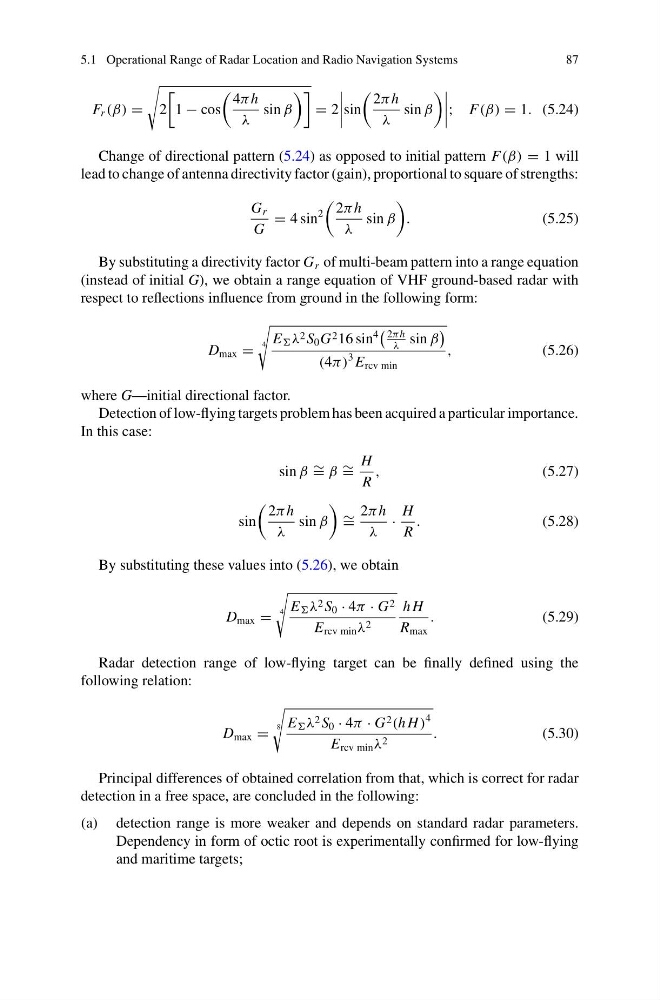
Change of directional pattern (5.24) as opposed to initial pattern F(β) = 1 will
lead to change of antenna directivity factor (gain), proportional to square of strengths:
G r
G
= 4 sin
2
2π h
λ
sin β
.
(5.25)
By substituting a directivity factor G r of multi-beam pattern into a range equation
(instead of initial G), we obtain a range equation of VHF ground-based radar with
respect to reflections influence from ground in the following form:
D max =
4
E λ 2 S 0 G 2 16 sin
4
2π h
λ
sin β
(4π )
3 E rcv min
,
(5.26)
where G—initial directional factor.
Detection of low-flying targets problem has been acquired a particular importance.
In this case:
sin β ∼ = β ∼ =
H
R
,
(5.27)
sin
2π h
λ
sin β
∼ =
2π h
λ
·
H
R
.
(5.28)
By substituting these values into (5.26), we obtain
D max =
4
E λ 2 S 0 · 4π · G 2
E rcv min λ 2
h H
R max
.
(5.29)
Radar detection range of low-flying target can be finally defined using the
following relation:
D max =
8
E λ 2 S 0 · 4π · G 2 (h H)
4
E rcv min λ 2
.
(5.30)
Principal differences of obtained correlation from that, which is correct for radar
detection in a free space, are concluded in the following:
(a) detection range is more weaker and depends on standard radar parameters.
Dependency in form of octic root is experimentally confirmed for low-flying
and maritime targets;
87
F r (β) =
2
1 − cos
4π h
λ
sin β
= 2
sin
2π h
λ
sin β
; F(β) = 1. (5.24)
Change of directional pattern (5.24) as opposed to initial pattern F(β) = 1 will
lead to change of antenna directivity factor (gain), proportional to square of strengths:
G r
G
= 4 sin
2
2π h
λ
sin β
.
(5.25)
By substituting a directivity factor G r of multi-beam pattern into a range equation
(instead of initial G), we obtain a range equation of VHF ground-based radar with
respect to reflections influence from ground in the following form:
D max =
4
E λ 2 S 0 G 2 16 sin
4
2π h
λ
sin β
(4π )
3 E rcv min
,
(5.26)
where G—initial directional factor.
Detection of low-flying targets problem has been acquired a particular importance.
In this case:
sin β ∼ = β ∼ =
H
R
,
(5.27)
sin
2π h
λ
sin β
∼ =
2π h
λ
·
H
R
.
(5.28)
By substituting these values into (5.26), we obtain
D max =
4
E λ 2 S 0 · 4π · G 2
E rcv min λ 2
h H
R max
.
(5.29)
Radar detection range of low-flying target can be finally defined using the
following relation:
D max =
8
E λ 2 S 0 · 4π · G 2 (h H)
4
E rcv min λ 2
.
(5.30)
Principal differences of obtained correlation from that, which is correct for radar
detection in a free space, are concluded in the following:
(a) detection range is more weaker and depends on standard radar parameters.
Dependency in form of octic root is experimentally confirmed for low-flying
and maritime targets;