

90
5 Performance Characteristics of Radar Location …
where: σ
2 —measuring error dispersion (variance); p ( p)—non-random (response)
value, called fixed (systematic) error.
In practice, it should be achieved that p ( p) = 0, then total and mean-root-square
errors are matched ε = σ .
In radar location systems, fixed errors can be eliminated through radar calibration,
and errors arisen by random factors are known only at an average, for a large number
of measurements. For radar location, the most important random processes are: electric noises and noises in radar receiver (self-generated and received by antenna);
signal fluctuations, reflected from a target, stipulated by target movements and other
reasons; unstable operation of different electric and mechanical measuring circuits;
instability of radio wave propagation in continuously variable atmosphere. At reradiating of sounding signal by responder, mounted on object, target fluctuations stop
influence on range measurement accuracy, but an error appears, connected with instability of responder actuation time. As we can see, random changes in real conditions
of radar operation are confirmed:
• measuring object itself—reflected signal, transforming due to electric noises influence into “signal + noise” value, not identical in shape of envelope to probing
radiation;
• radar measuring circuits;
• radio waves propagation path.
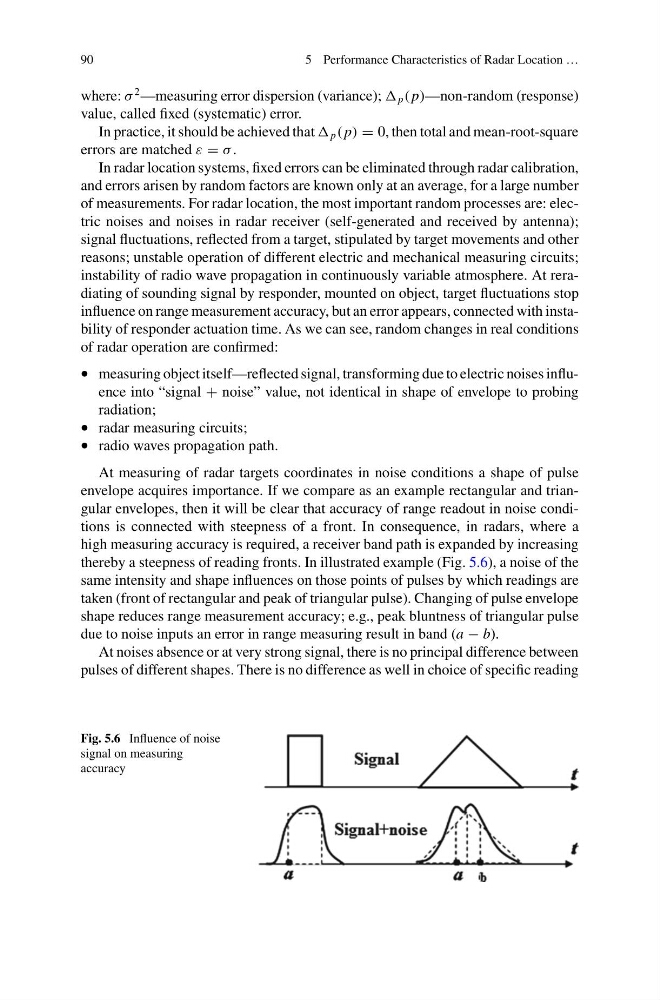
At measuring of radar targets coordinates in noise conditions a shape of pulse
envelope acquires importance. If we compare as an example rectangular and triangular envelopes, then it will be clear that accuracy of range readout in noise conditions is connected with steepness of a front. In consequence, in radars, where a
high measuring accuracy is required, a receiver band path is expanded by increasing
thereby a steepness of reading fronts. In illustrated example (Fig. 5.6), a noise of the
same intensity and shape influences on those points of pulses by which readings are
taken (front of rectangular and peak of triangular pulse). Changing of pulse envelope
shape reduces range measurement accuracy; e.g., peak bluntness of triangular pulse
due to noise inputs an error in range measuring result in band (a − b).
At noises absence or at very strong signal, there is no principal difference between
pulses of different shapes. There is no difference as well in choice of specific reading
Fig. 5.6 Influence of noise
signal on measuring
accuracy
5 Performance Characteristics of Radar Location …
where: σ
2 —measuring error dispersion (variance); p ( p)—non-random (response)
value, called fixed (systematic) error.
In practice, it should be achieved that p ( p) = 0, then total and mean-root-square
errors are matched ε = σ .
In radar location systems, fixed errors can be eliminated through radar calibration,
and errors arisen by random factors are known only at an average, for a large number
of measurements. For radar location, the most important random processes are: electric noises and noises in radar receiver (self-generated and received by antenna);
signal fluctuations, reflected from a target, stipulated by target movements and other
reasons; unstable operation of different electric and mechanical measuring circuits;
instability of radio wave propagation in continuously variable atmosphere. At reradiating of sounding signal by responder, mounted on object, target fluctuations stop
influence on range measurement accuracy, but an error appears, connected with instability of responder actuation time. As we can see, random changes in real conditions
of radar operation are confirmed:
• measuring object itself—reflected signal, transforming due to electric noises influence into “signal + noise” value, not identical in shape of envelope to probing
radiation;
• radar measuring circuits;
• radio waves propagation path.
At measuring of radar targets coordinates in noise conditions a shape of pulse
envelope acquires importance. If we compare as an example rectangular and triangular envelopes, then it will be clear that accuracy of range readout in noise conditions is connected with steepness of a front. In consequence, in radars, where a
high measuring accuracy is required, a receiver band path is expanded by increasing
thereby a steepness of reading fronts. In illustrated example (Fig. 5.6), a noise of the
same intensity and shape influences on those points of pulses by which readings are
taken (front of rectangular and peak of triangular pulse). Changing of pulse envelope
shape reduces range measurement accuracy; e.g., peak bluntness of triangular pulse
due to noise inputs an error in range measuring result in band (a − b).
At noises absence or at very strong signal, there is no principal difference between
pulses of different shapes. There is no difference as well in choice of specific reading
Fig. 5.6 Influence of noise
signal on measuring
accuracy