

positive characteristic AB as depicted in Fig. 2.20 appears as the reciprocal of dx/dt it
converges towards the characteristic x ¼ c 0 t.
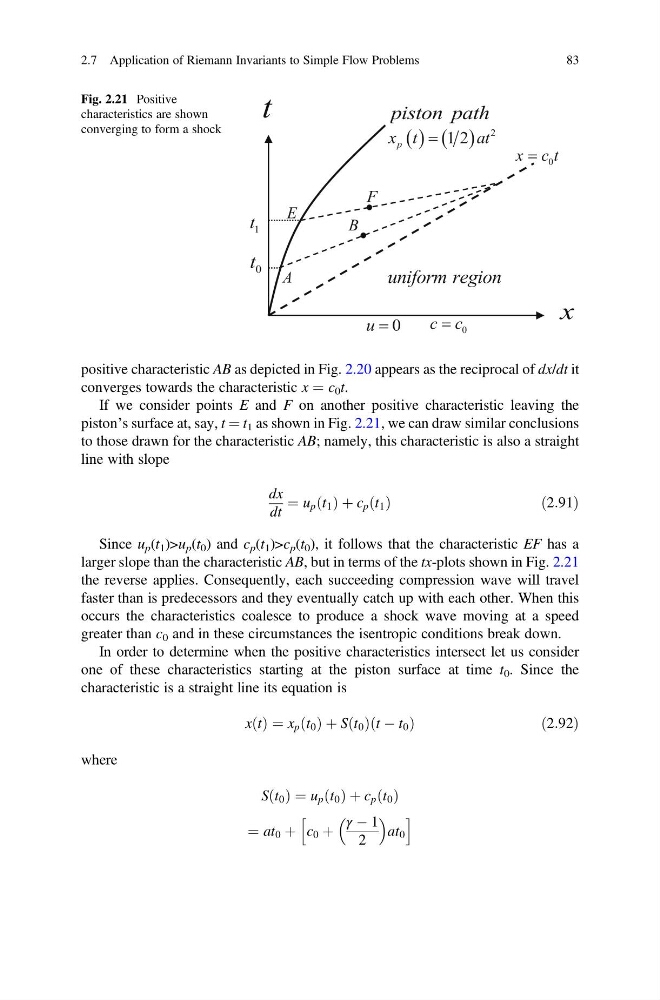
If we consider points E and F on another positive characteristic leaving the
piston’s surface at, say, t ¼ t 1 as shown in Fig. 2.21, we can draw similar conclusions
to those drawn for the characteristic AB; namely, this characteristic is also a straight
line with slope
dx
dt
¼ u p t 1
ð Þ þ c p t 1
ð Þ
ð2:91Þ
Since u p (t 1 )>u p (t 0 ) and c p (t 1 )>c p (t 0 ), it follows that the characteristic EF has a
larger slope than the characteristic AB, but in terms of the tx-plots shown in Fig. 2.21
the reverse applies. Consequently, each succeeding compression wave will travel
faster than is predecessors and they eventually catch up with each other. When this
occurs the characteristics coalesce to produce a shock wave moving at a speed
greater than c 0 and in these circumstances the isentropic conditions break down.
In order to determine when the positive characteristics intersect let us consider
one of these characteristics starting at the piston surface at time t 0 . Since the
characteristic is a straight line its equation is
x t
ð Þ ¼ x p t 0
ð Þ þ S t 0
ð Þ t À t 0
ð
Þ
ð2:92Þ
where
S t 0
ð Þ ¼ u p t 0
ð Þ þ c p t 0
ð Þ
¼ at 0 þ c 0 þ
γ À 1
2
at 0
h
i
Fig. 2.21 Positive
characteristics are shown
converging to form a shock
2.7 Application of Riemann Invariants to Simple Flow Problems
83
converges towards the characteristic x ¼ c 0 t.
If we consider points E and F on another positive characteristic leaving the
piston’s surface at, say, t ¼ t 1 as shown in Fig. 2.21, we can draw similar conclusions
to those drawn for the characteristic AB; namely, this characteristic is also a straight
line with slope
dx
dt
¼ u p t 1
ð Þ þ c p t 1
ð Þ
ð2:91Þ
Since u p (t 1 )>u p (t 0 ) and c p (t 1 )>c p (t 0 ), it follows that the characteristic EF has a
larger slope than the characteristic AB, but in terms of the tx-plots shown in Fig. 2.21
the reverse applies. Consequently, each succeeding compression wave will travel
faster than is predecessors and they eventually catch up with each other. When this
occurs the characteristics coalesce to produce a shock wave moving at a speed
greater than c 0 and in these circumstances the isentropic conditions break down.
In order to determine when the positive characteristics intersect let us consider
one of these characteristics starting at the piston surface at time t 0 . Since the
characteristic is a straight line its equation is
x t
ð Þ ¼ x p t 0
ð Þ þ S t 0
ð Þ t À t 0
ð
Þ
ð2:92Þ
where
S t 0
ð Þ ¼ u p t 0
ð Þ þ c p t 0
ð Þ
¼ at 0 þ c 0 þ
γ À 1
2
at 0
h
i
Fig. 2.21 Positive
characteristics are shown
converging to form a shock
2.7 Application of Riemann Invariants to Simple Flow Problems
83