

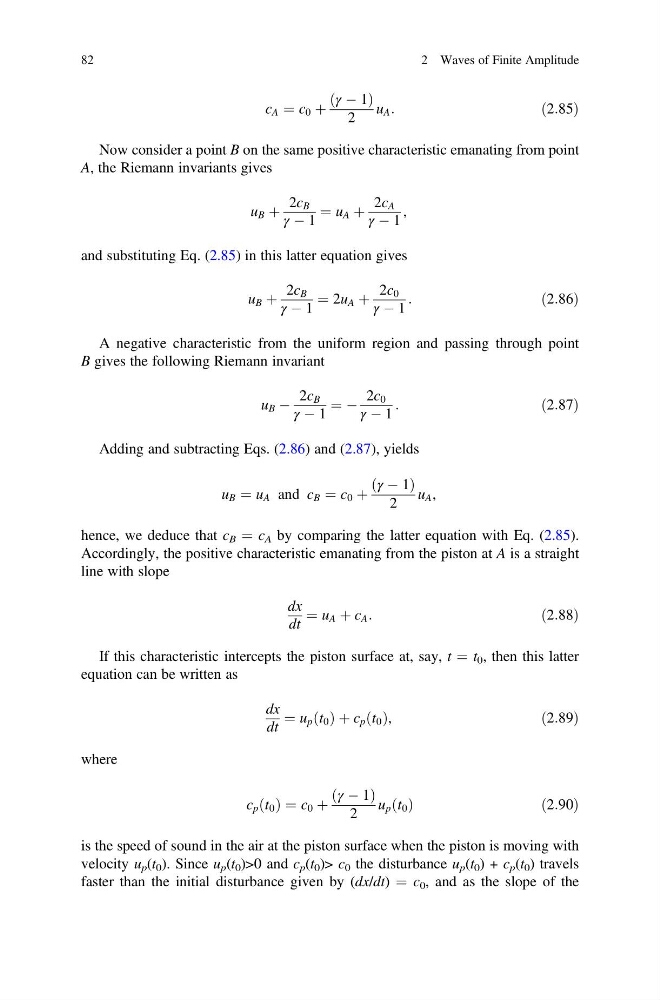
c A ¼ c 0 þ
γ À 1
ð
Þ
2
u A :
ð2:85Þ
Now consider a point B on the same positive characteristic emanating from point
A, the Riemann invariants gives
u B þ
2c B
γ À 1
¼ u A þ
2c A
γ À 1
,
and substituting Eq. (2.85) in this latter equation gives
u B þ
2c B
γ À 1
¼ 2u A þ
2c 0
γ À 1
:
ð2:86Þ
A negative characteristic from the uniform region and passing through point
B gives the following Riemann invariant
u B À
2c B
γ À 1
¼ À
2c 0
γ À 1
:
ð2:87Þ
Adding and subtracting Eqs. (2.86) and (2.87), yields
u B ¼ u A and c B ¼ c 0 þ
γ À 1
ð
Þ
2
u A ,
hence, we deduce that c B ¼ c A by comparing the latter equation with Eq. (2.85).
Accordingly, the positive characteristic emanating from the piston at A is a straight
line with slope
dx
dt
¼ u A þ c A :
ð2:88Þ
If this characteristic intercepts the piston surface at, say, t ¼ t 0 , then this latter
equation can be written as
dx
dt
¼ u p t 0
ð Þ þ c p t 0
ð Þ,
ð2:89Þ
where
c p t 0
ð Þ ¼ c 0 þ
γ À 1
ð
Þ
2
u p t 0
ð Þ
ð2:90Þ
is the speed of sound in the air at the piston surface when the piston is moving with
velocity u p (t 0 ). Since u p (t 0 )>0 and c p (t 0 )> c 0 the disturbance u p (t 0 ) + c p (t 0 ) travels
faster than the initial disturbance given by (dx/dt) ¼ c 0 , and as the slope of the
82
2 Waves of Finite Amplitude
γ À 1
ð
Þ
2
u A :
ð2:85Þ
Now consider a point B on the same positive characteristic emanating from point
A, the Riemann invariants gives
u B þ
2c B
γ À 1
¼ u A þ
2c A
γ À 1
,
and substituting Eq. (2.85) in this latter equation gives
u B þ
2c B
γ À 1
¼ 2u A þ
2c 0
γ À 1
:
ð2:86Þ
A negative characteristic from the uniform region and passing through point
B gives the following Riemann invariant
u B À
2c B
γ À 1
¼ À
2c 0
γ À 1
:
ð2:87Þ
Adding and subtracting Eqs. (2.86) and (2.87), yields
u B ¼ u A and c B ¼ c 0 þ
γ À 1
ð
Þ
2
u A ,
hence, we deduce that c B ¼ c A by comparing the latter equation with Eq. (2.85).
Accordingly, the positive characteristic emanating from the piston at A is a straight
line with slope
dx
dt
¼ u A þ c A :
ð2:88Þ
If this characteristic intercepts the piston surface at, say, t ¼ t 0 , then this latter
equation can be written as
dx
dt
¼ u p t 0
ð Þ þ c p t 0
ð Þ,
ð2:89Þ
where
c p t 0
ð Þ ¼ c 0 þ
γ À 1
ð
Þ
2
u p t 0
ð Þ
ð2:90Þ
is the speed of sound in the air at the piston surface when the piston is moving with
velocity u p (t 0 ). Since u p (t 0 )>0 and c p (t 0 )> c 0 the disturbance u p (t 0 ) + c p (t 0 ) travels
faster than the initial disturbance given by (dx/dt) ¼ c 0 , and as the slope of the
82
2 Waves of Finite Amplitude