

2.7.3 Piston Moving into a Tube
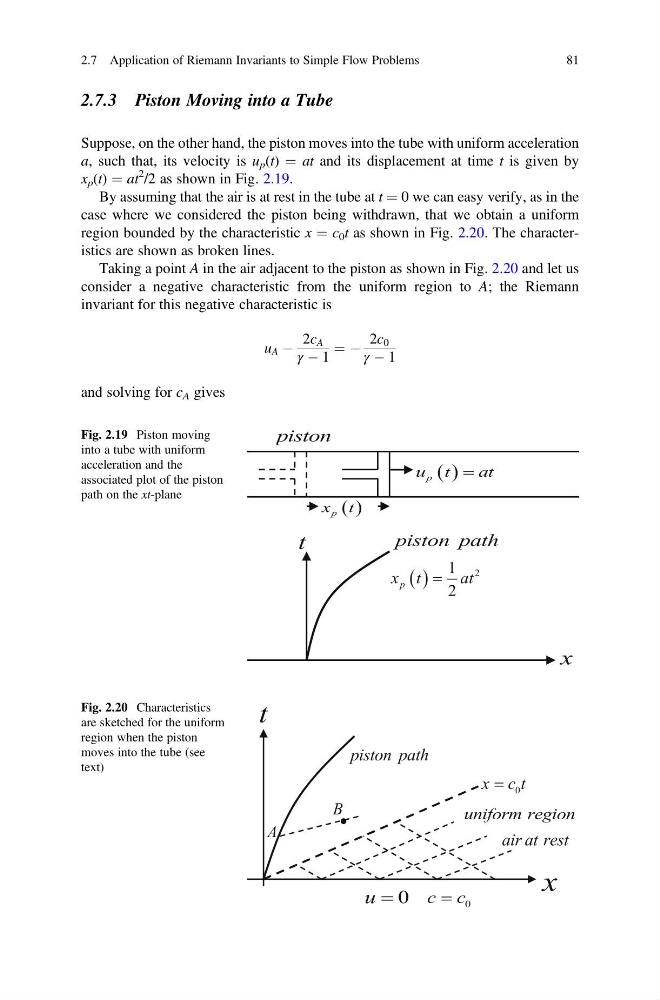
Suppose, on the other hand, the piston moves into the tube with uniform acceleration
a, such that, its velocity is u p (t) ¼ at and its displacement at time t is given by
x p (t) ¼ at
2 /2 as shown in Fig. 2.19.
By assuming that the air is at rest in the tube at t ¼ 0 we can easy verify, as in the
case where we considered the piston being withdrawn, that we obtain a uniform
region bounded by the characteristic x ¼ c 0 t as shown in Fig. 2.20. The characteristics are shown as broken lines.
Taking a point A in the air adjacent to the piston as shown in Fig. 2.20 and let us
consider a negative characteristic from the uniform region to A; the Riemann
invariant for this negative characteristic is
u A À
2c A
γ À 1
¼ À
2c 0
γ À 1
and solving for c A gives
Fig. 2.19 Piston moving
into a tube with uniform
acceleration and the
associated plot of the piston
path on the xt-plane
Fig. 2.20 Characteristics
are sketched for the uniform
region when the piston
moves into the tube (see
text)
2.7 Application of Riemann Invariants to Simple Flow Problems
81
Suppose, on the other hand, the piston moves into the tube with uniform acceleration
a, such that, its velocity is u p (t) ¼ at and its displacement at time t is given by
x p (t) ¼ at
2 /2 as shown in Fig. 2.19.
By assuming that the air is at rest in the tube at t ¼ 0 we can easy verify, as in the
case where we considered the piston being withdrawn, that we obtain a uniform
region bounded by the characteristic x ¼ c 0 t as shown in Fig. 2.20. The characteristics are shown as broken lines.
Taking a point A in the air adjacent to the piston as shown in Fig. 2.20 and let us
consider a negative characteristic from the uniform region to A; the Riemann
invariant for this negative characteristic is
u A À
2c A
γ À 1
¼ À
2c 0
γ À 1
and solving for c A gives
Fig. 2.19 Piston moving
into a tube with uniform
acceleration and the
associated plot of the piston
path on the xt-plane
Fig. 2.20 Characteristics
are sketched for the uniform
region when the piston
moves into the tube (see
text)
2.7 Application of Riemann Invariants to Simple Flow Problems
81