

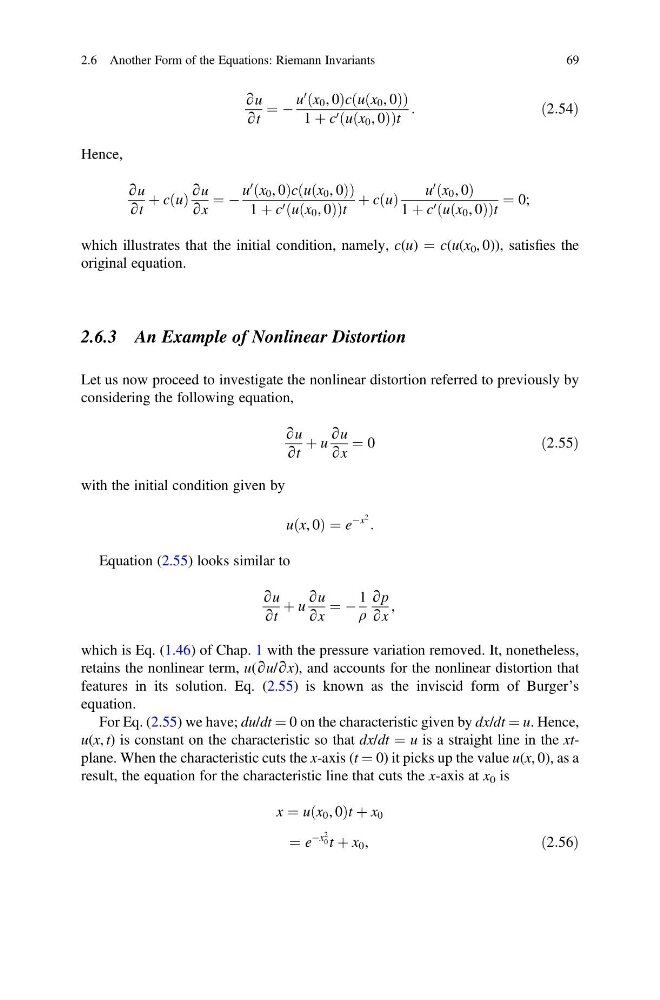
∂u
∂t
¼ À
u
0 x 0 , 0
ð
Þc u x 0 , 0
ð
Þ
ð
Þ
1 þ c 0 u x 0 , 0
ð
Þ
ð
Þ t
:
ð2:54Þ
Hence,
∂u
∂t
þ c u
ð Þ
∂u
∂x
¼ À
u
0 x 0 , 0
ð
Þc u x 0 , 0
ð
Þ
ð
Þ
1 þ c 0 u x 0 , 0
ð
Þ
ð
Þ t
þ c u
ð Þ
u
0 x 0 , 0
ð
Þ
1 þ c 0 u x 0 , 0
ð
Þ
ð
Þ t
¼ 0;
which illustrates that the initial condition, namely, c(u) ¼ c(u(x 0 , 0)), satisfies the
original equation.
2.6.3 An Example of Nonlinear Distortion
Let us now proceed to investigate the nonlinear distortion referred to previously by
considering the following equation,
∂u
∂t
þ u
∂u
∂x
¼ 0
ð2:55Þ
with the initial condition given by
u x, 0
ð Þ ¼ e
Àx
2 :
Equation (2.55) looks similar to
∂u
∂t
þ u
∂u
∂x
¼ À
1
ρ
∂p
∂x
,
which is Eq. (1.46) of Chap. 1 with the pressure variation removed. It, nonetheless,
retains the nonlinear term, u(∂u/∂x), and accounts for the nonlinear distortion that
features in its solution. Eq. (2.55) is known as the inviscid form of Burger’s
equation.
For Eq. (2.55) we have; du/dt ¼ 0 on the characteristic given by dx/dt ¼ u. Hence,
u(x, t) is constant on the characteristic so that dx/dt ¼ u is a straight line in the xtplane. When the characteristic cuts the x-axis (t ¼ 0) it picks up the value u(x, 0), as a
result, the equation for the characteristic line that cuts the x-axis at x 0 is
x ¼ u x 0 , 0
ð
Þt þ x 0
¼ e
Àx
2
0 t þ x 0 ,
ð2:56Þ
2.6 Another Form of the Equations: Riemann Invariants
69
∂t
¼ À
u
0 x 0 , 0
ð
Þc u x 0 , 0
ð
Þ
ð
Þ
1 þ c 0 u x 0 , 0
ð
Þ
ð
Þ t
:
ð2:54Þ
Hence,
∂u
∂t
þ c u
ð Þ
∂u
∂x
¼ À
u
0 x 0 , 0
ð
Þc u x 0 , 0
ð
Þ
ð
Þ
1 þ c 0 u x 0 , 0
ð
Þ
ð
Þ t
þ c u
ð Þ
u
0 x 0 , 0
ð
Þ
1 þ c 0 u x 0 , 0
ð
Þ
ð
Þ t
¼ 0;
which illustrates that the initial condition, namely, c(u) ¼ c(u(x 0 , 0)), satisfies the
original equation.
2.6.3 An Example of Nonlinear Distortion
Let us now proceed to investigate the nonlinear distortion referred to previously by
considering the following equation,
∂u
∂t
þ u
∂u
∂x
¼ 0
ð2:55Þ
with the initial condition given by
u x, 0
ð Þ ¼ e
Àx
2 :
Equation (2.55) looks similar to
∂u
∂t
þ u
∂u
∂x
¼ À
1
ρ
∂p
∂x
,
which is Eq. (1.46) of Chap. 1 with the pressure variation removed. It, nonetheless,
retains the nonlinear term, u(∂u/∂x), and accounts for the nonlinear distortion that
features in its solution. Eq. (2.55) is known as the inviscid form of Burger’s
equation.
For Eq. (2.55) we have; du/dt ¼ 0 on the characteristic given by dx/dt ¼ u. Hence,
u(x, t) is constant on the characteristic so that dx/dt ¼ u is a straight line in the xtplane. When the characteristic cuts the x-axis (t ¼ 0) it picks up the value u(x, 0), as a
result, the equation for the characteristic line that cuts the x-axis at x 0 is
x ¼ u x 0 , 0
ð
Þt þ x 0
¼ e
Àx
2
0 t þ x 0 ,
ð2:56Þ
2.6 Another Form of the Equations: Riemann Invariants
69