

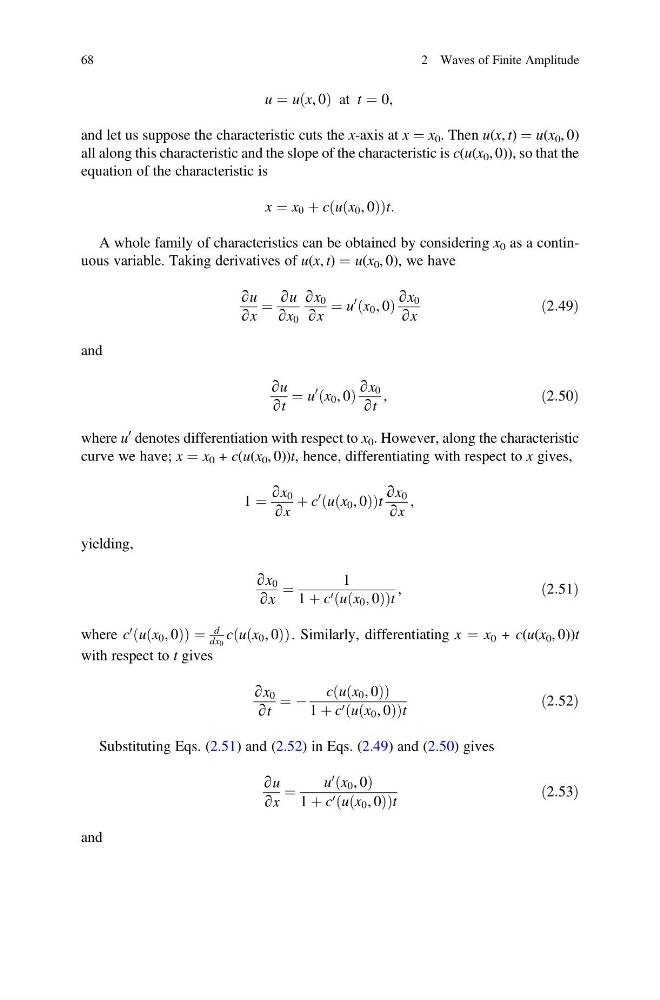
u ¼ u x, 0
ð Þ at t ¼ 0,
and let us suppose the characteristic cuts the x-axis at x ¼ x 0 . Then u(x, t) ¼ u(x 0 , 0)
all along this characteristic and the slope of the characteristic is c(u(x 0 , 0)), so that the
equation of the characteristic is
x ¼ x 0 þ c u x 0 , 0
ð
Þ
ð
Þ t:
A whole family of characteristics can be obtained by considering x 0 as a continuous variable. Taking derivatives of u(x, t) ¼ u(x 0 , 0), we have
∂u
∂x
¼
∂u
∂x 0
∂x 0
∂x
¼ u
0 x 0 , 0
ð
Þ
∂x 0
∂x
ð2:49Þ
and
∂u
∂t
¼ u
0 x 0 , 0
ð
Þ
∂x 0
∂t
,
ð2:50Þ
where u
0 denotes differentiation with respect to x 0 . However, along the characteristic
curve we have; x ¼ x 0 + c(u(x 0 , 0))t, hence, differentiating with respect to x gives,
1 ¼
∂x 0
∂x
þ c
0 u x 0 , 0
ð
Þ
ð
Þ t
∂x 0
∂x
,
yielding,
∂x 0
∂x
¼
1
1 þ c 0 u x 0 , 0
ð
Þ
ð
Þ t
,
ð2:51Þ
where c
0 u x 0 , 0
ð
Þ
ð
Þ¼
d
dx 0
c u x 0 , 0
ð
Þ
ð
Þ. Similarly, differentiating x ¼ x 0 + c(u(x 0 , 0))t
with respect to t gives
∂x 0
∂t
¼ À
c u x 0 , 0
ð
Þ
ð
Þ
1 þ c 0 u x 0 , 0
ð
Þ
ð
Þ t
ð2:52Þ
Substituting Eqs. (2.51) and (2.52) in Eqs. (2.49) and (2.50) gives
∂u
∂x
¼
u
0 x 0 , 0
ð
Þ
1 þ c 0 u x 0 , 0
ð
Þ
ð
Þ t
ð2:53Þ
and
68
2 Waves of Finite Amplitude
ð Þ at t ¼ 0,
and let us suppose the characteristic cuts the x-axis at x ¼ x 0 . Then u(x, t) ¼ u(x 0 , 0)
all along this characteristic and the slope of the characteristic is c(u(x 0 , 0)), so that the
equation of the characteristic is
x ¼ x 0 þ c u x 0 , 0
ð
Þ
ð
Þ t:
A whole family of characteristics can be obtained by considering x 0 as a continuous variable. Taking derivatives of u(x, t) ¼ u(x 0 , 0), we have
∂u
∂x
¼
∂u
∂x 0
∂x 0
∂x
¼ u
0 x 0 , 0
ð
Þ
∂x 0
∂x
ð2:49Þ
and
∂u
∂t
¼ u
0 x 0 , 0
ð
Þ
∂x 0
∂t
,
ð2:50Þ
where u
0 denotes differentiation with respect to x 0 . However, along the characteristic
curve we have; x ¼ x 0 + c(u(x 0 , 0))t, hence, differentiating with respect to x gives,
1 ¼
∂x 0
∂x
þ c
0 u x 0 , 0
ð
Þ
ð
Þ t
∂x 0
∂x
,
yielding,
∂x 0
∂x
¼
1
1 þ c 0 u x 0 , 0
ð
Þ
ð
Þ t
,
ð2:51Þ
where c
0 u x 0 , 0
ð
Þ
ð
Þ¼
d
dx 0
c u x 0 , 0
ð
Þ
ð
Þ. Similarly, differentiating x ¼ x 0 + c(u(x 0 , 0))t
with respect to t gives
∂x 0
∂t
¼ À
c u x 0 , 0
ð
Þ
ð
Þ
1 þ c 0 u x 0 , 0
ð
Þ
ð
Þ t
ð2:52Þ
Substituting Eqs. (2.51) and (2.52) in Eqs. (2.49) and (2.50) gives
∂u
∂x
¼
u
0 x 0 , 0
ð
Þ
1 þ c 0 u x 0 , 0
ð
Þ
ð
Þ t
ð2:53Þ
and
68
2 Waves of Finite Amplitude