

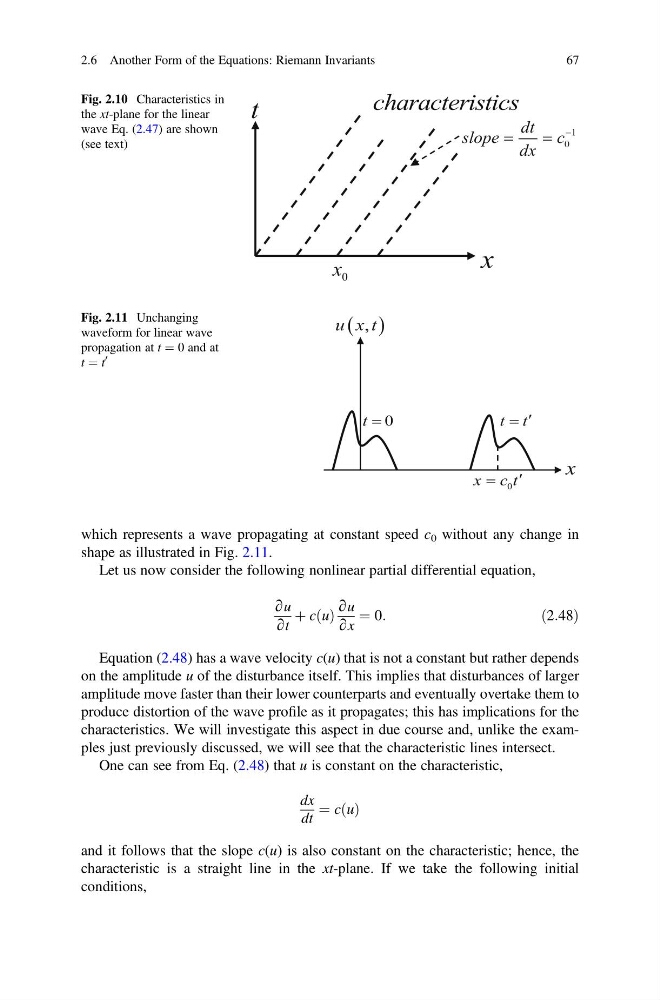
which represents a wave propagating at constant speed c 0 without any change in
shape as illustrated in Fig. 2.11.
Let us now consider the following nonlinear partial differential equation,
∂u
∂t
þ c u
ð Þ
∂u
∂x
¼ 0:
ð2:48Þ
Equation (2.48) has a wave velocity c(u) that is not a constant but rather depends
on the amplitude u of the disturbance itself. This implies that disturbances of larger
amplitude move faster than their lower counterparts and eventually overtake them to
produce distortion of the wave profile as it propagates; this has implications for the
characteristics. We will investigate this aspect in due course and, unlike the examples just previously discussed, we will see that the characteristic lines intersect.
One can see from Eq. (2.48) that u is constant on the characteristic,
dx
dt
¼ c u
ð Þ
and it follows that the slope c(u) is also constant on the characteristic; hence, the
characteristic is a straight line in the xt-plane. If we take the following initial
conditions,
Fig. 2.10 Characteristics in
the xt-plane for the linear
wave Eq. (2.47) are shown
(see text)
Fig. 2.11 Unchanging
waveform for linear wave
propagation at t ¼ 0 and at
t ¼ t
0
2.6 Another Form of the Equations: Riemann Invariants
67
shape as illustrated in Fig. 2.11.
Let us now consider the following nonlinear partial differential equation,
∂u
∂t
þ c u
ð Þ
∂u
∂x
¼ 0:
ð2:48Þ
Equation (2.48) has a wave velocity c(u) that is not a constant but rather depends
on the amplitude u of the disturbance itself. This implies that disturbances of larger
amplitude move faster than their lower counterparts and eventually overtake them to
produce distortion of the wave profile as it propagates; this has implications for the
characteristics. We will investigate this aspect in due course and, unlike the examples just previously discussed, we will see that the characteristic lines intersect.
One can see from Eq. (2.48) that u is constant on the characteristic,
dx
dt
¼ c u
ð Þ
and it follows that the slope c(u) is also constant on the characteristic; hence, the
characteristic is a straight line in the xt-plane. If we take the following initial
conditions,
Fig. 2.10 Characteristics in
the xt-plane for the linear
wave Eq. (2.47) are shown
(see text)
Fig. 2.11 Unchanging
waveform for linear wave
propagation at t ¼ 0 and at
t ¼ t
0
2.6 Another Form of the Equations: Riemann Invariants
67