

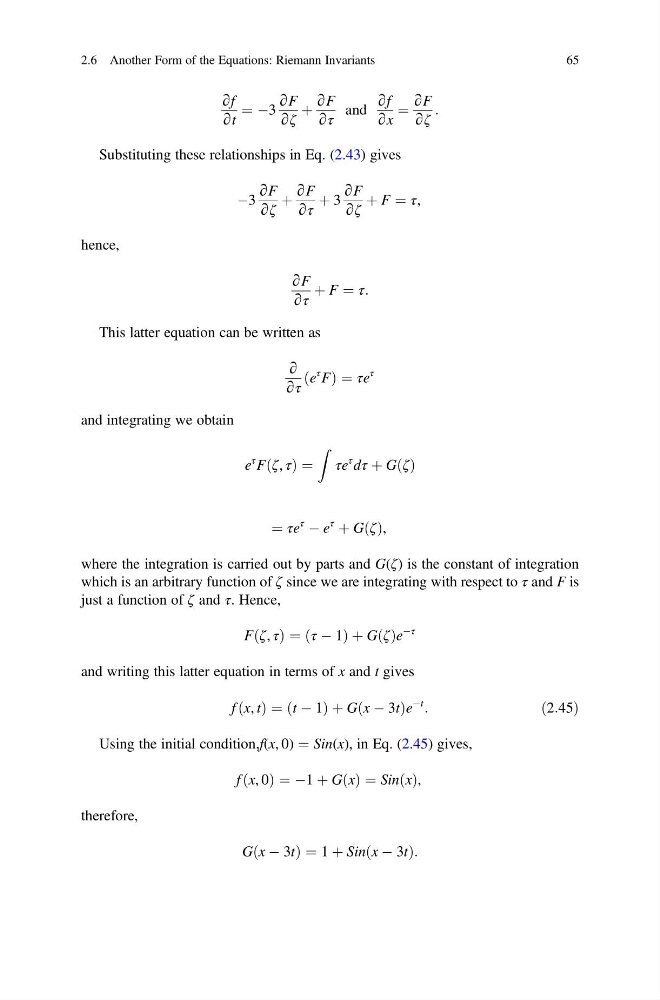
∂f
∂t
¼ À3
∂F
∂ζ
þ
∂F
∂τ
and
∂f
∂x
¼
∂F
∂ζ
:
Substituting these relationships in Eq. (2.43) gives
À3
∂F
∂ζ
þ
∂F
∂τ
þ 3
∂F
∂ζ
þ F ¼ τ,
hence,
∂F
∂τ
þ F ¼ τ:
This latter equation can be written as
∂
∂τ
e
τ F
ð Þ ¼ τe
τ
and integrating we obtain
e
τ F ζ, τ
ð Þ ¼
Z
τe
τ dτ þ G ζ
ð Þ
¼ τe
τ
À e
τ
þ G ζ
ð Þ,
where the integration is carried out by parts and G(ζ) is the constant of integration
which is an arbitrary function of ζ since we are integrating with respect to τ and F is
just a function of ζ and τ. Hence,
F ζ, τ
ð Þ ¼ τ À 1
ð
ÞþG ζ
ð Þe
Àτ
and writing this latter equation in terms of x and t gives
f x, t
ð Þ ¼ t À 1
ð
ÞþG x À 3t
ð
Þe
Àt
:
ð2:45Þ
Using the initial condition,f(x, 0) ¼ Sin(x), in Eq. (2.45) gives,
f x, 0
ð Þ ¼ À1 þ G x
ð Þ ¼ Sin x
ð Þ,
therefore,
G x À 3t
ð
Þ¼1 þ Sin x À 3t
ð
Þ:
2.6 Another Form of the Equations: Riemann Invariants
65
∂t
¼ À3
∂F
∂ζ
þ
∂F
∂τ
and
∂f
∂x
¼
∂F
∂ζ
:
Substituting these relationships in Eq. (2.43) gives
À3
∂F
∂ζ
þ
∂F
∂τ
þ 3
∂F
∂ζ
þ F ¼ τ,
hence,
∂F
∂τ
þ F ¼ τ:
This latter equation can be written as
∂
∂τ
e
τ F
ð Þ ¼ τe
τ
and integrating we obtain
e
τ F ζ, τ
ð Þ ¼
Z
τe
τ dτ þ G ζ
ð Þ
¼ τe
τ
À e
τ
þ G ζ
ð Þ,
where the integration is carried out by parts and G(ζ) is the constant of integration
which is an arbitrary function of ζ since we are integrating with respect to τ and F is
just a function of ζ and τ. Hence,
F ζ, τ
ð Þ ¼ τ À 1
ð
ÞþG ζ
ð Þe
Àτ
and writing this latter equation in terms of x and t gives
f x, t
ð Þ ¼ t À 1
ð
ÞþG x À 3t
ð
Þe
Àt
:
ð2:45Þ
Using the initial condition,f(x, 0) ¼ Sin(x), in Eq. (2.45) gives,
f x, 0
ð Þ ¼ À1 þ G x
ð Þ ¼ Sin x
ð Þ,
therefore,
G x À 3t
ð
Þ¼1 þ Sin x À 3t
ð
Þ:
2.6 Another Form of the Equations: Riemann Invariants
65