

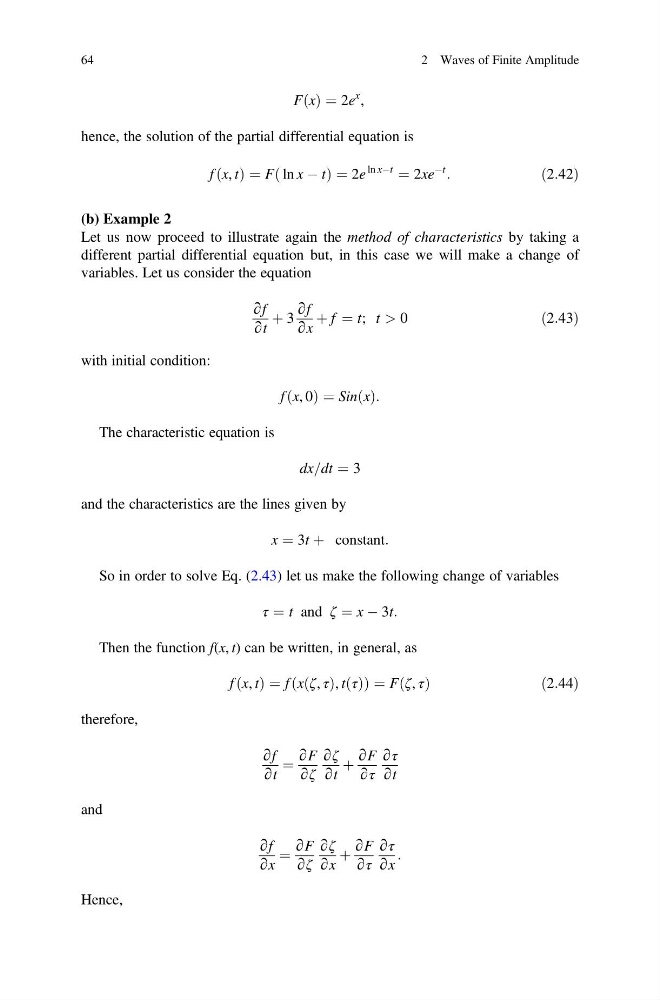
F x
ð Þ ¼ 2e
x ,
hence, the solution of the partial differential equation is
f x, t
ð Þ ¼ F ln x À t
ð
Þ¼2e
ln xÀt
¼ 2xe
Àt
:
ð2:42Þ
(b) Example 2
Let us now proceed to illustrate again the method of characteristics by taking a
different partial differential equation but, in this case we will make a change of
variables. Let us consider the equation
∂f
∂t
þ 3
∂f
∂x
þ f ¼ t; t > 0
ð2:43Þ
with initial condition:
f x, 0
ð Þ ¼ Sin x
ð Þ:
The characteristic equation is
dx=dt ¼ 3
and the characteristics are the lines given by
x ¼ 3t þ constant:
So in order to solve Eq. (2.43) let us make the following change of variables
τ ¼ t and ζ ¼ x À 3t:
Then the function f(x, t) can be written, in general, as
f x, t
ð Þ ¼ f x ζ, τ
ð Þ, t τ
ð Þ
ð
Þ¼F ζ, τ
ð Þ
ð2:44Þ
therefore,
∂f
∂t
¼
∂F
∂ζ
∂ζ
∂t
þ
∂F
∂τ
∂τ
∂t
and
∂f
∂x
¼
∂F
∂ζ
∂ζ
∂x
þ
∂F
∂τ
∂τ
∂x
:
Hence,
64
2 Waves of Finite Amplitude
ð Þ ¼ 2e
x ,
hence, the solution of the partial differential equation is
f x, t
ð Þ ¼ F ln x À t
ð
Þ¼2e
ln xÀt
¼ 2xe
Àt
:
ð2:42Þ
(b) Example 2
Let us now proceed to illustrate again the method of characteristics by taking a
different partial differential equation but, in this case we will make a change of
variables. Let us consider the equation
∂f
∂t
þ 3
∂f
∂x
þ f ¼ t; t > 0
ð2:43Þ
with initial condition:
f x, 0
ð Þ ¼ Sin x
ð Þ:
The characteristic equation is
dx=dt ¼ 3
and the characteristics are the lines given by
x ¼ 3t þ constant:
So in order to solve Eq. (2.43) let us make the following change of variables
τ ¼ t and ζ ¼ x À 3t:
Then the function f(x, t) can be written, in general, as
f x, t
ð Þ ¼ f x ζ, τ
ð Þ, t τ
ð Þ
ð
Þ¼F ζ, τ
ð Þ
ð2:44Þ
therefore,
∂f
∂t
¼
∂F
∂ζ
∂ζ
∂t
þ
∂F
∂τ
∂τ
∂t
and
∂f
∂x
¼
∂F
∂ζ
∂ζ
∂x
þ
∂F
∂τ
∂τ
∂x
:
Hence,
64
2 Waves of Finite Amplitude