

Now, f(x, t) is constant on this curve and the curve cuts the x-axis (t ¼ 0) and
“picks up” the value
f x, 0
ð Þ ¼ 2x:
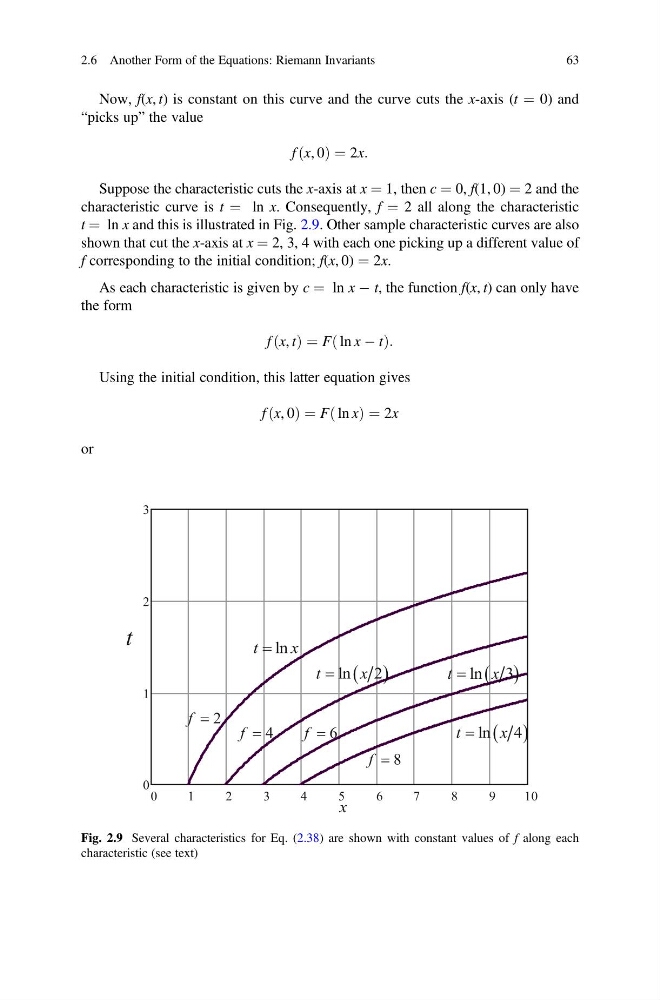
Suppose the characteristic cuts the x-axis at x ¼ 1, then c ¼ 0, f(1, 0) ¼ 2 and the
characteristic curve is t ¼ ln x. Consequently, f ¼ 2 all along the characteristic
t ¼ ln x and this is illustrated in Fig. 2.9. Other sample characteristic curves are also
shown that cut the x-axis at x ¼ 2, 3, 4 with each one picking up a different value of
f corresponding to the initial condition; f(x, 0) ¼ 2x.
As each characteristic is given by c ¼ ln x À t, the function f(x, t) can only have
the form
f x, t
ð Þ ¼ F ln x À t
ð
Þ :
Using the initial condition, this latter equation gives
f x, 0
ð Þ ¼ F ln x
ð
Þ ¼ 2x
or
Fig. 2.9 Several characteristics for Eq. (2.38) are shown with constant values of f along each
characteristic (see text)
2.6 Another Form of the Equations: Riemann Invariants
63
“picks up” the value
f x, 0
ð Þ ¼ 2x:
Suppose the characteristic cuts the x-axis at x ¼ 1, then c ¼ 0, f(1, 0) ¼ 2 and the
characteristic curve is t ¼ ln x. Consequently, f ¼ 2 all along the characteristic
t ¼ ln x and this is illustrated in Fig. 2.9. Other sample characteristic curves are also
shown that cut the x-axis at x ¼ 2, 3, 4 with each one picking up a different value of
f corresponding to the initial condition; f(x, 0) ¼ 2x.
As each characteristic is given by c ¼ ln x À t, the function f(x, t) can only have
the form
f x, t
ð Þ ¼ F ln x À t
ð
Þ :
Using the initial condition, this latter equation gives
f x, 0
ð Þ ¼ F ln x
ð
Þ ¼ 2x
or
Fig. 2.9 Several characteristics for Eq. (2.38) are shown with constant values of f along each
characteristic (see text)
2.6 Another Form of the Equations: Riemann Invariants
63