

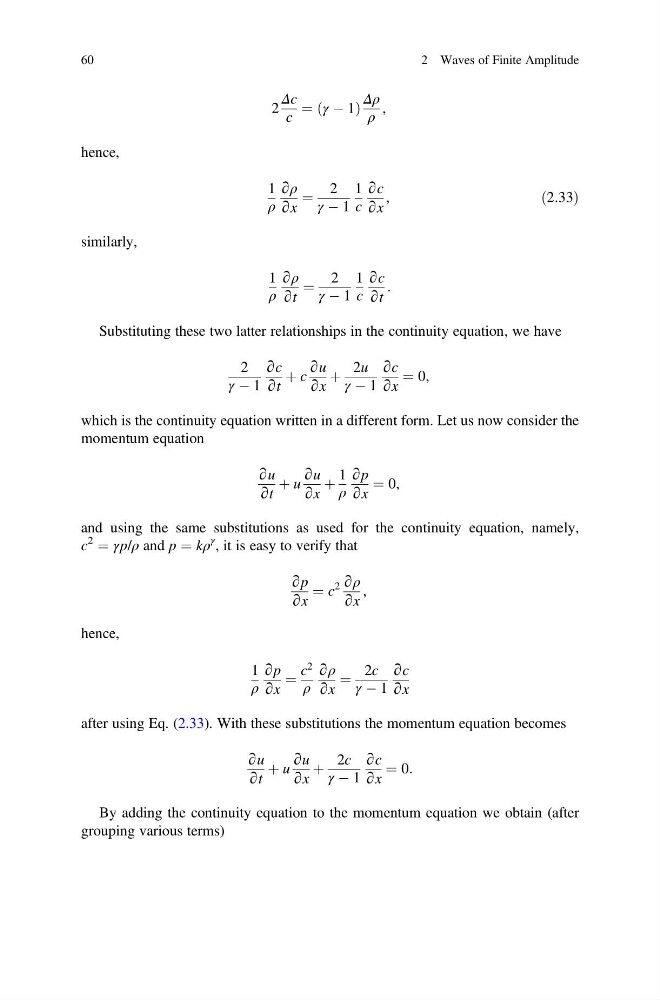
2
Δc
c
¼ γ À 1
ð
Þ
Δρ
ρ
,
hence,
1
ρ
∂ρ
∂x
¼
2
γ À 1
1
c
∂c
∂x
,
ð2:33Þ
similarly,
1
ρ
∂ρ
∂t
¼
2
γ À 1
1
c
∂c
∂t
:
Substituting these two latter relationships in the continuity equation, we have
2
γ À 1
∂c
∂t
þ c
∂u
∂x
þ
2u
γ À 1
∂c
∂x
¼ 0,
which is the continuity equation written in a different form. Let us now consider the
momentum equation
∂u
∂t
þ u
∂u
∂x
þ
1
ρ
∂p
∂x
¼ 0,
and using the same substitutions as used for the continuity equation, namely,
c
2
¼ γp/ρ and p ¼ kρ
γ , it is easy to verify that
∂p
∂x
¼ c
2 ∂ρ
∂x
,
hence,
1
ρ
∂p
∂x
¼
c
2
ρ
∂ρ
∂x
¼
2c
γ À 1
∂c
∂x
after using Eq. (2.33). With these substitutions the momentum equation becomes
∂u
∂t
þ u
∂u
∂x
þ
2c
γ À 1
∂c
∂x
¼ 0:
By adding the continuity equation to the momentum equation we obtain (after
grouping various terms)
60
2 Waves of Finite Amplitude
Δc
c
¼ γ À 1
ð
Þ
Δρ
ρ
,
hence,
1
ρ
∂ρ
∂x
¼
2
γ À 1
1
c
∂c
∂x
,
ð2:33Þ
similarly,
1
ρ
∂ρ
∂t
¼
2
γ À 1
1
c
∂c
∂t
:
Substituting these two latter relationships in the continuity equation, we have
2
γ À 1
∂c
∂t
þ c
∂u
∂x
þ
2u
γ À 1
∂c
∂x
¼ 0,
which is the continuity equation written in a different form. Let us now consider the
momentum equation
∂u
∂t
þ u
∂u
∂x
þ
1
ρ
∂p
∂x
¼ 0,
and using the same substitutions as used for the continuity equation, namely,
c
2
¼ γp/ρ and p ¼ kρ
γ , it is easy to verify that
∂p
∂x
¼ c
2 ∂ρ
∂x
,
hence,
1
ρ
∂p
∂x
¼
c
2
ρ
∂ρ
∂x
¼
2c
γ À 1
∂c
∂x
after using Eq. (2.33). With these substitutions the momentum equation becomes
∂u
∂t
þ u
∂u
∂x
þ
2c
γ À 1
∂c
∂x
¼ 0:
By adding the continuity equation to the momentum equation we obtain (after
grouping various terms)
60
2 Waves of Finite Amplitude