

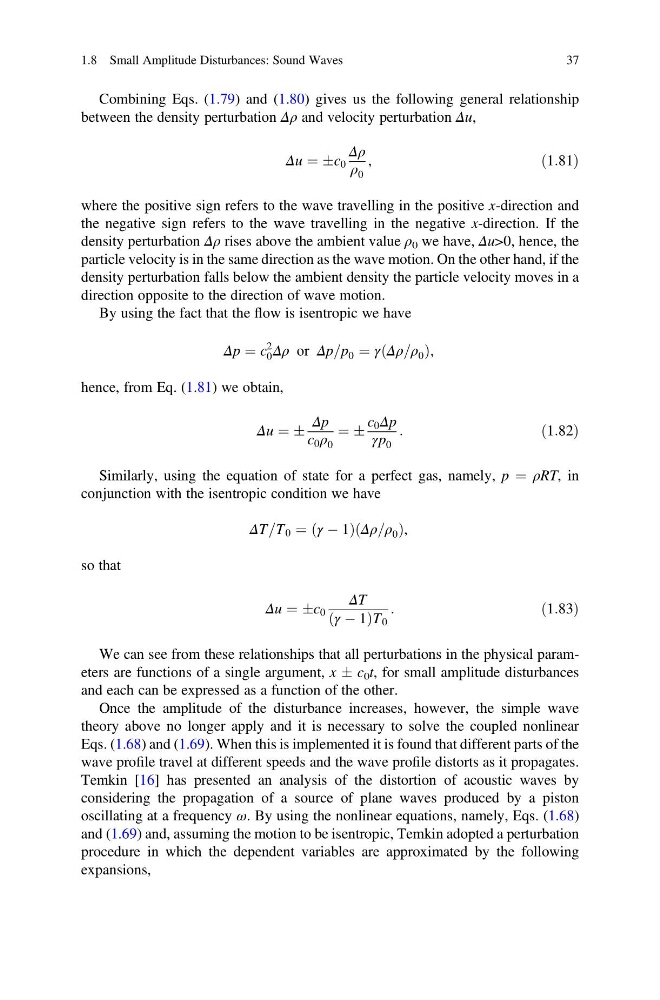
Combining Eqs. (1.79) and (1.80) gives us the following general relationship
between the density perturbation Δρ and velocity perturbation Δu,
Δu ¼ Æc 0
Δρ
ρ 0
,
ð1:81Þ
where the positive sign refers to the wave travelling in the positive x-direction and
the negative sign refers to the wave travelling in the negative x-direction. If the
density perturbation Δρ rises above the ambient value ρ 0 we have, Δu>0, hence, the
particle velocity is in the same direction as the wave motion. On the other hand, if the
density perturbation falls below the ambient density the particle velocity moves in a
direction opposite to the direction of wave motion.
By using the fact that the flow is isentropic we have
Δp ¼ c
2
0 Δρ or Δp=p 0 ¼ γ Δρ=ρ 0
ð
Þ,
hence, from Eq. (1.81) we obtain,
Δu ¼ Æ
Δp
c 0 ρ 0
¼ Æ
c 0 Δp
γp 0
:
ð1:82Þ
Similarly, using the equation of state for a perfect gas, namely, p ¼ ρRT, in
conjunction with the isentropic condition we have
ΔT=T 0 ¼ γ À 1
ð
Þ Δρ=ρ 0
ð
Þ,
so that
Δu ¼ Æc 0
ΔT
γ À 1
ð
ÞT 0
:
ð1:83Þ
We can see from these relationships that all perturbations in the physical parameters are functions of a single argument, x Æ c 0 t, for small amplitude disturbances
and each can be expressed as a function of the other.
Once the amplitude of the disturbance increases, however, the simple wave
theory above no longer apply and it is necessary to solve the coupled nonlinear
Eqs. (1.68) and (1.69). When this is implemented it is found that different parts of the
wave profile travel at different speeds and the wave profile distorts as it propagates.
Temkin [16] has presented an analysis of the distortion of acoustic waves by
considering the propagation of a source of plane waves produced by a piston
oscillating at a frequency ω. By using the nonlinear equations, namely, Eqs. (1.68)
and (1.69) and, assuming the motion to be isentropic, Temkin adopted a perturbation
procedure in which the dependent variables are approximated by the following
expansions,
1.8 Small Amplitude Disturbances: Sound Waves
37
between the density perturbation Δρ and velocity perturbation Δu,
Δu ¼ Æc 0
Δρ
ρ 0
,
ð1:81Þ
where the positive sign refers to the wave travelling in the positive x-direction and
the negative sign refers to the wave travelling in the negative x-direction. If the
density perturbation Δρ rises above the ambient value ρ 0 we have, Δu>0, hence, the
particle velocity is in the same direction as the wave motion. On the other hand, if the
density perturbation falls below the ambient density the particle velocity moves in a
direction opposite to the direction of wave motion.
By using the fact that the flow is isentropic we have
Δp ¼ c
2
0 Δρ or Δp=p 0 ¼ γ Δρ=ρ 0
ð
Þ,
hence, from Eq. (1.81) we obtain,
Δu ¼ Æ
Δp
c 0 ρ 0
¼ Æ
c 0 Δp
γp 0
:
ð1:82Þ
Similarly, using the equation of state for a perfect gas, namely, p ¼ ρRT, in
conjunction with the isentropic condition we have
ΔT=T 0 ¼ γ À 1
ð
Þ Δρ=ρ 0
ð
Þ,
so that
Δu ¼ Æc 0
ΔT
γ À 1
ð
ÞT 0
:
ð1:83Þ
We can see from these relationships that all perturbations in the physical parameters are functions of a single argument, x Æ c 0 t, for small amplitude disturbances
and each can be expressed as a function of the other.
Once the amplitude of the disturbance increases, however, the simple wave
theory above no longer apply and it is necessary to solve the coupled nonlinear
Eqs. (1.68) and (1.69). When this is implemented it is found that different parts of the
wave profile travel at different speeds and the wave profile distorts as it propagates.
Temkin [16] has presented an analysis of the distortion of acoustic waves by
considering the propagation of a source of plane waves produced by a piston
oscillating at a frequency ω. By using the nonlinear equations, namely, Eqs. (1.68)
and (1.69) and, assuming the motion to be isentropic, Temkin adopted a perturbation
procedure in which the dependent variables are approximated by the following
expansions,
1.8 Small Amplitude Disturbances: Sound Waves
37