

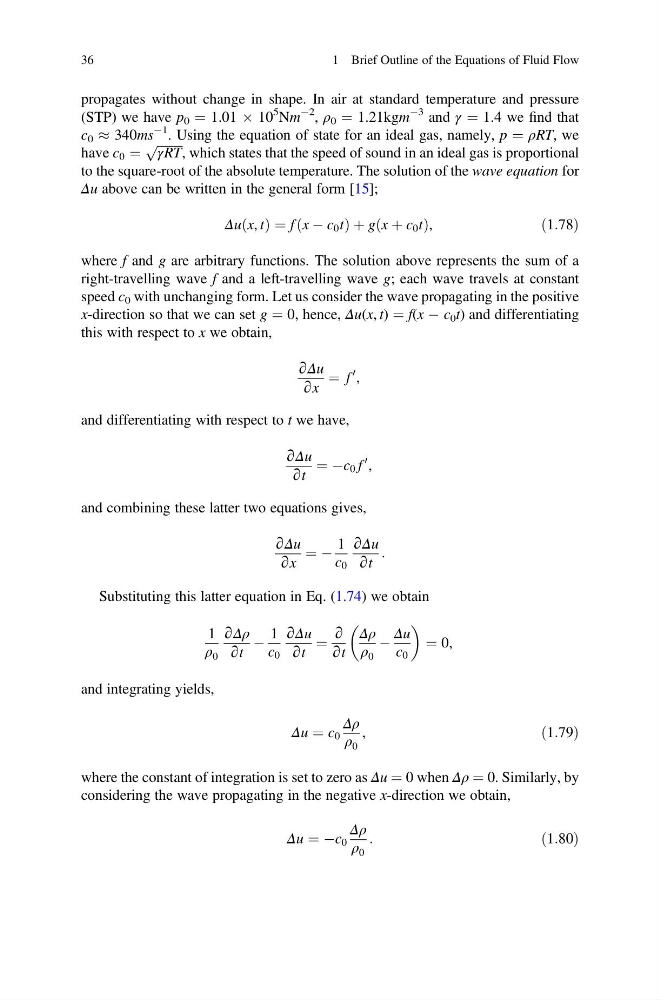
propagates without change in shape. In air at standard temperature and pressure
(STP) we have p 0 ¼ 1.01 Â 10
5 Nm
À2 , ρ 0 ¼ 1.21kgm
À3 and γ ¼ 1.4 we find that
c 0 % 340ms
À1 . Using the equation of state for an ideal gas, namely, p ¼ ρRT, we
have c 0 ¼
ffiffiffiffiffiffiffiffi ffi
γRT
p
, which states that the speed of sound in an ideal gas is proportional
to the square-root of the absolute temperature. The solution of the wave equation for
Δu above can be written in the general form [15];
Δu x, t
ð Þ ¼ f x À c 0 t
ð
Þþg x þ c 0 t
ð
Þ,
ð1:78Þ
where f and g are arbitrary functions. The solution above represents the sum of a
right-travelling wave f and a left-travelling wave g; each wave travels at constant
speed c 0 with unchanging form. Let us consider the wave propagating in the positive
x-direction so that we can set g ¼ 0, hence, Δu(x, t) ¼ f(x À c 0 t) and differentiating
this with respect to x we obtain,
∂Δu
∂x
¼ f
0 ,
and differentiating with respect to t we have,
∂Δu
∂t
¼ Àc 0 f
0 ,
and combining these latter two equations gives,
∂Δu
∂x
¼ À
1
c 0
∂Δu
∂t
:
Substituting this latter equation in Eq. (1.74) we obtain
1
ρ 0
∂Δρ
∂t
À
1
c 0
∂Δu
∂t
¼
∂
∂t
Δρ
ρ 0
À
Δu
c 0
¼ 0,
and integrating yields,
Δu ¼ c 0
Δρ
ρ 0
,
ð1:79Þ
where the constant of integration is set to zero as Δu ¼ 0 when Δρ ¼ 0. Similarly, by
considering the wave propagating in the negative x-direction we obtain,
Δu ¼ Àc 0
Δρ
ρ 0
:
ð1:80Þ
36
1 Brief Outline of the Equations of Fluid Flow
(STP) we have p 0 ¼ 1.01 Â 10
5 Nm
À2 , ρ 0 ¼ 1.21kgm
À3 and γ ¼ 1.4 we find that
c 0 % 340ms
À1 . Using the equation of state for an ideal gas, namely, p ¼ ρRT, we
have c 0 ¼
ffiffiffiffiffiffiffiffi ffi
γRT
p
, which states that the speed of sound in an ideal gas is proportional
to the square-root of the absolute temperature. The solution of the wave equation for
Δu above can be written in the general form [15];
Δu x, t
ð Þ ¼ f x À c 0 t
ð
Þþg x þ c 0 t
ð
Þ,
ð1:78Þ
where f and g are arbitrary functions. The solution above represents the sum of a
right-travelling wave f and a left-travelling wave g; each wave travels at constant
speed c 0 with unchanging form. Let us consider the wave propagating in the positive
x-direction so that we can set g ¼ 0, hence, Δu(x, t) ¼ f(x À c 0 t) and differentiating
this with respect to x we obtain,
∂Δu
∂x
¼ f
0 ,
and differentiating with respect to t we have,
∂Δu
∂t
¼ Àc 0 f
0 ,
and combining these latter two equations gives,
∂Δu
∂x
¼ À
1
c 0
∂Δu
∂t
:
Substituting this latter equation in Eq. (1.74) we obtain
1
ρ 0
∂Δρ
∂t
À
1
c 0
∂Δu
∂t
¼
∂
∂t
Δρ
ρ 0
À
Δu
c 0
¼ 0,
and integrating yields,
Δu ¼ c 0
Δρ
ρ 0
,
ð1:79Þ
where the constant of integration is set to zero as Δu ¼ 0 when Δρ ¼ 0. Similarly, by
considering the wave propagating in the negative x-direction we obtain,
Δu ¼ Àc 0
Δρ
ρ 0
:
ð1:80Þ
36
1 Brief Outline of the Equations of Fluid Flow