

By using some representative results that arise from the numerical computations,
a plot is shown in Fig. 6.6d of the normalized overpressure ( p S À p 0 )/p 0 at the shock
front as a function of the normalized shock radius, λ 0S , where r 0S is the radius of the
shock front and ε ¼ (E 0 /p 0 )
1/3
, where E 0 is the total blast energy. This gives the
decay of the overpressure with distance which is shown plotted using log scales for
both axes as the overpressure decays quite rapidly for large values of the pressure p S
at the front.
6.9 Shock Wave from a Sphere of High-Pressure,
High-Temperature Gas
In this section we will consider the sudden expansion of a sphere of high pressure
air into the surrounding atmosphere. Brode has investigated this expansion and he
has presented his numerical results in graphical form in two reports [4, 5]. This
sudden expansion is analogous to the shock tube previously discussed, except in
this case, it involves the bursting of a spherical diaphragm surrounding the highpressure sphere. We will assume that the initial density inside the sphere is at
Normalized Lagrangian radius
Normalized Lagrangian radius
Normalized Lagrangian radius
Normalized Lagrangian radius
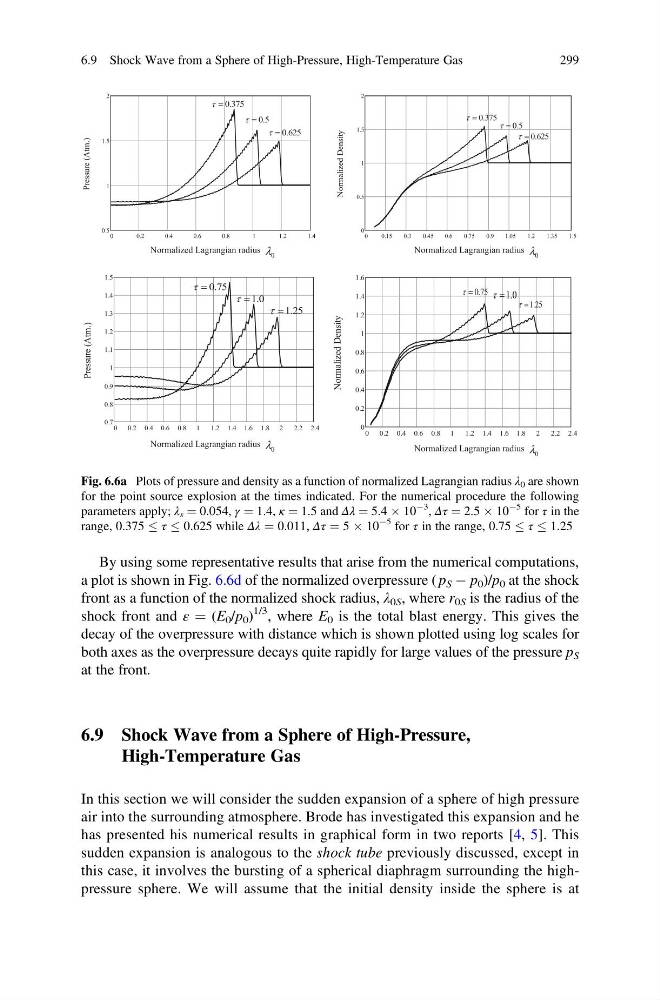
Fig. 6.6a Plots of pressure and density as a function of normalized Lagrangian radius λ 0 are shown
for the point source explosion at the times indicated. For the numerical procedure the following
parameters apply; λ s ¼ 0.054, γ ¼ 1.4, κ ¼ 1.5 and Δλ ¼ 5.4 Â 10
À3
, Δτ ¼ 2.5 Â 10
À5 for τ in the
range, 0.375 τ 0.625 while Δλ ¼ 0.011, Δτ ¼ 5 Â 10
À5 for τ in the range, 0.75 τ 1.25
6.9 Shock Wave from a Sphere of High-Pressure, High-Temperature Gas
299
a plot is shown in Fig. 6.6d of the normalized overpressure ( p S À p 0 )/p 0 at the shock
front as a function of the normalized shock radius, λ 0S , where r 0S is the radius of the
shock front and ε ¼ (E 0 /p 0 )
1/3
, where E 0 is the total blast energy. This gives the
decay of the overpressure with distance which is shown plotted using log scales for
both axes as the overpressure decays quite rapidly for large values of the pressure p S
at the front.
6.9 Shock Wave from a Sphere of High-Pressure,
High-Temperature Gas
In this section we will consider the sudden expansion of a sphere of high pressure
air into the surrounding atmosphere. Brode has investigated this expansion and he
has presented his numerical results in graphical form in two reports [4, 5]. This
sudden expansion is analogous to the shock tube previously discussed, except in
this case, it involves the bursting of a spherical diaphragm surrounding the highpressure sphere. We will assume that the initial density inside the sphere is at
Normalized Lagrangian radius
Normalized Lagrangian radius
Normalized Lagrangian radius
Normalized Lagrangian radius
Fig. 6.6a Plots of pressure and density as a function of normalized Lagrangian radius λ 0 are shown
for the point source explosion at the times indicated. For the numerical procedure the following
parameters apply; λ s ¼ 0.054, γ ¼ 1.4, κ ¼ 1.5 and Δλ ¼ 5.4 Â 10
À3
, Δτ ¼ 2.5 Â 10
À5 for τ in the
range, 0.375 τ 0.625 while Δλ ¼ 0.011, Δτ ¼ 5 Â 10
À5 for τ in the range, 0.75 τ 1.25
6.9 Shock Wave from a Sphere of High-Pressure, High-Temperature Gas
299