

normal sea-level air density and that the internal pressure is 1000 atmospheres.
This implies that the initial temperature in this isothermal sphere is very high,
perhaps several hundreds of thousands of degrees. It is unlikely that the ideal gas
equation applies at these elevated temperatures and pressures in this very hot
sphere, so that the use of the equation, p ¼ ρRT, may not accurately predict the
initial temperature. Temperatures of this magnitude typically occur in nuclear
explosions when the fireball has expanded to several tens of meters, so that the
ideal gas equation can be used as a first attempt to predict the variations in pressure,
density and particle velocity for this expanding sphere and can form a basis for
predicting the hydrodynamic effects of strong explosions despite the absence of a
more realistic model for the equation of state for air.
Normalized Lagrangian radius at times indicated
Normalized Lagrangian radius at times indicated
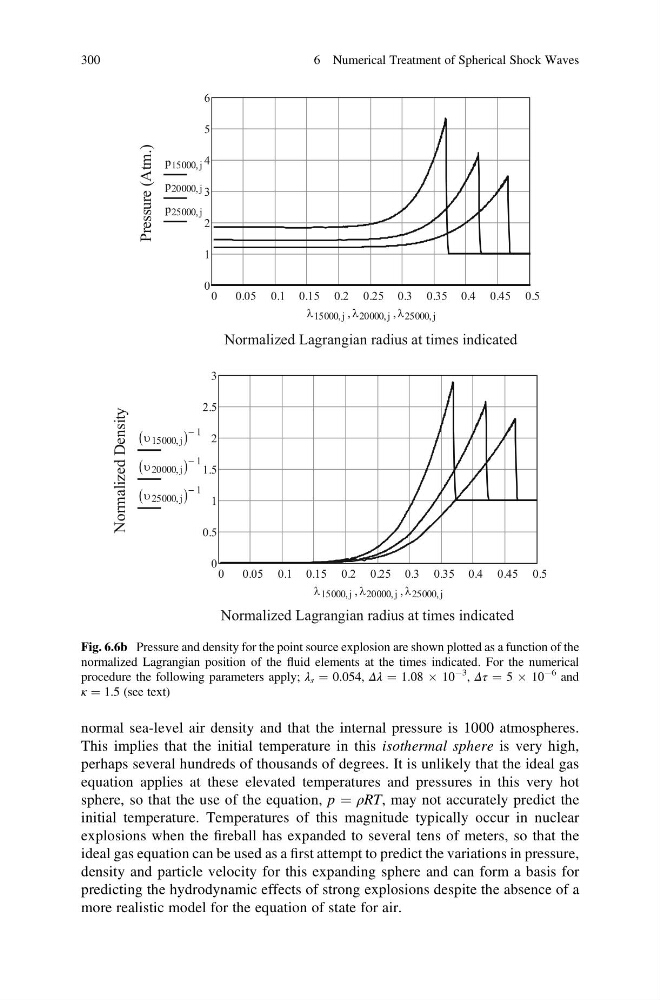
Fig. 6.6b Pressure and density for the point source explosion are shown plotted as a function of the
normalized Lagrangian position of the fluid elements at the times indicated. For the numerical
procedure the following parameters apply; λ s ¼ 0.054, Δλ ¼ 1.08 Â 10
À3
, Δτ ¼ 5 Â 10
À6 and
κ ¼ 1.5 (see text)
300
6 Numerical Treatment of Spherical Shock Waves
This implies that the initial temperature in this isothermal sphere is very high,
perhaps several hundreds of thousands of degrees. It is unlikely that the ideal gas
equation applies at these elevated temperatures and pressures in this very hot
sphere, so that the use of the equation, p ¼ ρRT, may not accurately predict the
initial temperature. Temperatures of this magnitude typically occur in nuclear
explosions when the fireball has expanded to several tens of meters, so that the
ideal gas equation can be used as a first attempt to predict the variations in pressure,
density and particle velocity for this expanding sphere and can form a basis for
predicting the hydrodynamic effects of strong explosions despite the absence of a
more realistic model for the equation of state for air.
Normalized Lagrangian radius at times indicated
Normalized Lagrangian radius at times indicated
Fig. 6.6b Pressure and density for the point source explosion are shown plotted as a function of the
normalized Lagrangian position of the fluid elements at the times indicated. For the numerical
procedure the following parameters apply; λ s ¼ 0.054, Δλ ¼ 1.08 Â 10
À3
, Δτ ¼ 5 Â 10
À6 and
κ ¼ 1.5 (see text)
300
6 Numerical Treatment of Spherical Shock Waves