

r r 0 , t
ð
Þ
R
¼
r 0
R
γÀ1
γ ,
ð5:110Þ
hence,
r r 0 , t
ð
Þ ¼ R
1
γ r
γÀ1
γ
0 :
ð5:111Þ
Noting that R R(t), Eq. (5.111) gives the position r(r 0 , t) as a function of time of
an arbitrary material particle or mass element whose initial position is r 0 . The
velocity _
r r 0 , t
ð
Þof a specific mass element can be determined from the latter equation
by using the formula;
_
r r 0 , t
ð
Þ ¼
∂r r 0 , t
ð
Þ
∂t
r 0
:
ð5:112Þ
Carrying out the differentiation of Eq. (5.111), we have
_
r r 0 , t
ð
Þ ¼
1
γ
r 0
R
γÀ1
γ
_
R
and by using Eq. (5.110) we can write the latter equation as
_
r r 0 , t
ð
Þ ¼
1
γ
r r 0 , t
ð
Þ
R
_
R:
ð5:113Þ
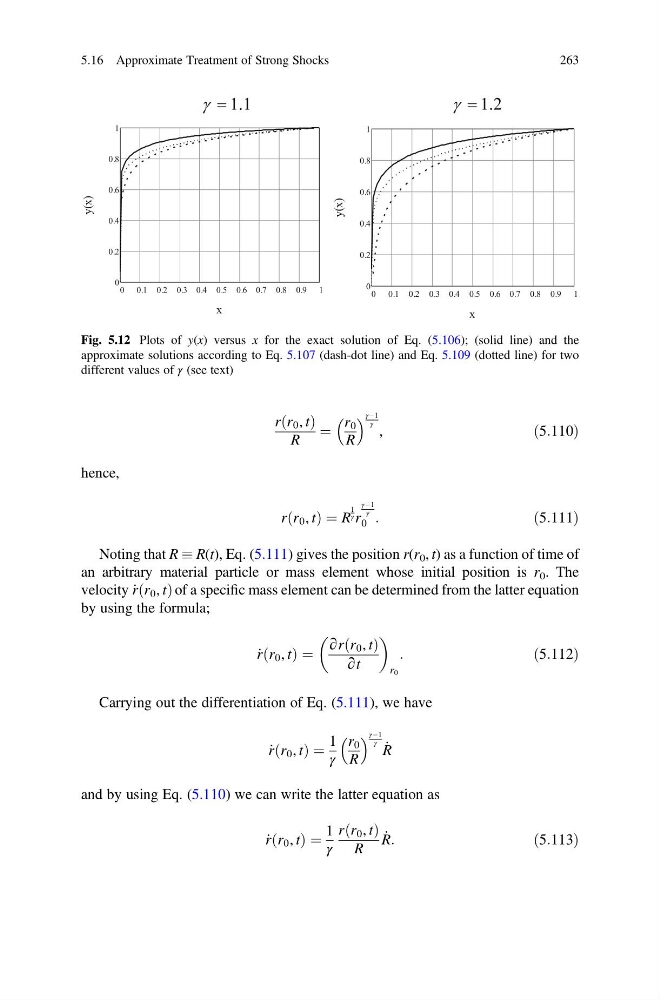
Fig. 5.12 Plots of y(x) versus x for the exact solution of Eq. (5.106); (solid line) and the
approximate solutions according to Eq. 5.107 (dash-dot line) and Eq. 5.109 (dotted line) for two
different values of γ (see text)
5.16 Approximate Treatment of Strong Shocks
263
ð
Þ
R
¼
r 0
R
γÀ1
γ ,
ð5:110Þ
hence,
r r 0 , t
ð
Þ ¼ R
1
γ r
γÀ1
γ
0 :
ð5:111Þ
Noting that R R(t), Eq. (5.111) gives the position r(r 0 , t) as a function of time of
an arbitrary material particle or mass element whose initial position is r 0 . The
velocity _
r r 0 , t
ð
Þof a specific mass element can be determined from the latter equation
by using the formula;
_
r r 0 , t
ð
Þ ¼
∂r r 0 , t
ð
Þ
∂t
r 0
:
ð5:112Þ
Carrying out the differentiation of Eq. (5.111), we have
_
r r 0 , t
ð
Þ ¼
1
γ
r 0
R
γÀ1
γ
_
R
and by using Eq. (5.110) we can write the latter equation as
_
r r 0 , t
ð
Þ ¼
1
γ
r r 0 , t
ð
Þ
R
_
R:
ð5:113Þ
Fig. 5.12 Plots of y(x) versus x for the exact solution of Eq. (5.106); (solid line) and the
approximate solutions according to Eq. 5.107 (dash-dot line) and Eq. 5.109 (dotted line) for two
different values of γ (see text)
5.16 Approximate Treatment of Strong Shocks
263