

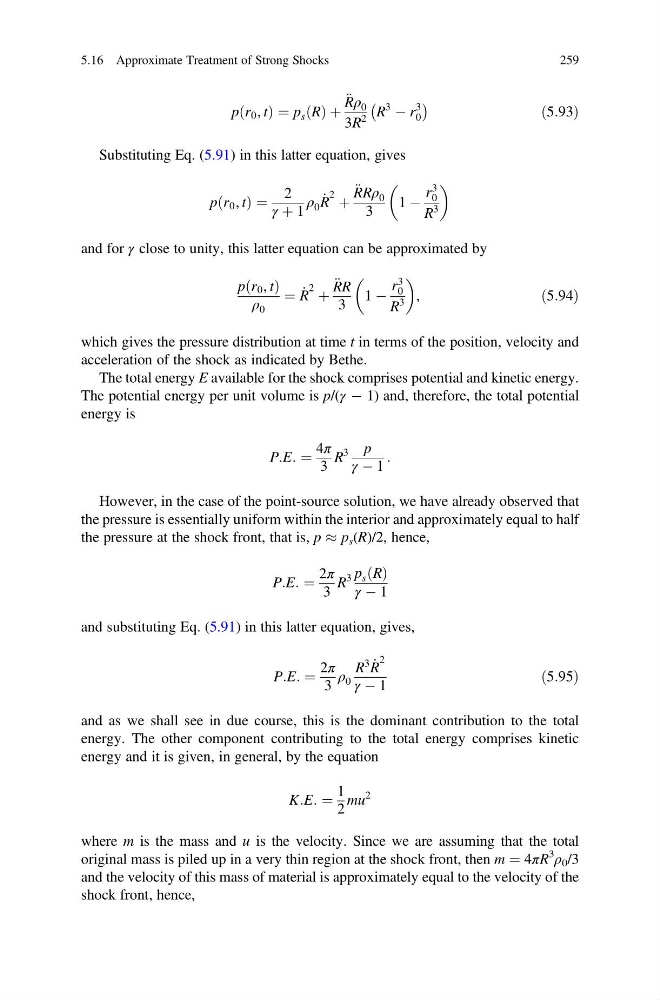
p r 0 , t
ð
Þ ¼ p s R
ð Þ þ
€
Rρ 0
3R
2
R
3
À r
3
0
À
Á
ð5:93Þ
Substituting Eq. (5.91) in this latter equation, gives
p r 0 , t
ð
Þ ¼
2
γ þ 1
ρ 0 _
R
2 þ
€
RRρ 0
3
1 À
r
3
0
R
3
and for γ close to unity, this latter equation can be approximated by
p r 0 , t
ð
Þ
ρ 0
¼ _
R
2 þ
€
RR
3
1 À
r
3
0
R
3
,
ð5:94Þ
which gives the pressure distribution at time t in terms of the position, velocity and
acceleration of the shock as indicated by Bethe.
The total energy E available for the shock comprises potential and kinetic energy.
The potential energy per unit volume is p/(γ À 1) and, therefore, the total potential
energy is
P:E: ¼
4π
3
R
3 p
γ À 1
:
However, in the case of the point-source solution, we have already observed that
the pressure is essentially uniform within the interior and approximately equal to half
the pressure at the shock front, that is, p % p s (R)/2, hence,
P:E: ¼
2π
3
R
3 p s R
ð Þ
γ À 1
and substituting Eq. (5.91) in this latter equation, gives,
P:E: ¼
2π
3
ρ 0
R
3 _
R
2
γ À 1
ð5:95Þ
and as we shall see in due course, this is the dominant contribution to the total
energy. The other component contributing to the total energy comprises kinetic
energy and it is given, in general, by the equation
K:E: ¼
1
2
mu
2
where m is the mass and u is the velocity. Since we are assuming that the total
original mass is piled up in a very thin region at the shock front, then m ¼ 4πR
3
ρ 0 /3
and the velocity of this mass of material is approximately equal to the velocity of the
shock front, hence,
5.16 Approximate Treatment of Strong Shocks
259
ð
Þ ¼ p s R
ð Þ þ
€
Rρ 0
3R
2
R
3
À r
3
0
À
Á
ð5:93Þ
Substituting Eq. (5.91) in this latter equation, gives
p r 0 , t
ð
Þ ¼
2
γ þ 1
ρ 0 _
R
2 þ
€
RRρ 0
3
1 À
r
3
0
R
3
and for γ close to unity, this latter equation can be approximated by
p r 0 , t
ð
Þ
ρ 0
¼ _
R
2 þ
€
RR
3
1 À
r
3
0
R
3
,
ð5:94Þ
which gives the pressure distribution at time t in terms of the position, velocity and
acceleration of the shock as indicated by Bethe.
The total energy E available for the shock comprises potential and kinetic energy.
The potential energy per unit volume is p/(γ À 1) and, therefore, the total potential
energy is
P:E: ¼
4π
3
R
3 p
γ À 1
:
However, in the case of the point-source solution, we have already observed that
the pressure is essentially uniform within the interior and approximately equal to half
the pressure at the shock front, that is, p % p s (R)/2, hence,
P:E: ¼
2π
3
R
3 p s R
ð Þ
γ À 1
and substituting Eq. (5.91) in this latter equation, gives,
P:E: ¼
2π
3
ρ 0
R
3 _
R
2
γ À 1
ð5:95Þ
and as we shall see in due course, this is the dominant contribution to the total
energy. The other component contributing to the total energy comprises kinetic
energy and it is given, in general, by the equation
K:E: ¼
1
2
mu
2
where m is the mass and u is the velocity. Since we are assuming that the total
original mass is piled up in a very thin region at the shock front, then m ¼ 4πR
3
ρ 0 /3
and the velocity of this mass of material is approximately equal to the velocity of the
shock front, hence,
5.16 Approximate Treatment of Strong Shocks
259