

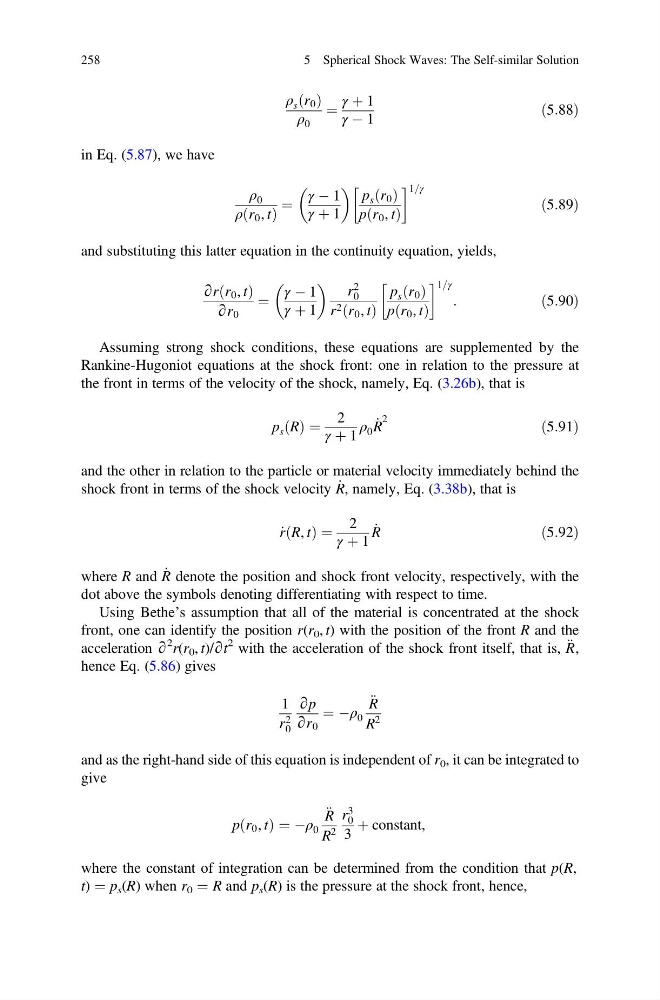
ρ s r 0
ð Þ
ρ 0
¼
γ þ 1
γ À 1
ð5:88Þ
in Eq. (5.87), we have
ρ 0
ρ r 0 , t
ð
Þ
¼
γ À 1
γ þ 1
p s r 0
ð Þ
p r 0 , t
ð
Þ
! 1=γ
ð5:89Þ
and substituting this latter equation in the continuity equation, yields,
∂r r 0 , t
ð
Þ
∂r 0
¼
γ À 1
γ þ 1
r
2
0
r 2 r 0 , t
ð
Þ
p s r 0
ð Þ
p r 0 , t
ð
Þ
! 1=γ
:
ð5:90Þ
Assuming strong shock conditions, these equations are supplemented by the
Rankine-Hugoniot equations at the shock front: one in relation to the pressure at
the front in terms of the velocity of the shock, namely, Eq. (3.26b), that is
p s R
ð Þ ¼
2
γ þ 1
ρ 0 _
R
2
ð5:91Þ
and the other in relation to the particle or material velocity immediately behind the
shock front in terms of the shock velocity _
R, namely, Eq. (3.38b), that is
_
r R, t
ð Þ ¼
2
γ þ 1
_
R
ð5:92Þ
where R and _
R denote the position and shock front velocity, respectively, with the
dot above the symbols denoting differentiating with respect to time.
Using Bethe’s assumption that all of the material is concentrated at the shock
front, one can identify the position r(r 0 , t) with the position of the front R and the
acceleration ∂
2 r(r 0 , t)/∂t
2 with the acceleration of the shock front itself, that is, €
R,
hence Eq. (5.86) gives
1
r 2
0
∂p
∂r 0
¼ Àρ 0
€
R
R
2
and as the right-hand side of this equation is independent of r 0 , it can be integrated to
give
p r 0 , t
ð
Þ ¼ Àρ 0
€
R
R
2
r
3
0
3
þ constant,
where the constant of integration can be determined from the condition that p(R,
t) ¼ p s (R) when r 0 ¼ R and p s (R) is the pressure at the shock front, hence,
258
5 Spherical Shock Waves: The Self-similar Solution
ð Þ
ρ 0
¼
γ þ 1
γ À 1
ð5:88Þ
in Eq. (5.87), we have
ρ 0
ρ r 0 , t
ð
Þ
¼
γ À 1
γ þ 1
p s r 0
ð Þ
p r 0 , t
ð
Þ
! 1=γ
ð5:89Þ
and substituting this latter equation in the continuity equation, yields,
∂r r 0 , t
ð
Þ
∂r 0
¼
γ À 1
γ þ 1
r
2
0
r 2 r 0 , t
ð
Þ
p s r 0
ð Þ
p r 0 , t
ð
Þ
! 1=γ
:
ð5:90Þ
Assuming strong shock conditions, these equations are supplemented by the
Rankine-Hugoniot equations at the shock front: one in relation to the pressure at
the front in terms of the velocity of the shock, namely, Eq. (3.26b), that is
p s R
ð Þ ¼
2
γ þ 1
ρ 0 _
R
2
ð5:91Þ
and the other in relation to the particle or material velocity immediately behind the
shock front in terms of the shock velocity _
R, namely, Eq. (3.38b), that is
_
r R, t
ð Þ ¼
2
γ þ 1
_
R
ð5:92Þ
where R and _
R denote the position and shock front velocity, respectively, with the
dot above the symbols denoting differentiating with respect to time.
Using Bethe’s assumption that all of the material is concentrated at the shock
front, one can identify the position r(r 0 , t) with the position of the front R and the
acceleration ∂
2 r(r 0 , t)/∂t
2 with the acceleration of the shock front itself, that is, €
R,
hence Eq. (5.86) gives
1
r 2
0
∂p
∂r 0
¼ Àρ 0
€
R
R
2
and as the right-hand side of this equation is independent of r 0 , it can be integrated to
give
p r 0 , t
ð
Þ ¼ Àρ 0
€
R
R
2
r
3
0
3
þ constant,
where the constant of integration can be determined from the condition that p(R,
t) ¼ p s (R) when r 0 ¼ R and p s (R) is the pressure at the shock front, hence,
258
5 Spherical Shock Waves: The Self-similar Solution