

material directly behind the shock front. This velocity is given by Eq. (3.38b),
namely, u ¼ [2/(γ + 1)]U, which is almost identical to the velocity U of the shock
front itself as γ approaches unity.
We will follow Bethe’s analysis but we will adopt a slightly different notation for
some of the quantities encountered: Bethe uses Y, _
Y and €
Y for the position, velocity
and acceleration of the shock front, respectively; here, we use R, _
R and €
R instead, in
order to be consistent with the notation already adopted. In addition, we will use r 0 to
denote the initial position of an arbitrary mass element and r(r 0 , t) to denote its
position at some time t later, clearly, r(r 0 , 0) ¼ r 0 ; Bethe uses r for its initial position
and R for its position at a time t later, otherwise, similar notation is used for the
remaining parameters encountered, such as, pressure and density.
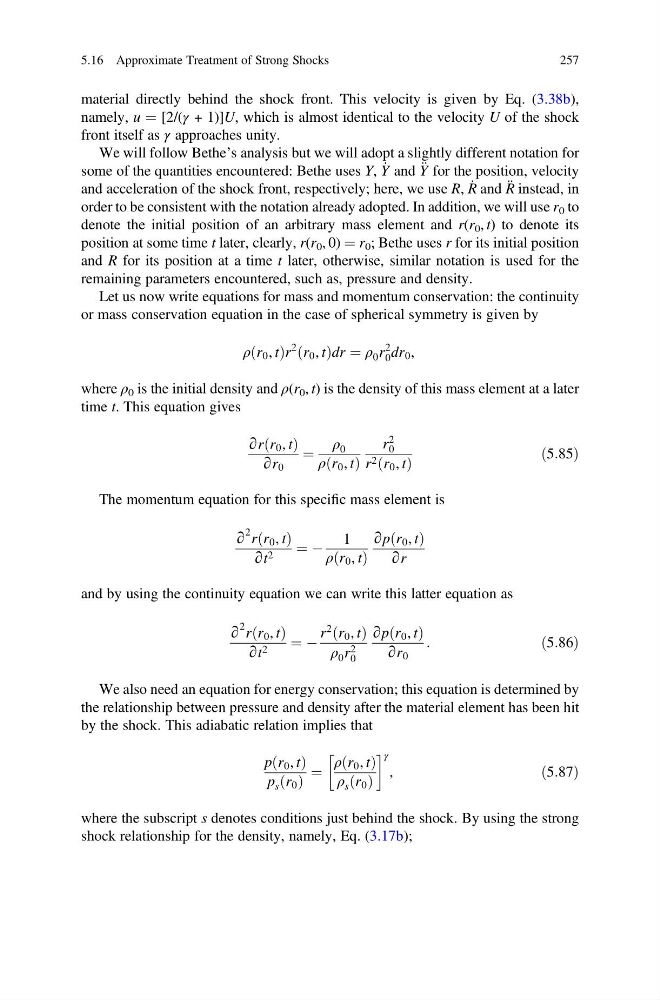
Let us now write equations for mass and momentum conservation: the continuity
or mass conservation equation in the case of spherical symmetry is given by
ρ r 0 , t
ð
Þr
2 r 0 , t
ð
Þdr ¼ ρ 0 r
2
0 dr 0 ,
where ρ 0 is the initial density and ρ(r 0 , t) is the density of this mass element at a later
time t. This equation gives
∂r r 0 , t
ð
Þ
∂r 0
¼
ρ 0
ρ r 0 , t
ð
Þ
r
2
0
r 2 r 0 , t
ð
Þ
ð5:85Þ
The momentum equation for this specific mass element is
∂
2 r r 0 , t
ð
Þ
∂t 2
¼ À
1
ρ r 0 , t
ð
Þ
∂p r 0 , t
ð
Þ
∂r
and by using the continuity equation we can write this latter equation as
∂
2 r r 0 , t
ð
Þ
∂t 2
¼ À
r
2 r 0 , t
ð
Þ
ρ 0 r 2
0
∂p r 0 , t
ð
Þ
∂r 0
:
ð5:86Þ
We also need an equation for energy conservation; this equation is determined by
the relationship between pressure and density after the material element has been hit
by the shock. This adiabatic relation implies that
p r 0 , t
ð
Þ
p s r 0
ð Þ
¼
ρ r 0 , t
ð
Þ
ρ s r 0
ð Þ
! γ
,
ð5:87Þ
where the subscript s denotes conditions just behind the shock. By using the strong
shock relationship for the density, namely, Eq. (3.17b);
5.16 Approximate Treatment of Strong Shocks
257
namely, u ¼ [2/(γ + 1)]U, which is almost identical to the velocity U of the shock
front itself as γ approaches unity.
We will follow Bethe’s analysis but we will adopt a slightly different notation for
some of the quantities encountered: Bethe uses Y, _
Y and €
Y for the position, velocity
and acceleration of the shock front, respectively; here, we use R, _
R and €
R instead, in
order to be consistent with the notation already adopted. In addition, we will use r 0 to
denote the initial position of an arbitrary mass element and r(r 0 , t) to denote its
position at some time t later, clearly, r(r 0 , 0) ¼ r 0 ; Bethe uses r for its initial position
and R for its position at a time t later, otherwise, similar notation is used for the
remaining parameters encountered, such as, pressure and density.
Let us now write equations for mass and momentum conservation: the continuity
or mass conservation equation in the case of spherical symmetry is given by
ρ r 0 , t
ð
Þr
2 r 0 , t
ð
Þdr ¼ ρ 0 r
2
0 dr 0 ,
where ρ 0 is the initial density and ρ(r 0 , t) is the density of this mass element at a later
time t. This equation gives
∂r r 0 , t
ð
Þ
∂r 0
¼
ρ 0
ρ r 0 , t
ð
Þ
r
2
0
r 2 r 0 , t
ð
Þ
ð5:85Þ
The momentum equation for this specific mass element is
∂
2 r r 0 , t
ð
Þ
∂t 2
¼ À
1
ρ r 0 , t
ð
Þ
∂p r 0 , t
ð
Þ
∂r
and by using the continuity equation we can write this latter equation as
∂
2 r r 0 , t
ð
Þ
∂t 2
¼ À
r
2 r 0 , t
ð
Þ
ρ 0 r 2
0
∂p r 0 , t
ð
Þ
∂r 0
:
ð5:86Þ
We also need an equation for energy conservation; this equation is determined by
the relationship between pressure and density after the material element has been hit
by the shock. This adiabatic relation implies that
p r 0 , t
ð
Þ
p s r 0
ð Þ
¼
ρ r 0 , t
ð
Þ
ρ s r 0
ð Þ
! γ
,
ð5:87Þ
where the subscript s denotes conditions just behind the shock. By using the strong
shock relationship for the density, namely, Eq. (3.17b);
5.16 Approximate Treatment of Strong Shocks
257