

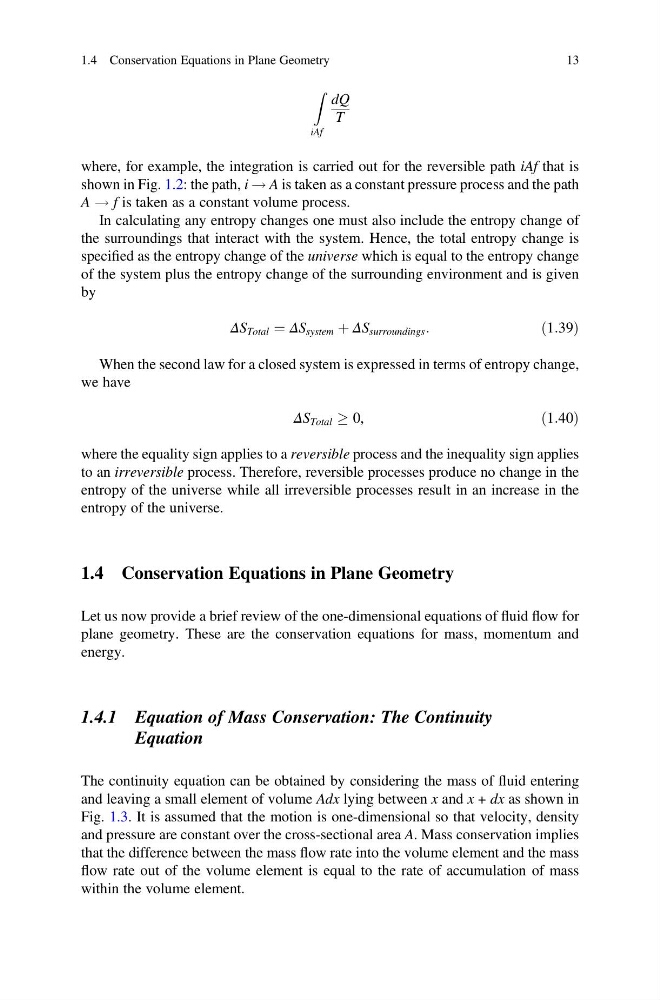
Z
iAf
dQ
T
where, for example, the integration is carried out for the reversible path iAf that is
shown in Fig. 1.2: the path, i ! A is taken as a constant pressure process and the path
A ! f is taken as a constant volume process.
In calculating any entropy changes one must also include the entropy change of
the surroundings that interact with the system. Hence, the total entropy change is
specified as the entropy change of the universe which is equal to the entropy change
of the system plus the entropy change of the surrounding environment and is given
by
ΔS Total ¼ ΔS system þ ΔS surroundings :
ð1:39Þ
When the second law for a closed system is expressed in terms of entropy change,
we have
ΔS Total ! 0,
ð1:40Þ
where the equality sign applies to a reversible process and the inequality sign applies
to an irreversible process. Therefore, reversible processes produce no change in the
entropy of the universe while all irreversible processes result in an increase in the
entropy of the universe.
1.4 Conservation Equations in Plane Geometry
Let us now provide a brief review of the one-dimensional equations of fluid flow for
plane geometry. These are the conservation equations for mass, momentum and
energy.
1.4.1 Equation of Mass Conservation: The Continuity
Equation
The continuity equation can be obtained by considering the mass of fluid entering
and leaving a small element of volume Adx lying between x and x + dx as shown in
Fig. 1.3. It is assumed that the motion is one-dimensional so that velocity, density
and pressure are constant over the cross-sectional area A. Mass conservation implies
that the difference between the mass flow rate into the volume element and the mass
flow rate out of the volume element is equal to the rate of accumulation of mass
within the volume element.
1.4 Conservation Equations in Plane Geometry
13
iAf
dQ
T
where, for example, the integration is carried out for the reversible path iAf that is
shown in Fig. 1.2: the path, i ! A is taken as a constant pressure process and the path
A ! f is taken as a constant volume process.
In calculating any entropy changes one must also include the entropy change of
the surroundings that interact with the system. Hence, the total entropy change is
specified as the entropy change of the universe which is equal to the entropy change
of the system plus the entropy change of the surrounding environment and is given
by
ΔS Total ¼ ΔS system þ ΔS surroundings :
ð1:39Þ
When the second law for a closed system is expressed in terms of entropy change,
we have
ΔS Total ! 0,
ð1:40Þ
where the equality sign applies to a reversible process and the inequality sign applies
to an irreversible process. Therefore, reversible processes produce no change in the
entropy of the universe while all irreversible processes result in an increase in the
entropy of the universe.
1.4 Conservation Equations in Plane Geometry
Let us now provide a brief review of the one-dimensional equations of fluid flow for
plane geometry. These are the conservation equations for mass, momentum and
energy.
1.4.1 Equation of Mass Conservation: The Continuity
Equation
The continuity equation can be obtained by considering the mass of fluid entering
and leaving a small element of volume Adx lying between x and x + dx as shown in
Fig. 1.3. It is assumed that the motion is one-dimensional so that velocity, density
and pressure are constant over the cross-sectional area A. Mass conservation implies
that the difference between the mass flow rate into the volume element and the mass
flow rate out of the volume element is equal to the rate of accumulation of mass
within the volume element.
1.4 Conservation Equations in Plane Geometry
13