

where the subscript rev on dQ implies that the heat transfer must occur reversibly.
3
In the case of a finite change from some initial (i) state to a final ( f ) state, the entropy
change of the system is given by
S f À S i ¼
Z f
i
dQ rev
T
ð1:38Þ
and the integral must be evaluated along any reversible path connecting the initial
and final states. Entropy, like internal energy, is a property of the system; hence, the
change S f À S i is independent of the path connecting the two states. For a reversible
adiabatic process, dQ rev ¼ 0, so that dS ¼ 0, hence, the entropy remains constant and
the process is called isentropic. An adiabatic process is one in which no heat
exchange occurs between the system and its surroundings, so, in general, an adiabatic process is not necessarily isentropic; the process must be reversible for it to be
isentropic.
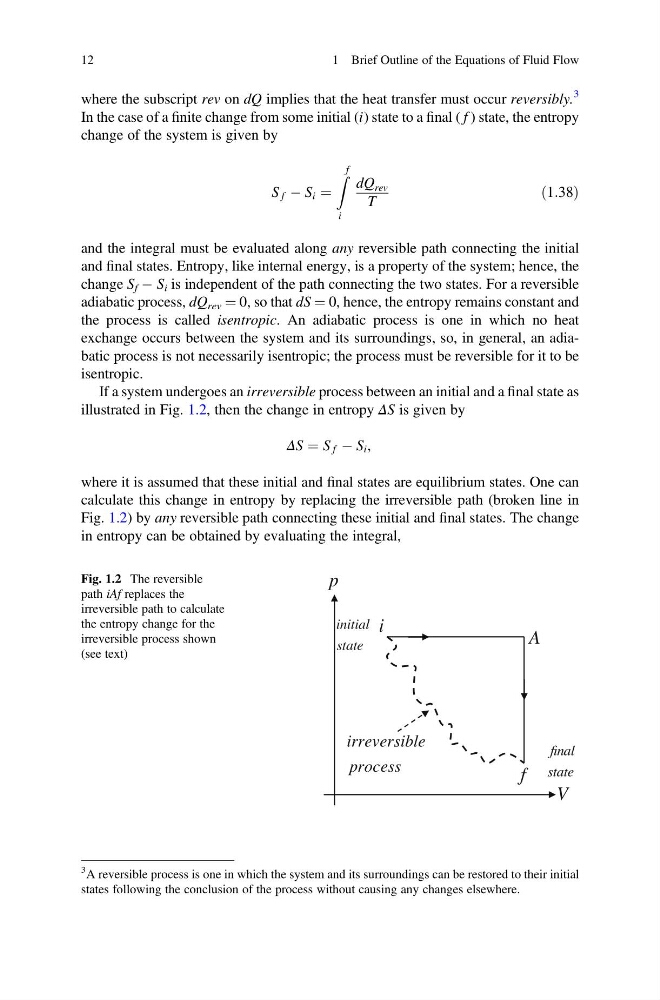
If a system undergoes an irreversible process between an initial and a final state as
illustrated in Fig. 1.2, then the change in entropy ΔS is given by
ΔS ¼ S f À S i ,
where it is assumed that these initial and final states are equilibrium states. One can
calculate this change in entropy by replacing the irreversible path (broken line in
Fig. 1.2) by any reversible path connecting these initial and final states. The change
in entropy can be obtained by evaluating the integral,
V
p
initial
state
final
state
i
f
irreversible
process
A
Fig. 1.2 The reversible
path iAf replaces the
irreversible path to calculate
the entropy change for the
irreversible process shown
(see text)
3 A reversible process is one in which the system and its surroundings can be restored to their initial
states following the conclusion of the process without causing any changes elsewhere.
12
1 Brief Outline of the Equations of Fluid Flow
3
In the case of a finite change from some initial (i) state to a final ( f ) state, the entropy
change of the system is given by
S f À S i ¼
Z f
i
dQ rev
T
ð1:38Þ
and the integral must be evaluated along any reversible path connecting the initial
and final states. Entropy, like internal energy, is a property of the system; hence, the
change S f À S i is independent of the path connecting the two states. For a reversible
adiabatic process, dQ rev ¼ 0, so that dS ¼ 0, hence, the entropy remains constant and
the process is called isentropic. An adiabatic process is one in which no heat
exchange occurs between the system and its surroundings, so, in general, an adiabatic process is not necessarily isentropic; the process must be reversible for it to be
isentropic.
If a system undergoes an irreversible process between an initial and a final state as
illustrated in Fig. 1.2, then the change in entropy ΔS is given by
ΔS ¼ S f À S i ,
where it is assumed that these initial and final states are equilibrium states. One can
calculate this change in entropy by replacing the irreversible path (broken line in
Fig. 1.2) by any reversible path connecting these initial and final states. The change
in entropy can be obtained by evaluating the integral,
V
p
initial
state
final
state
i
f
irreversible
process
A
Fig. 1.2 The reversible
path iAf replaces the
irreversible path to calculate
the entropy change for the
irreversible process shown
(see text)
3 A reversible process is one in which the system and its surroundings can be restored to their initial
states following the conclusion of the process without causing any changes elsewhere.
12
1 Brief Outline of the Equations of Fluid Flow