

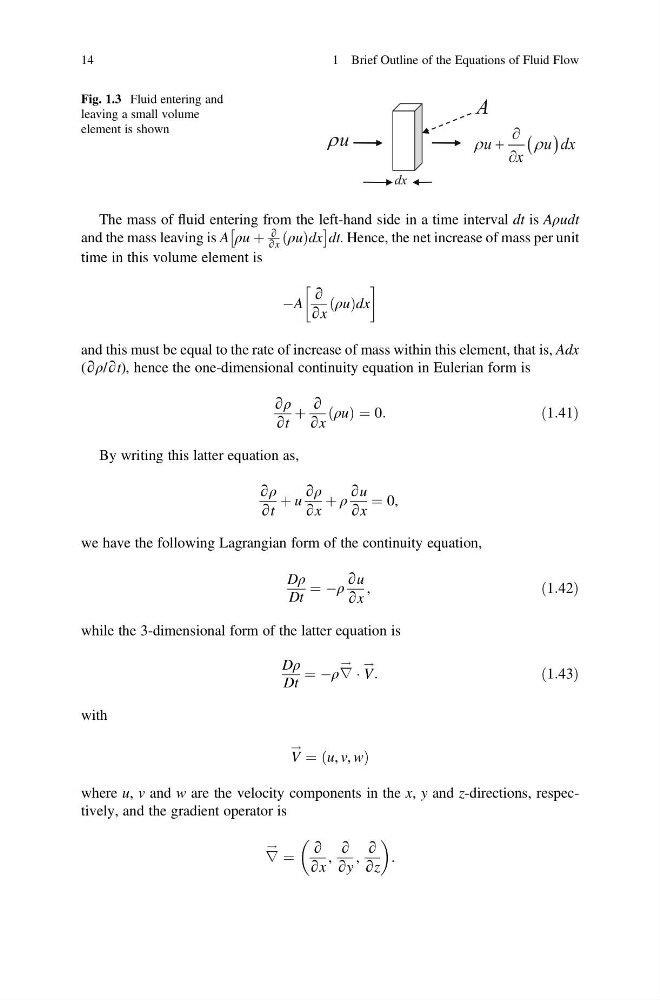
The mass of fluid entering from the left-hand side in a time interval dt is Aρudt
and the mass leaving is A ρu þ
∂
∂x
ρu
ð Þdx
Â
Ã
dt. Hence, the net increase of mass per unit
time in this volume element is
ÀA
∂
∂x
ρu
ð Þdx
!
and this must be equal to the rate of increase of mass within this element, that is, Adx
(∂ρ/∂t), hence the one-dimensional continuity equation in Eulerian form is
∂ρ
∂t
þ
∂
∂x
ρu
ð Þ ¼ 0:
ð1:41Þ
By writing this latter equation as,
∂ρ
∂t
þ u
∂ρ
∂x
þ ρ
∂u
∂x
¼ 0,
we have the following Lagrangian form of the continuity equation,
Dρ
Dt
¼ Àρ
∂u
∂x
,
ð1:42Þ
while the 3-dimensional form of the latter equation is
Dρ
Dt
¼ Àρ∇
! Á V
!
:
ð1:43Þ
with
V
! ¼ u, v, w
ð
Þ
where u, v and w are the velocity components in the x, y and z-directions, respectively, and the gradient operator is
∇
! ¼
∂
∂x
,
∂
∂y
,
∂
∂z
:
Fig. 1.3 Fluid entering and
leaving a small volume
element is shown
14
1 Brief Outline of the Equations of Fluid Flow
and the mass leaving is A ρu þ
∂
∂x
ρu
ð Þdx
Â
Ã
dt. Hence, the net increase of mass per unit
time in this volume element is
ÀA
∂
∂x
ρu
ð Þdx
!
and this must be equal to the rate of increase of mass within this element, that is, Adx
(∂ρ/∂t), hence the one-dimensional continuity equation in Eulerian form is
∂ρ
∂t
þ
∂
∂x
ρu
ð Þ ¼ 0:
ð1:41Þ
By writing this latter equation as,
∂ρ
∂t
þ u
∂ρ
∂x
þ ρ
∂u
∂x
¼ 0,
we have the following Lagrangian form of the continuity equation,
Dρ
Dt
¼ Àρ
∂u
∂x
,
ð1:42Þ
while the 3-dimensional form of the latter equation is
Dρ
Dt
¼ Àρ∇
! Á V
!
:
ð1:43Þ
with
V
! ¼ u, v, w
ð
Þ
where u, v and w are the velocity components in the x, y and z-directions, respectively, and the gradient operator is
∇
! ¼
∂
∂x
,
∂
∂y
,
∂
∂z
:
Fig. 1.3 Fluid entering and
leaving a small volume
element is shown
14
1 Brief Outline of the Equations of Fluid Flow