

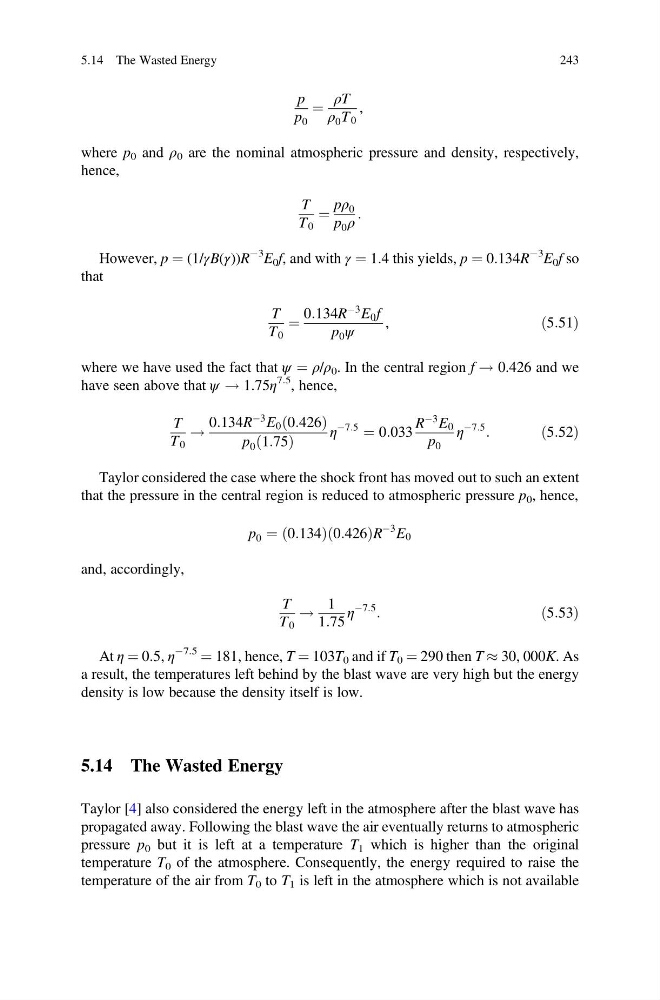
p
p 0
¼
ρT
ρ 0 T 0
,
where p 0 and ρ 0 are the nominal atmospheric pressure and density, respectively,
hence,
T
T 0
¼
pρ 0
p 0 ρ
:
However, p ¼ (1/γB(γ))R
À3 E 0 f, and with γ ¼ 1.4 this yields, p ¼ 0.134R
À3 E 0 f so
that
T
T 0
¼
0:134R
À3 E 0 f
p 0 ψ
,
ð5:51Þ
where we have used the fact that ψ ¼ ρ/ρ 0 . In the central region f ! 0.426 and we
have seen above that ψ ! 1.75η
7.5
, hence,
T
T 0
!
0:134R
À3 E 0 0:426
ð
Þ
p 0 1:75
ð
Þ
η
À7:5
¼ 0:033
R
À3 E 0
p 0
η
À7:5
:
ð5:52Þ
Taylor considered the case where the shock front has moved out to such an extent
that the pressure in the central region is reduced to atmospheric pressure p 0 , hence,
p 0 ¼ 0:134
ð
Þ 0:426
ð
ÞR
À3 E 0
and, accordingly,
T
T 0
!
1
1:75
η
À7:5
:
ð5:53Þ
At η ¼ 0.5, η
À7.5
¼ 181, hence, T ¼ 103T 0 and if T 0 ¼ 290 then T % 30, 000K. As
a result, the temperatures left behind by the blast wave are very high but the energy
density is low because the density itself is low.
5.14 The Wasted Energy
Taylor [4] also considered the energy left in the atmosphere after the blast wave has
propagated away. Following the blast wave the air eventually returns to atmospheric
pressure p 0 but it is left at a temperature T 1 which is higher than the original
temperature T 0 of the atmosphere. Consequently, the energy required to raise the
temperature of the air from T 0 to T 1 is left in the atmosphere which is not available
5.14 The Wasted Energy
243
p 0
¼
ρT
ρ 0 T 0
,
where p 0 and ρ 0 are the nominal atmospheric pressure and density, respectively,
hence,
T
T 0
¼
pρ 0
p 0 ρ
:
However, p ¼ (1/γB(γ))R
À3 E 0 f, and with γ ¼ 1.4 this yields, p ¼ 0.134R
À3 E 0 f so
that
T
T 0
¼
0:134R
À3 E 0 f
p 0 ψ
,
ð5:51Þ
where we have used the fact that ψ ¼ ρ/ρ 0 . In the central region f ! 0.426 and we
have seen above that ψ ! 1.75η
7.5
, hence,
T
T 0
!
0:134R
À3 E 0 0:426
ð
Þ
p 0 1:75
ð
Þ
η
À7:5
¼ 0:033
R
À3 E 0
p 0
η
À7:5
:
ð5:52Þ
Taylor considered the case where the shock front has moved out to such an extent
that the pressure in the central region is reduced to atmospheric pressure p 0 , hence,
p 0 ¼ 0:134
ð
Þ 0:426
ð
ÞR
À3 E 0
and, accordingly,
T
T 0
!
1
1:75
η
À7:5
:
ð5:53Þ
At η ¼ 0.5, η
À7.5
¼ 181, hence, T ¼ 103T 0 and if T 0 ¼ 290 then T % 30, 000K. As
a result, the temperatures left behind by the blast wave are very high but the energy
density is low because the density itself is low.
5.14 The Wasted Energy
Taylor [4] also considered the energy left in the atmosphere after the blast wave has
propagated away. Following the blast wave the air eventually returns to atmospheric
pressure p 0 but it is left at a temperature T 1 which is higher than the original
temperature T 0 of the atmosphere. Consequently, the energy required to raise the
temperature of the air from T 0 to T 1 is left in the atmosphere which is not available
5.14 The Wasted Energy
243