

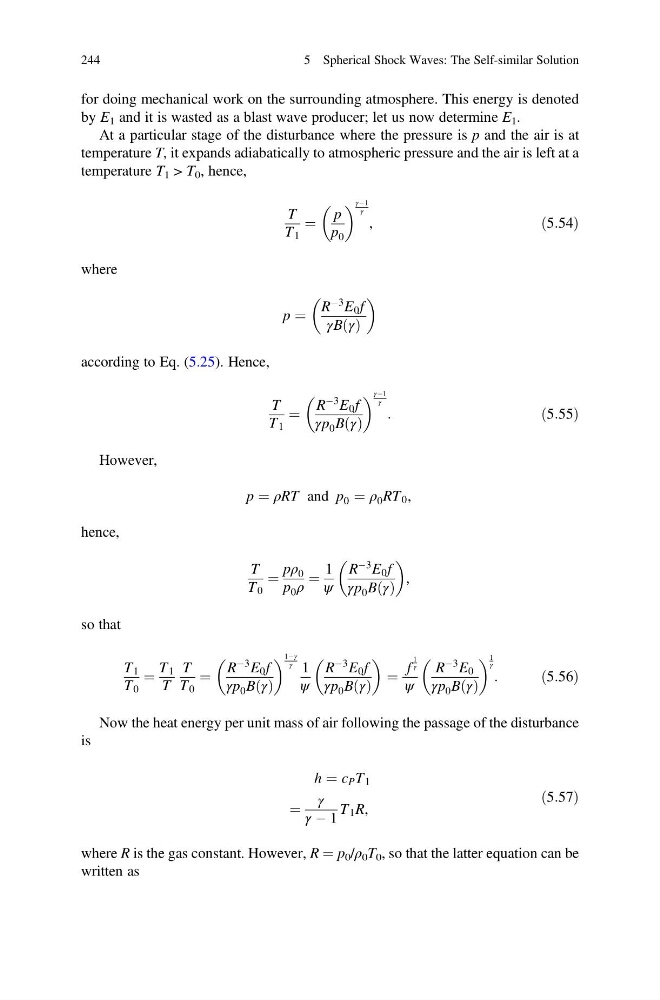
for doing mechanical work on the surrounding atmosphere. This energy is denoted
by E 1 and it is wasted as a blast wave producer; let us now determine E 1 .
At a particular stage of the disturbance where the pressure is p and the air is at
temperature T, it expands adiabatically to atmospheric pressure and the air is left at a
temperature T 1 > T 0 , hence,
T
T 1
¼
p
p 0
γÀ1 γ
,
ð5:54Þ
where
p ¼
R
À3 E 0 f
γB γ
ð Þ
according to Eq. (5.25). Hence,
T
T 1
¼
R
À3 E 0 f
γp 0 B γ
ð Þ
γÀ1
γ :
ð5:55Þ
However,
p ¼ ρRT and p 0 ¼ ρ 0 RT 0 ,
hence,
T
T 0
¼
pρ 0
p 0 ρ
¼
1
ψ
R
À3 E 0 f
γp 0 B γ
ð Þ
,
so that
T 1
T 0
¼
T 1
T
T
T 0
¼
R
À3 E 0 f
γp 0 B γ
ð Þ
1Àγ
γ 1
ψ
R
À3 E 0 f
γp 0 B γ
ð Þ
¼
f
1
γ
ψ
R
À3 E 0
γp 0 B γ
ð Þ
1
γ :
ð5:56Þ
Now the heat energy per unit mass of air following the passage of the disturbance
is
h ¼ c P T 1
¼
γ
γ À 1
T 1 R,
ð5:57Þ
where R is the gas constant. However, R ¼ p 0 /ρ 0 T 0 , so that the latter equation can be
written as
244
5 Spherical Shock Waves: The Self-similar Solution
by E 1 and it is wasted as a blast wave producer; let us now determine E 1 .
At a particular stage of the disturbance where the pressure is p and the air is at
temperature T, it expands adiabatically to atmospheric pressure and the air is left at a
temperature T 1 > T 0 , hence,
T
T 1
¼
p
p 0
γÀ1 γ
,
ð5:54Þ
where
p ¼
R
À3 E 0 f
γB γ
ð Þ
according to Eq. (5.25). Hence,
T
T 1
¼
R
À3 E 0 f
γp 0 B γ
ð Þ
γÀ1
γ :
ð5:55Þ
However,
p ¼ ρRT and p 0 ¼ ρ 0 RT 0 ,
hence,
T
T 0
¼
pρ 0
p 0 ρ
¼
1
ψ
R
À3 E 0 f
γp 0 B γ
ð Þ
,
so that
T 1
T 0
¼
T 1
T
T
T 0
¼
R
À3 E 0 f
γp 0 B γ
ð Þ
1Àγ
γ 1
ψ
R
À3 E 0 f
γp 0 B γ
ð Þ
¼
f
1
γ
ψ
R
À3 E 0
γp 0 B γ
ð Þ
1
γ :
ð5:56Þ
Now the heat energy per unit mass of air following the passage of the disturbance
is
h ¼ c P T 1
¼
γ
γ À 1
T 1 R,
ð5:57Þ
where R is the gas constant. However, R ¼ p 0 /ρ 0 T 0 , so that the latter equation can be
written as
244
5 Spherical Shock Waves: The Self-similar Solution