

having different specific heat ratios and densities; secondly, we will consider the
overtaking of one shock by another and, finally, we will present some numerical
results obtained for the head-on collision of two shock waves.
(a) Shock reflection from a plane boundary between two gases
The incident shock wave is assumed to propagate in gas 2 as shown in Fig. 4.61 as
a result of the sudden motion of the piston to a constant velocity of 0.3 (Arb. units).
From our previous examples with this piston velocity we have already established
that the shock speed is 1.377 in gas 2 and the pressure behind the shock is 1.413. The
condition for the shock wave to be reflected from the boundary is given by Landau
and Lifshitz [16] as
υ 01
γ 1 þ 1
ð
Þ
p
p 1
þ γ 1 À 1
ð
Þ
<
υ 02
γ 2 þ 1
ð
Þ
p
p 1
þ γ 2 À 1
ð
Þ
,
where p is the pressure behind the shock wave which is equal to 1.413 in this
particular case.
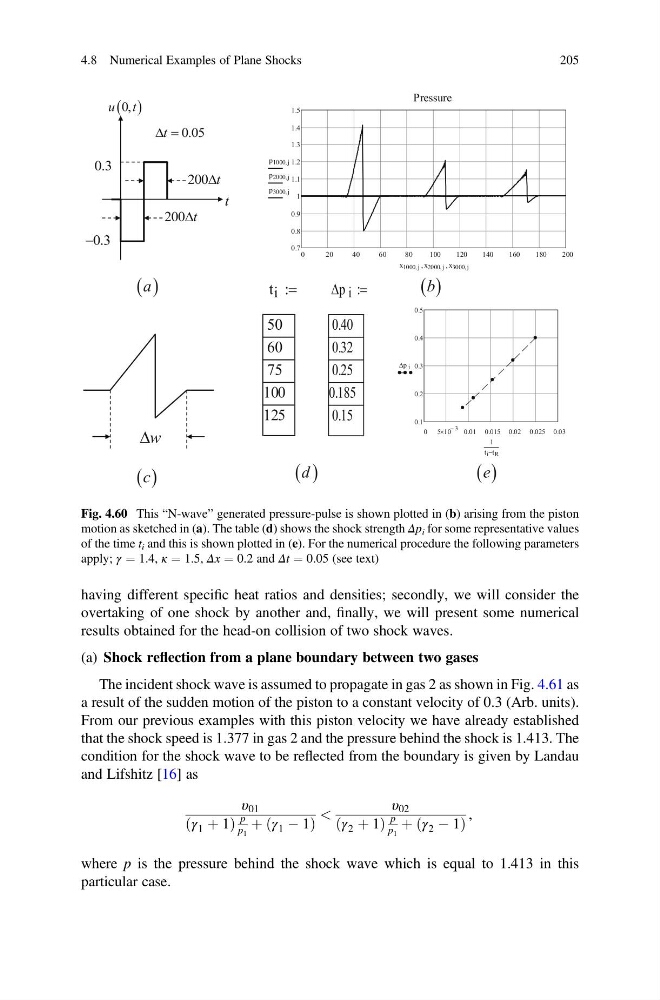
Fig. 4.60 This “N-wave” generated pressure-pulse is shown plotted in (b) arising from the piston
motion as sketched in (a). The table (d) shows the shock strength Δp i for some representative values
of the time t i and this is shown plotted in (e). For the numerical procedure the following parameters
apply; γ ¼ 1.4, κ ¼ 1.5, Δx ¼ 0.2 and Δt ¼ 0.05 (see text)
4.8 Numerical Examples of Plane Shocks
205
overtaking of one shock by another and, finally, we will present some numerical
results obtained for the head-on collision of two shock waves.
(a) Shock reflection from a plane boundary between two gases
The incident shock wave is assumed to propagate in gas 2 as shown in Fig. 4.61 as
a result of the sudden motion of the piston to a constant velocity of 0.3 (Arb. units).
From our previous examples with this piston velocity we have already established
that the shock speed is 1.377 in gas 2 and the pressure behind the shock is 1.413. The
condition for the shock wave to be reflected from the boundary is given by Landau
and Lifshitz [16] as
υ 01
γ 1 þ 1
ð
Þ
p
p 1
þ γ 1 À 1
ð
Þ
<
υ 02
γ 2 þ 1
ð
Þ
p
p 1
þ γ 2 À 1
ð
Þ
,
where p is the pressure behind the shock wave which is equal to 1.413 in this
particular case.
Fig. 4.60 This “N-wave” generated pressure-pulse is shown plotted in (b) arising from the piston
motion as sketched in (a). The table (d) shows the shock strength Δp i for some representative values
of the time t i and this is shown plotted in (e). For the numerical procedure the following parameters
apply; γ ¼ 1.4, κ ¼ 1.5, Δx ¼ 0.2 and Δt ¼ 0.05 (see text)
4.8 Numerical Examples of Plane Shocks
205