

4 À σ
4
¼ 1 þ
σ 1
4 À σ 1
ffiffiffiffiffiffiffiffiffiffiffiffiffi
t 1 À t R
t À t R
r
! À1
,
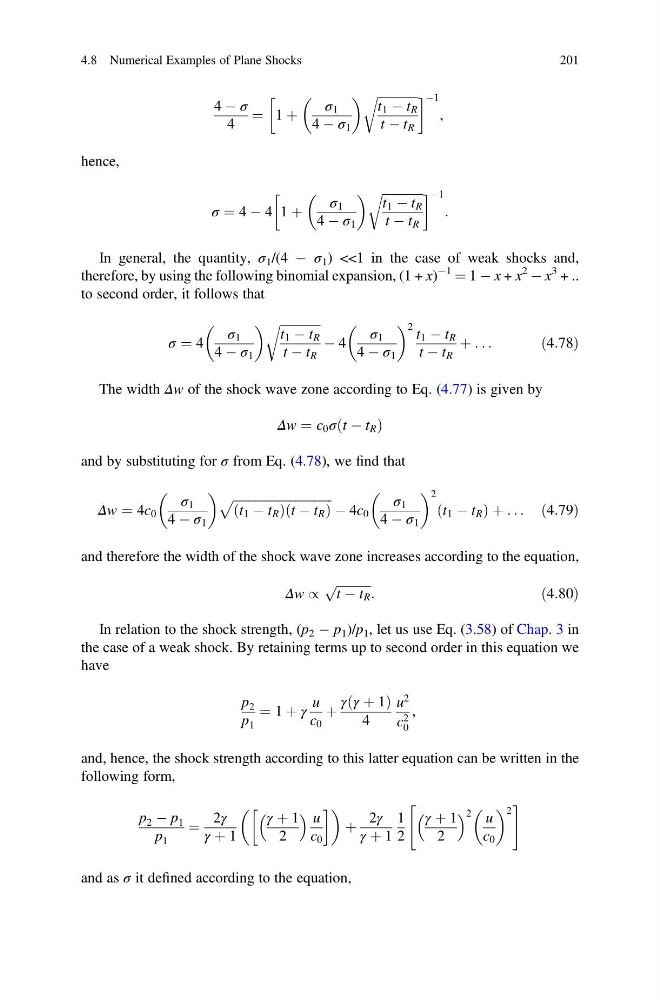
hence,
σ ¼ 4 À 4 1 þ
σ 1
4 À σ 1
ffiffiffiffiffiffiffiffiffiffiffiffiffi
t 1 À t R
t À t R
r
! À1
:
In general, the quantity, σ 1 /(4 À σ 1 ) <<1 in the case of weak shocks and,
therefore, by using the following binomial expansion, (1 + x)
À1
¼ 1 À x + x
2
À x
3 + ..
to second order, it follows that
σ ¼ 4
σ 1
4 À σ 1
ffiffiffiffiffiffiffiffiffiffiffiffiffi
t 1 À t R
t À t R
r
À 4
σ 1
4 À σ 1
2 t 1 À t R
t À t R
þ . . .
ð4:78Þ
The width Δw of the shock wave zone according to Eq. (4.77) is given by
Δw ¼ c 0 σ t À t R
ð
Þ
and by substituting for σ from Eq. (4.78), we find that
Δw ¼ 4c 0
σ 1
4 À σ 1
ffiffiffiffiffiffiffiffiffiffiffiffiffiffiffiffiffiffiffiffiffiffiffiffiffiffiffiffiffiffiffi ffi
t 1 À t R
ð
Þ t À t R
ð
Þ
p
À 4c 0
σ 1
4 À σ 1
2
t 1 À t R
ð
Þþ. . . ð4:79Þ
and therefore the width of the shock wave zone increases according to the equation,
Δw /
ffiffiffiffiffiffiffiffiffiffiffi
t À t R
p
:
ð4:80Þ
In relation to the shock strength, (p 2 À p 1 )/p 1 , let us use Eq. (3.58) of Chap. 3 in
the case of a weak shock. By retaining terms up to second order in this equation we
have
p 2
p 1
¼ 1 þ γ
u
c 0
þ
γ γ þ 1
ð
Þ
4
u
2
c 2
0
,
and, hence, the shock strength according to this latter equation can be written in the
following form,
p 2 À p 1
p 1
¼
2γ
γ þ 1
γ þ 1
2
u
c 0
!
þ
2γ
γ þ 1
1
2
γ þ 1
2
2 u
c 0
2
"
#
and as σ it defined according to the equation,
4.8 Numerical Examples of Plane Shocks
201
4
¼ 1 þ
σ 1
4 À σ 1
ffiffiffiffiffiffiffiffiffiffiffiffiffi
t 1 À t R
t À t R
r
! À1
,
hence,
σ ¼ 4 À 4 1 þ
σ 1
4 À σ 1
ffiffiffiffiffiffiffiffiffiffiffiffiffi
t 1 À t R
t À t R
r
! À1
:
In general, the quantity, σ 1 /(4 À σ 1 ) <<1 in the case of weak shocks and,
therefore, by using the following binomial expansion, (1 + x)
À1
¼ 1 À x + x
2
À x
3 + ..
to second order, it follows that
σ ¼ 4
σ 1
4 À σ 1
ffiffiffiffiffiffiffiffiffiffiffiffiffi
t 1 À t R
t À t R
r
À 4
σ 1
4 À σ 1
2 t 1 À t R
t À t R
þ . . .
ð4:78Þ
The width Δw of the shock wave zone according to Eq. (4.77) is given by
Δw ¼ c 0 σ t À t R
ð
Þ
and by substituting for σ from Eq. (4.78), we find that
Δw ¼ 4c 0
σ 1
4 À σ 1
ffiffiffiffiffiffiffiffiffiffiffiffiffiffiffiffiffiffiffiffiffiffiffiffiffiffiffiffiffiffiffi ffi
t 1 À t R
ð
Þ t À t R
ð
Þ
p
À 4c 0
σ 1
4 À σ 1
2
t 1 À t R
ð
Þþ. . . ð4:79Þ
and therefore the width of the shock wave zone increases according to the equation,
Δw /
ffiffiffiffiffiffiffiffiffiffiffi
t À t R
p
:
ð4:80Þ
In relation to the shock strength, (p 2 À p 1 )/p 1 , let us use Eq. (3.58) of Chap. 3 in
the case of a weak shock. By retaining terms up to second order in this equation we
have
p 2
p 1
¼ 1 þ γ
u
c 0
þ
γ γ þ 1
ð
Þ
4
u
2
c 2
0
,
and, hence, the shock strength according to this latter equation can be written in the
following form,
p 2 À p 1
p 1
¼
2γ
γ þ 1
γ þ 1
2
u
c 0
!
þ
2γ
γ þ 1
1
2
γ þ 1
2
2 u
c 0
2
"
#
and as σ it defined according to the equation,
4.8 Numerical Examples of Plane Shocks
201