

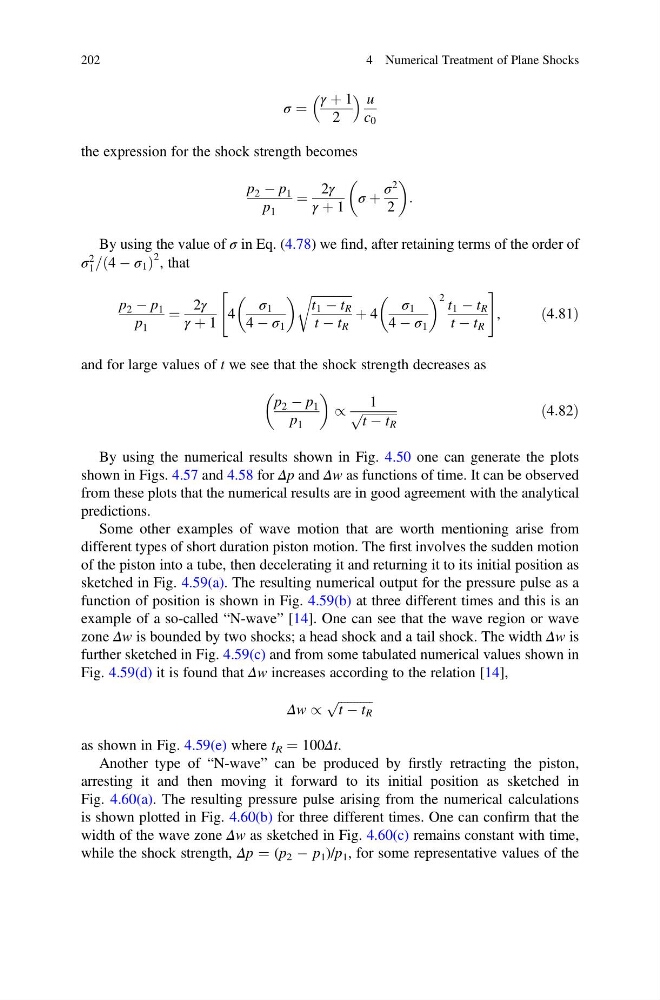
σ ¼
γ þ 1
2
u
c 0
the expression for the shock strength becomes
p 2 À p 1
p 1
¼
2γ
γ þ 1
σ þ
σ
2
2
:
By using the value of σ in Eq. (4.78) we find, after retaining terms of the order of
σ
2
1 = 4 À σ 1
ð
Þ
2 , that
p 2 À p 1
p 1
¼
2γ
γ þ 1
4
σ 1
4 À σ 1
ffiffiffiffiffiffiffiffiffiffiffiffiffi
t 1 À t R
t À t R
r
þ 4
σ 1
4 À σ 1
2 t 1 À t R
t À t R
"
#
,
ð4:81Þ
and for large values of t we see that the shock strength decreases as
p 2 À p 1
p 1
/
1
ffiffiffiffiffiffiffiffiffiffiffi
t À t R
p
ð4:82Þ
By using the numerical results shown in Fig. 4.50 one can generate the plots
shown in Figs. 4.57 and 4.58 for Δp and Δw as functions of time. It can be observed
from these plots that the numerical results are in good agreement with the analytical
predictions.
Some other examples of wave motion that are worth mentioning arise from
different types of short duration piston motion. The first involves the sudden motion
of the piston into a tube, then decelerating it and returning it to its initial position as
sketched in Fig. 4.59(a). The resulting numerical output for the pressure pulse as a
function of position is shown in Fig. 4.59(b) at three different times and this is an
example of a so-called “N-wave” [14]. One can see that the wave region or wave
zone Δw is bounded by two shocks; a head shock and a tail shock. The width Δw is
further sketched in Fig. 4.59(c) and from some tabulated numerical values shown in
Fig. 4.59(d) it is found that Δw increases according to the relation [14],
Δw /
ffiffiffiffiffiffiffiffiffiffiffi
t À t R
p
as shown in Fig. 4.59(e) where t R ¼ 100Δt.
Another type of “N-wave” can be produced by firstly retracting the piston,
arresting it and then moving it forward to its initial position as sketched in
Fig. 4.60(a). The resulting pressure pulse arising from the numerical calculations
is shown plotted in Fig. 4.60(b) for three different times. One can confirm that the
width of the wave zone Δw as sketched in Fig. 4.60(c) remains constant with time,
while the shock strength, Δp ¼ (p 2 À p 1 )/p 1 , for some representative values of the
202
4 Numerical Treatment of Plane Shocks
γ þ 1
2
u
c 0
the expression for the shock strength becomes
p 2 À p 1
p 1
¼
2γ
γ þ 1
σ þ
σ
2
2
:
By using the value of σ in Eq. (4.78) we find, after retaining terms of the order of
σ
2
1 = 4 À σ 1
ð
Þ
2 , that
p 2 À p 1
p 1
¼
2γ
γ þ 1
4
σ 1
4 À σ 1
ffiffiffiffiffiffiffiffiffiffiffiffiffi
t 1 À t R
t À t R
r
þ 4
σ 1
4 À σ 1
2 t 1 À t R
t À t R
"
#
,
ð4:81Þ
and for large values of t we see that the shock strength decreases as
p 2 À p 1
p 1
/
1
ffiffiffiffiffiffiffiffiffiffiffi
t À t R
p
ð4:82Þ
By using the numerical results shown in Fig. 4.50 one can generate the plots
shown in Figs. 4.57 and 4.58 for Δp and Δw as functions of time. It can be observed
from these plots that the numerical results are in good agreement with the analytical
predictions.
Some other examples of wave motion that are worth mentioning arise from
different types of short duration piston motion. The first involves the sudden motion
of the piston into a tube, then decelerating it and returning it to its initial position as
sketched in Fig. 4.59(a). The resulting numerical output for the pressure pulse as a
function of position is shown in Fig. 4.59(b) at three different times and this is an
example of a so-called “N-wave” [14]. One can see that the wave region or wave
zone Δw is bounded by two shocks; a head shock and a tail shock. The width Δw is
further sketched in Fig. 4.59(c) and from some tabulated numerical values shown in
Fig. 4.59(d) it is found that Δw increases according to the relation [14],
Δw /
ffiffiffiffiffiffiffiffiffiffiffi
t À t R
p
as shown in Fig. 4.59(e) where t R ¼ 100Δt.
Another type of “N-wave” can be produced by firstly retracting the piston,
arresting it and then moving it forward to its initial position as sketched in
Fig. 4.60(a). The resulting pressure pulse arising from the numerical calculations
is shown plotted in Fig. 4.60(b) for three different times. One can confirm that the
width of the wave zone Δw as sketched in Fig. 4.60(c) remains constant with time,
while the shock strength, Δp ¼ (p 2 À p 1 )/p 1 , for some representative values of the
202
4 Numerical Treatment of Plane Shocks