

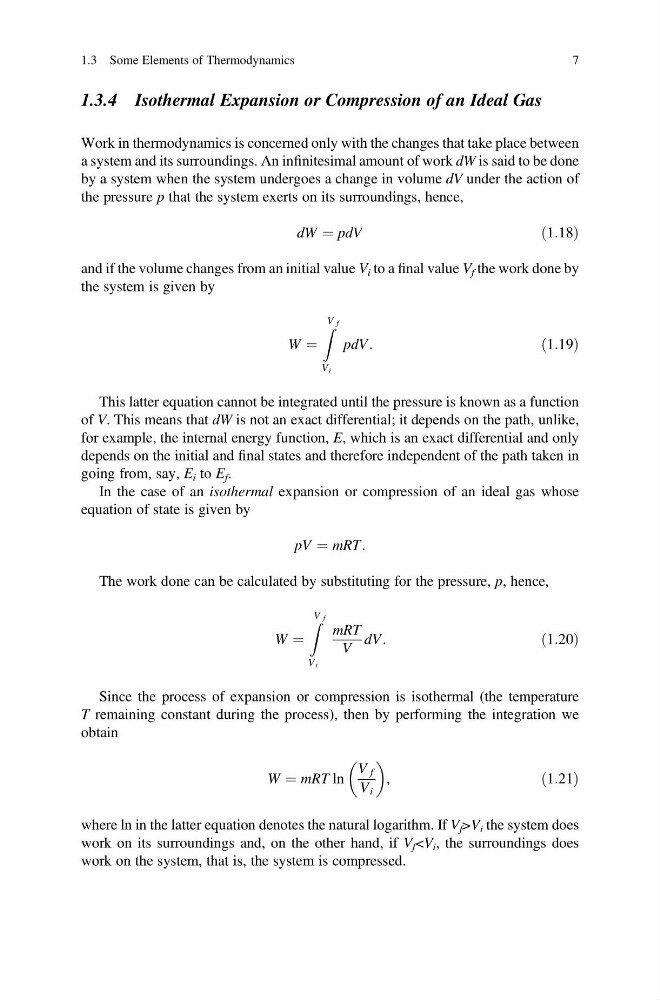
1.3.4 Isothermal Expansion or Compression of an Ideal Gas
Work in thermodynamics is concerned only with the changes that take place between
a system and its surroundings. An infinitesimal amount of work dW is said to be done
by a system when the system undergoes a change in volume dV under the action of
the pressure p that the system exerts on its surroundings, hence,
dW ¼ pdV
ð1:18Þ
and if the volume changes from an initial value V i to a final value V f the work done by
the system is given by
W ¼
Z V f
V i
pdV:
ð1:19Þ
This latter equation cannot be integrated until the pressure is known as a function
of V. This means that dW is not an exact differential; it depends on the path, unlike,
for example, the internal energy function, E, which is an exact differential and only
depends on the initial and final states and therefore independent of the path taken in
going from, say, E i to E f .
In the case of an isothermal expansion or compression of an ideal gas whose
equation of state is given by
pV ¼ mRT:
The work done can be calculated by substituting for the pressure, p, hence,
W ¼
Z V f
V i
mRT
V
dV:
ð1:20Þ
Since the process of expansion or compression is isothermal (the temperature
T remaining constant during the process), then by performing the integration we
obtain
W ¼ mRT ln
V f
V i
,
ð1:21Þ
where ln in the latter equation denotes the natural logarithm. If V f >V i the system does
work on its surroundings and, on the other hand, if V f
1.3 Some Elements of Thermodynamics
7
Work in thermodynamics is concerned only with the changes that take place between
a system and its surroundings. An infinitesimal amount of work dW is said to be done
by a system when the system undergoes a change in volume dV under the action of
the pressure p that the system exerts on its surroundings, hence,
dW ¼ pdV
ð1:18Þ
and if the volume changes from an initial value V i to a final value V f the work done by
the system is given by
W ¼
Z V f
V i
pdV:
ð1:19Þ
This latter equation cannot be integrated until the pressure is known as a function
of V. This means that dW is not an exact differential; it depends on the path, unlike,
for example, the internal energy function, E, which is an exact differential and only
depends on the initial and final states and therefore independent of the path taken in
going from, say, E i to E f .
In the case of an isothermal expansion or compression of an ideal gas whose
equation of state is given by
pV ¼ mRT:
The work done can be calculated by substituting for the pressure, p, hence,
W ¼
Z V f
V i
mRT
V
dV:
ð1:20Þ
Since the process of expansion or compression is isothermal (the temperature
T remaining constant during the process), then by performing the integration we
obtain
W ¼ mRT ln
V f
V i
,
ð1:21Þ
where ln in the latter equation denotes the natural logarithm. If V f >V i the system does
work on its surroundings and, on the other hand, if V f
1.3 Some Elements of Thermodynamics
7