

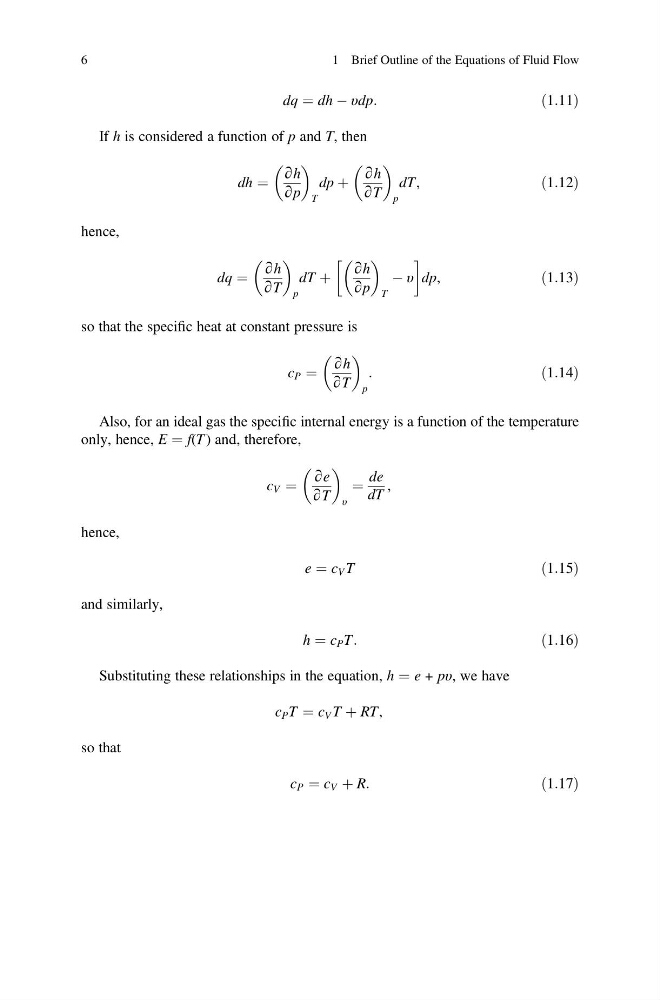
dq ¼ dh À υdp:
ð1:11Þ
If h is considered a function of p and T, then
dh ¼
∂h
∂p
T
dp þ
∂h
∂T
p
dT,
ð1:12Þ
hence,
dq ¼
∂h
∂T
p
dT þ
∂h
∂p
T
À υ
!
dp,
ð1:13Þ
so that the specific heat at constant pressure is
c P ¼
∂h
∂T
p
:
ð1:14Þ
Also, for an ideal gas the specific internal energy is a function of the temperature
only, hence, E ¼ f(T ) and, therefore,
c V ¼
∂e
∂T
υ
¼
de
dT
,
hence,
e ¼ c V T
ð1:15Þ
and similarly,
h ¼ c P T:
ð1:16Þ
Substituting these relationships in the equation, h ¼ e + pυ, we have
c P T ¼ c V T þ RT,
so that
c P ¼ c V þ R:
ð1:17Þ
6
1 Brief Outline of the Equations of Fluid Flow
ð1:11Þ
If h is considered a function of p and T, then
dh ¼
∂h
∂p
T
dp þ
∂h
∂T
p
dT,
ð1:12Þ
hence,
dq ¼
∂h
∂T
p
dT þ
∂h
∂p
T
À υ
!
dp,
ð1:13Þ
so that the specific heat at constant pressure is
c P ¼
∂h
∂T
p
:
ð1:14Þ
Also, for an ideal gas the specific internal energy is a function of the temperature
only, hence, E ¼ f(T ) and, therefore,
c V ¼
∂e
∂T
υ
¼
de
dT
,
hence,
e ¼ c V T
ð1:15Þ
and similarly,
h ¼ c P T:
ð1:16Þ
Substituting these relationships in the equation, h ¼ e + pυ, we have
c P T ¼ c V T þ RT,
so that
c P ¼ c V þ R:
ð1:17Þ
6
1 Brief Outline of the Equations of Fluid Flow