

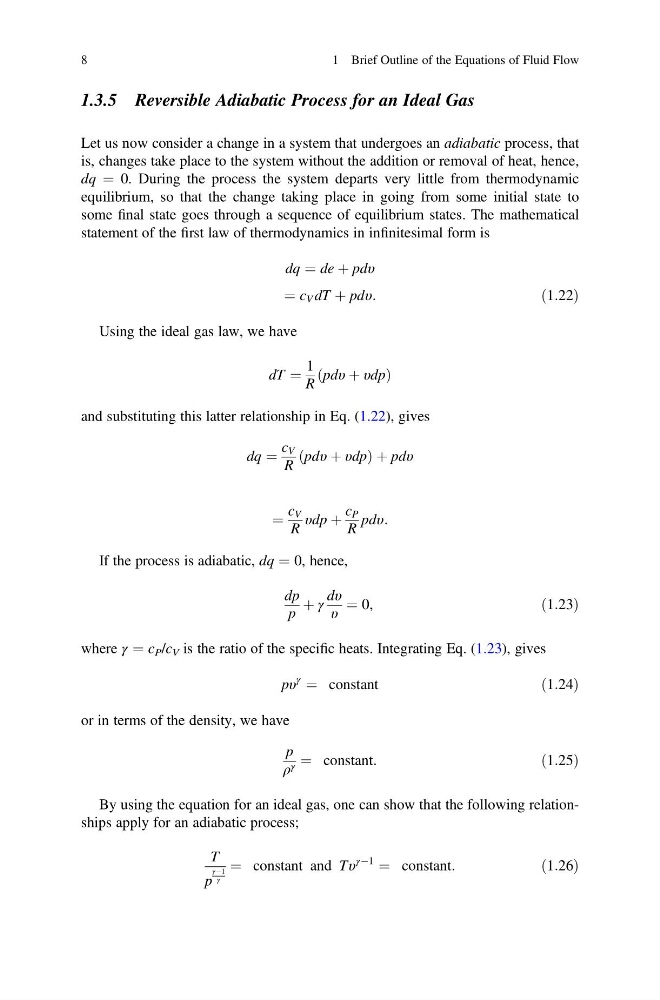
1.3.5 Reversible Adiabatic Process for an Ideal Gas
Let us now consider a change in a system that undergoes an adiabatic process, that
is, changes take place to the system without the addition or removal of heat, hence,
dq ¼ 0. During the process the system departs very little from thermodynamic
equilibrium, so that the change taking place in going from some initial state to
some final state goes through a sequence of equilibrium states. The mathematical
statement of the first law of thermodynamics in infinitesimal form is
dq ¼ de þ pdυ
¼ c V dT þ pdυ:
ð1:22Þ
Using the ideal gas law, we have
dT ¼
1
R
pdυ þ υdp
ð
Þ
and substituting this latter relationship in Eq. (1.22), gives
dq ¼
c V
R
pdυ þ υdp
ð
Þþpdυ
¼
c V
R
υdp þ
c P
R
pdυ:
If the process is adiabatic, dq ¼ 0, hence,
dp
p
þ γ
dυ
υ
¼ 0,
ð1:23Þ
where γ ¼ c P /c V is the ratio of the specific heats. Integrating Eq. (1.23), gives
pυ
γ
¼ constant
ð1:24Þ
or in terms of the density, we have
p
ρ γ ¼ constant:
ð1:25Þ
By using the equation for an ideal gas, one can show that the following relationships apply for an adiabatic process;
T
p
γÀ1
γ
¼ constant and Tυ
γÀ1
¼ constant:
ð1:26Þ
8
1 Brief Outline of the Equations of Fluid Flow
Let us now consider a change in a system that undergoes an adiabatic process, that
is, changes take place to the system without the addition or removal of heat, hence,
dq ¼ 0. During the process the system departs very little from thermodynamic
equilibrium, so that the change taking place in going from some initial state to
some final state goes through a sequence of equilibrium states. The mathematical
statement of the first law of thermodynamics in infinitesimal form is
dq ¼ de þ pdυ
¼ c V dT þ pdυ:
ð1:22Þ
Using the ideal gas law, we have
dT ¼
1
R
pdυ þ υdp
ð
Þ
and substituting this latter relationship in Eq. (1.22), gives
dq ¼
c V
R
pdυ þ υdp
ð
Þþpdυ
¼
c V
R
υdp þ
c P
R
pdυ:
If the process is adiabatic, dq ¼ 0, hence,
dp
p
þ γ
dυ
υ
¼ 0,
ð1:23Þ
where γ ¼ c P /c V is the ratio of the specific heats. Integrating Eq. (1.23), gives
pυ
γ
¼ constant
ð1:24Þ
or in terms of the density, we have
p
ρ γ ¼ constant:
ð1:25Þ
By using the equation for an ideal gas, one can show that the following relationships apply for an adiabatic process;
T
p
γÀ1
γ
¼ constant and Tυ
γÀ1
¼ constant:
ð1:26Þ
8
1 Brief Outline of the Equations of Fluid Flow