

We have already noted in Chap. 1 that small perturbations about ambient values
generate disturbances that propagate at the acoustic velocity and, in these circumstances, the propagation of the disturbance satisfies the following wave equation;
∂
2 Δu x, t
ð Þ
∂x 2
¼
1
c 2
0
∂
2 Δu x, t
ð Þ
∂t 2
,
which is Eq. (1.76) of Chap. 1. Let us set out to solve this equation for the example
we are considering here in which the piston is suddenly pushed into a tube at a
constant velocity of 0.0003 and the tube is closed at x ¼ 80 so that a reflected wave
ensues. Using the separation of variables method one can write,
Δu x, t
ð Þ ¼
X 1
n¼0
a n Cos 2n þ 1
ð
Þ
πx
2L
h
i
Sin 2n þ 1
ð
Þ
πc 0 t
2L
h
i
,
ð4:61Þ
which satisfies the initial conditions in the tube, namely, u(x, 0) ¼ 0, and the
boundary condition, u(L, t) ¼ 0 at the end (L ¼ 80) of the tube. Specifying the
piston velocity as
Δu 0, t
ð Þ ¼ 0:0003 for t > 0
we obtain
X 1
n¼0
a n Sin 2n þ 1
ð
Þ
πc 0 t
2L
h
i
¼ 0:0003:
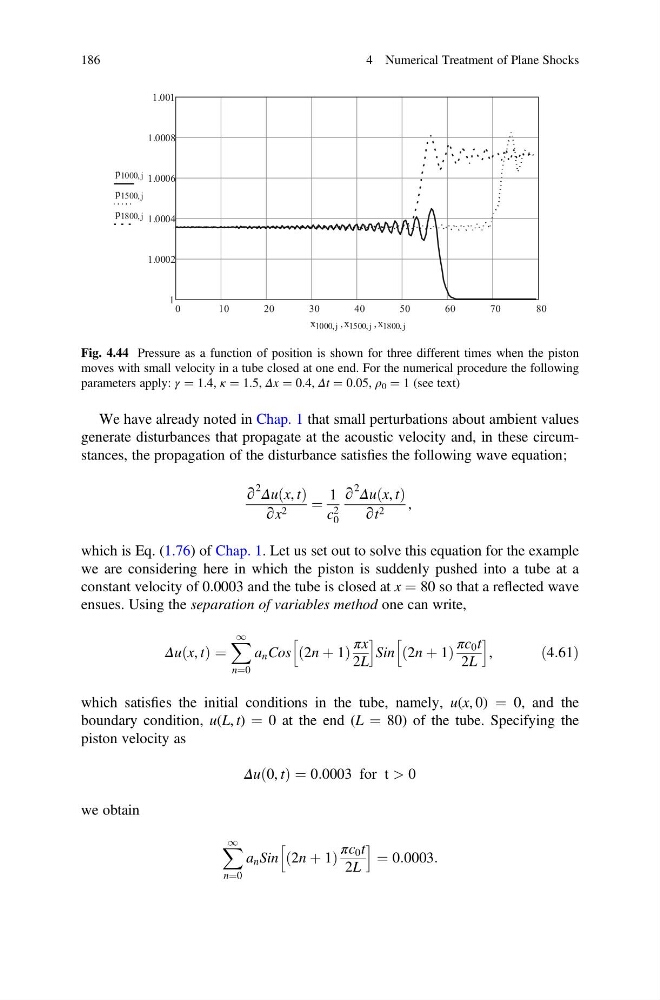
Fig. 4.44 Pressure as a function of position is shown for three different times when the piston
moves with small velocity in a tube closed at one end. For the numerical procedure the following
parameters apply: γ ¼ 1.4, κ ¼ 1.5, Δx ¼ 0.4, Δt ¼ 0.05, ρ 0 ¼ 1 (see text)
186
4 Numerical Treatment of Plane Shocks
generate disturbances that propagate at the acoustic velocity and, in these circumstances, the propagation of the disturbance satisfies the following wave equation;
∂
2 Δu x, t
ð Þ
∂x 2
¼
1
c 2
0
∂
2 Δu x, t
ð Þ
∂t 2
,
which is Eq. (1.76) of Chap. 1. Let us set out to solve this equation for the example
we are considering here in which the piston is suddenly pushed into a tube at a
constant velocity of 0.0003 and the tube is closed at x ¼ 80 so that a reflected wave
ensues. Using the separation of variables method one can write,
Δu x, t
ð Þ ¼
X 1
n¼0
a n Cos 2n þ 1
ð
Þ
πx
2L
h
i
Sin 2n þ 1
ð
Þ
πc 0 t
2L
h
i
,
ð4:61Þ
which satisfies the initial conditions in the tube, namely, u(x, 0) ¼ 0, and the
boundary condition, u(L, t) ¼ 0 at the end (L ¼ 80) of the tube. Specifying the
piston velocity as
Δu 0, t
ð Þ ¼ 0:0003 for t > 0
we obtain
X 1
n¼0
a n Sin 2n þ 1
ð
Þ
πc 0 t
2L
h
i
¼ 0:0003:
Fig. 4.44 Pressure as a function of position is shown for three different times when the piston
moves with small velocity in a tube closed at one end. For the numerical procedure the following
parameters apply: γ ¼ 1.4, κ ¼ 1.5, Δx ¼ 0.4, Δt ¼ 0.05, ρ 0 ¼ 1 (see text)
186
4 Numerical Treatment of Plane Shocks