

to a fundamental propagation speed of c 0 but, nonetheless, by examining the results
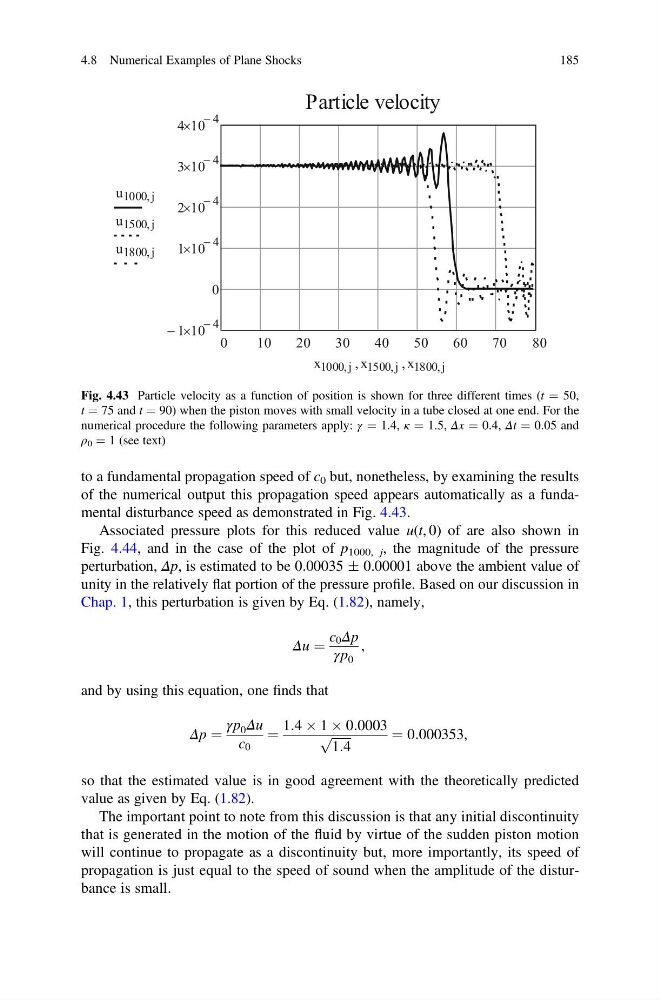
of the numerical output this propagation speed appears automatically as a fundamental disturbance speed as demonstrated in Fig. 4.43.
Associated pressure plots for this reduced value u(t, 0) of are also shown in
Fig. 4.44, and in the case of the plot of p 1000, j , the magnitude of the pressure
perturbation, Δp, is estimated to be 0.00035 Æ 0.00001 above the ambient value of
unity in the relatively flat portion of the pressure profile. Based on our discussion in
Chap. 1, this perturbation is given by Eq. (1.82), namely,
Δu ¼
c 0 Δp
γp 0
,
and by using this equation, one finds that
Δp ¼
γp 0 Δu
c 0
¼
1:4 Â 1 Â 0:0003
ffiffiffiffiffiffi ffi
1:4
p
¼ 0:000353,
so that the estimated value is in good agreement with the theoretically predicted
value as given by Eq. (1.82).
The important point to note from this discussion is that any initial discontinuity
that is generated in the motion of the fluid by virtue of the sudden piston motion
will continue to propagate as a discontinuity but, more importantly, its speed of
propagation is just equal to the speed of sound when the amplitude of the disturbance is small.
Fig. 4.43 Particle velocity as a function of position is shown for three different times (t ¼ 50,
t ¼ 75 and t ¼ 90) when the piston moves with small velocity in a tube closed at one end. For the
numerical procedure the following parameters apply: γ ¼ 1.4, κ ¼ 1.5, Δx ¼ 0.4, Δt ¼ 0.05 and
ρ 0 ¼ 1 (see text)
4.8 Numerical Examples of Plane Shocks
185
of the numerical output this propagation speed appears automatically as a fundamental disturbance speed as demonstrated in Fig. 4.43.
Associated pressure plots for this reduced value u(t, 0) of are also shown in
Fig. 4.44, and in the case of the plot of p 1000, j , the magnitude of the pressure
perturbation, Δp, is estimated to be 0.00035 Æ 0.00001 above the ambient value of
unity in the relatively flat portion of the pressure profile. Based on our discussion in
Chap. 1, this perturbation is given by Eq. (1.82), namely,
Δu ¼
c 0 Δp
γp 0
,
and by using this equation, one finds that
Δp ¼
γp 0 Δu
c 0
¼
1:4 Â 1 Â 0:0003
ffiffiffiffiffiffi ffi
1:4
p
¼ 0:000353,
so that the estimated value is in good agreement with the theoretically predicted
value as given by Eq. (1.82).
The important point to note from this discussion is that any initial discontinuity
that is generated in the motion of the fluid by virtue of the sudden piston motion
will continue to propagate as a discontinuity but, more importantly, its speed of
propagation is just equal to the speed of sound when the amplitude of the disturbance is small.
Fig. 4.43 Particle velocity as a function of position is shown for three different times (t ¼ 50,
t ¼ 75 and t ¼ 90) when the piston moves with small velocity in a tube closed at one end. For the
numerical procedure the following parameters apply: γ ¼ 1.4, κ ¼ 1.5, Δx ¼ 0.4, Δt ¼ 0.05 and
ρ 0 ¼ 1 (see text)
4.8 Numerical Examples of Plane Shocks
185