

4.8.6 Piston Withdrawal Generating an Expansion Wave
In Sect. 2.7.2 we discussed the centered expansion wave that was produced by the
sudden withdrawal of a piston in a tube at a constant velocity Àu 0 . Here we will
consider this particular problem numerically and investigate the changes that take
place to particle velocity, pressure and density within the tube and compare the
results with those predicted using the method of characteristics.
Initially, the piston is located at x ¼ 0 and it is withdrawn at constant speed
u 0 ¼ À 0.3 (Arb. units). The following increments; Δx ¼ 0.1 and Δt ¼ 0.01, were
assumed for the numerical procedure and the other parameters chosen are; γ ¼ 1.4,
κ ¼ 1.2 and ρ 0 ¼ 1. Initially, the air is at rest in the tube and the pressure and density
are assumed to have unity values, which implies that the ambient sonic velocity is
given by c 0 ¼
ffiffi ffi
γ
p .
In this example we consider a specific time following the piston’s withdrawal and
this time is taken to be t ¼ 5 (Arb. units), consequently, the position of the piston at
this time is À0.3 Â 5 ¼ À 1.5 (Arb. units).
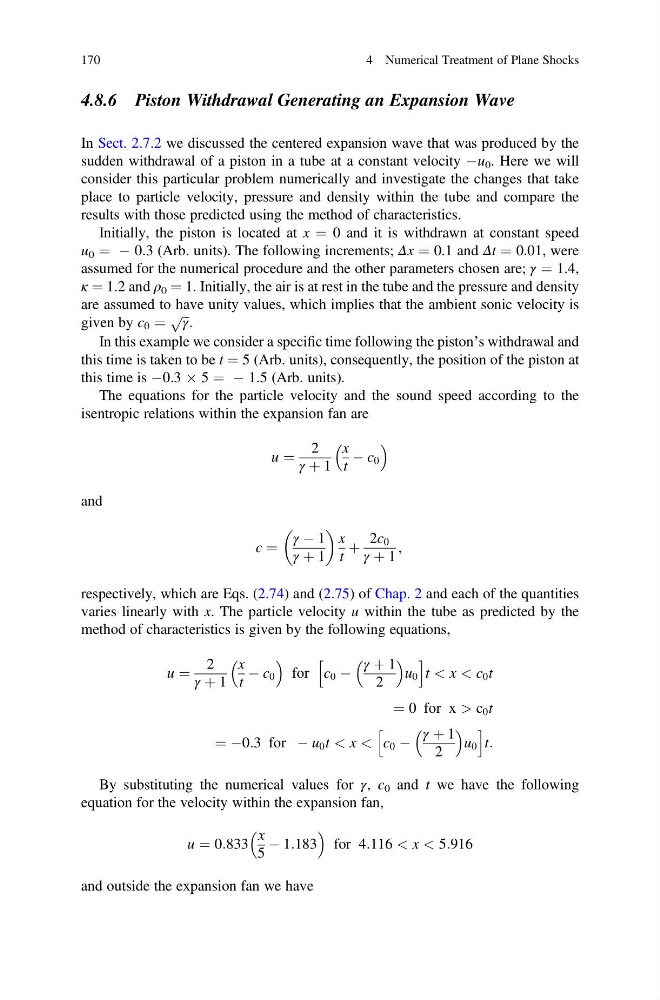
The equations for the particle velocity and the sound speed according to the
isentropic relations within the expansion fan are
u ¼
2
γ þ 1
x
t
À c 0
and
c ¼
γ À 1
γ þ 1
x
t
þ
2c 0
γ þ 1
,
respectively, which are Eqs. (2.74) and (2.75) of Chap. 2 and each of the quantities
varies linearly with x. The particle velocity u within the tube as predicted by the
method of characteristics is given by the following equations,
u ¼
2
γ þ 1
x
t
À c 0
for c 0 À
γ þ 1
2
u 0
h
i
t < x < c 0 t
¼ 0 for x > c 0 t
¼ À0:3 for À u 0 t < x < c 0 À
γ þ 1
2
u 0
h
i
t:
By substituting the numerical values for γ, c 0 and t we have the following
equation for the velocity within the expansion fan,
u ¼ 0:833
x
5
À 1:183
for 4:116 < x < 5:916
and outside the expansion fan we have
170
4 Numerical Treatment of Plane Shocks
In Sect. 2.7.2 we discussed the centered expansion wave that was produced by the
sudden withdrawal of a piston in a tube at a constant velocity Àu 0 . Here we will
consider this particular problem numerically and investigate the changes that take
place to particle velocity, pressure and density within the tube and compare the
results with those predicted using the method of characteristics.
Initially, the piston is located at x ¼ 0 and it is withdrawn at constant speed
u 0 ¼ À 0.3 (Arb. units). The following increments; Δx ¼ 0.1 and Δt ¼ 0.01, were
assumed for the numerical procedure and the other parameters chosen are; γ ¼ 1.4,
κ ¼ 1.2 and ρ 0 ¼ 1. Initially, the air is at rest in the tube and the pressure and density
are assumed to have unity values, which implies that the ambient sonic velocity is
given by c 0 ¼
ffiffi ffi
γ
p .
In this example we consider a specific time following the piston’s withdrawal and
this time is taken to be t ¼ 5 (Arb. units), consequently, the position of the piston at
this time is À0.3 Â 5 ¼ À 1.5 (Arb. units).
The equations for the particle velocity and the sound speed according to the
isentropic relations within the expansion fan are
u ¼
2
γ þ 1
x
t
À c 0
and
c ¼
γ À 1
γ þ 1
x
t
þ
2c 0
γ þ 1
,
respectively, which are Eqs. (2.74) and (2.75) of Chap. 2 and each of the quantities
varies linearly with x. The particle velocity u within the tube as predicted by the
method of characteristics is given by the following equations,
u ¼
2
γ þ 1
x
t
À c 0
for c 0 À
γ þ 1
2
u 0
h
i
t < x < c 0 t
¼ 0 for x > c 0 t
¼ À0:3 for À u 0 t < x < c 0 À
γ þ 1
2
u 0
h
i
t:
By substituting the numerical values for γ, c 0 and t we have the following
equation for the velocity within the expansion fan,
u ¼ 0:833
x
5
À 1:183
for 4:116 < x < 5:916
and outside the expansion fan we have
170
4 Numerical Treatment of Plane Shocks