

process for j ¼ 2, etc. When the process is completed, corresponding to j ¼ J, one
knows the values of all the quantities at t n + Δt and then it is just a matter of
repeating the process to find the quantities at t n + 2Δt, etc. Other boundary
conditions would be required at a closed end of a tube (corresponding to j ¼ J)
and, in this case, u n + 1, J ¼ 0.
4.6 Stability of the Difference Equations
The system of difference equations above is explicit; that is, each of the quantities on
the left-hand side is determined from quantities on the right-hand side which are
known at a short time Δt earlier. However, the explicit method comes with a penalty
as we are not at liberty to choose Δx and Δt separately; if Δx is chosen then Δt must be
less than some prescribed value, otherwise the numerical solution quickly develops
very large oscillations with increasing n, and eventually these oscillations can grow
exponentially to swamp the entire calculation. This growth is due to numerical
instability of the difference equations; accordingly, the stability of the numerical
procedure is of paramount importance in order to obtain a workable solution. This
behaviour has been discussed by Anderson [4] and others [1, 2, 6, 7]. The actual
stability requirement is dependent on the form of the difference equations employed
in the analysis and it is expressed in the form of an inequality containing Δx and Δt.
Depending on the specific forms of the equations used this stability analysis leads, in
general, to two separate stability conditions; one called the von Neumann stability
condition and the other called the Courant-Friedrichs-Lewy (CFL) condition. A
rigorous account of stability analysis is outside the scope of the present text and,
accordingly, one is directed to the text by Anderson [4] for an appreciation of the
stability requirements that pertain to several specific types of equations.
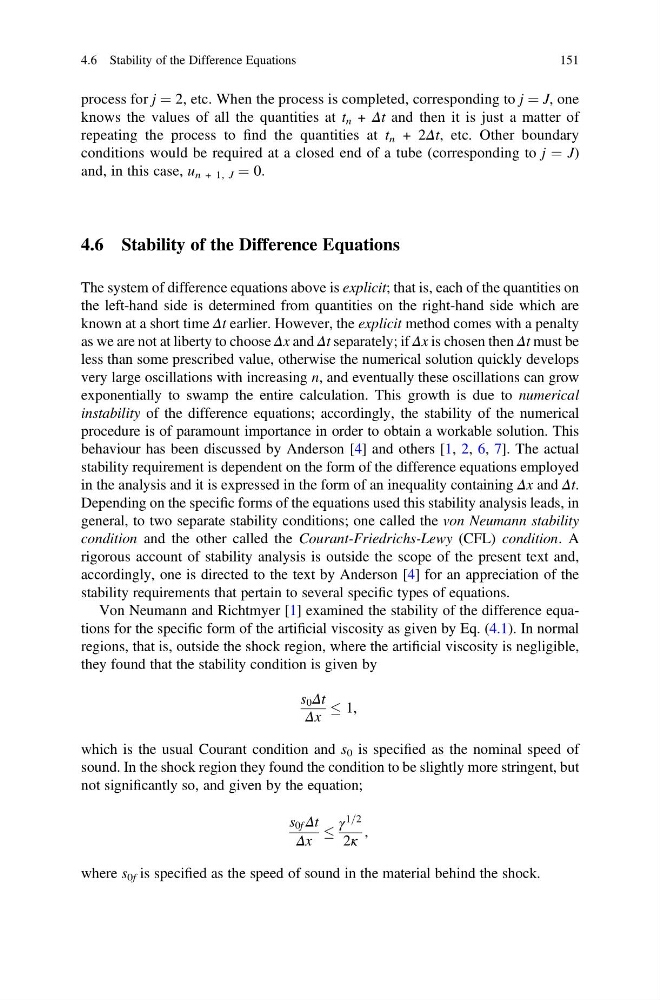
Von Neumann and Richtmyer [1] examined the stability of the difference equations for the specific form of the artificial viscosity as given by Eq. (4.1). In normal
regions, that is, outside the shock region, where the artificial viscosity is negligible,
they found that the stability condition is given by
s 0 Δt
Δx
1,
which is the usual Courant condition and s 0 is specified as the nominal speed of
sound. In the shock region they found the condition to be slightly more stringent, but
not significantly so, and given by the equation;
s 0f Δt
Δx
γ
1=2
2κ
,
where s 0f is specified as the speed of sound in the material behind the shock.
4.6 Stability of the Difference Equations
151
knows the values of all the quantities at t n + Δt and then it is just a matter of
repeating the process to find the quantities at t n + 2Δt, etc. Other boundary
conditions would be required at a closed end of a tube (corresponding to j ¼ J)
and, in this case, u n + 1, J ¼ 0.
4.6 Stability of the Difference Equations
The system of difference equations above is explicit; that is, each of the quantities on
the left-hand side is determined from quantities on the right-hand side which are
known at a short time Δt earlier. However, the explicit method comes with a penalty
as we are not at liberty to choose Δx and Δt separately; if Δx is chosen then Δt must be
less than some prescribed value, otherwise the numerical solution quickly develops
very large oscillations with increasing n, and eventually these oscillations can grow
exponentially to swamp the entire calculation. This growth is due to numerical
instability of the difference equations; accordingly, the stability of the numerical
procedure is of paramount importance in order to obtain a workable solution. This
behaviour has been discussed by Anderson [4] and others [1, 2, 6, 7]. The actual
stability requirement is dependent on the form of the difference equations employed
in the analysis and it is expressed in the form of an inequality containing Δx and Δt.
Depending on the specific forms of the equations used this stability analysis leads, in
general, to two separate stability conditions; one called the von Neumann stability
condition and the other called the Courant-Friedrichs-Lewy (CFL) condition. A
rigorous account of stability analysis is outside the scope of the present text and,
accordingly, one is directed to the text by Anderson [4] for an appreciation of the
stability requirements that pertain to several specific types of equations.
Von Neumann and Richtmyer [1] examined the stability of the difference equations for the specific form of the artificial viscosity as given by Eq. (4.1). In normal
regions, that is, outside the shock region, where the artificial viscosity is negligible,
they found that the stability condition is given by
s 0 Δt
Δx
1,
which is the usual Courant condition and s 0 is specified as the nominal speed of
sound. In the shock region they found the condition to be slightly more stringent, but
not significantly so, and given by the equation;
s 0f Δt
Δx
γ
1=2
2κ
,
where s 0f is specified as the speed of sound in the material behind the shock.
4.6 Stability of the Difference Equations
151