

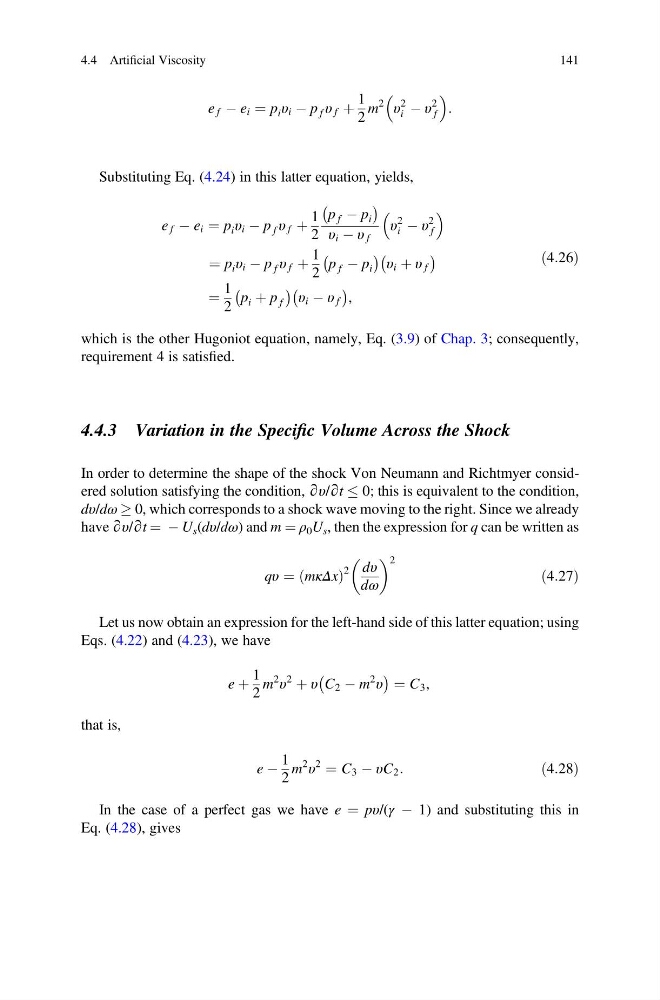
e f À e i ¼ p i υ i À p f υ f þ
1
2
m
2
υ
2
i À υ
2
f
:
Substituting Eq. (4.24) in this latter equation, yields,
e f À e i ¼ p i υ i À p f υ f þ
1
2
p f À p i
À
Á
υ i À υ f
υ
2
i À υ
2
f
¼ p i υ i À p f υ f þ
1
2
p f À p i
À
Á υ i þ υ f
À
Á
¼
1
2
p i þ p f
À
Á υ i À υ f
À
Á
,
ð4:26Þ
which is the other Hugoniot equation, namely, Eq. (3.9) of Chap. 3; consequently,
requirement 4 is satisfied.
4.4.3 Variation in the Specific Volume Across the Shock
In order to determine the shape of the shock Von Neumann and Richtmyer considered solution satisfying the condition, ∂υ/∂t 0; this is equivalent to the condition,
dυ/dω ! 0, which corresponds to a shock wave moving to the right. Since we already
have ∂υ/∂t ¼ À U s (dυ/dω) and m ¼ ρ 0 U s , then the expression for q can be written as
qυ ¼ mκΔx
ð
Þ
2 dυ
dω
2
ð4:27Þ
Let us now obtain an expression for the left-hand side of this latter equation; using
Eqs. (4.22) and (4.23), we have
e þ
1
2
m
2
υ
2
þ υ C 2 À m
2
υ
À
Á ¼ C 3 ,
that is,
e À
1
2
m
2
υ
2
¼ C 3 À υC 2 :
ð4:28Þ
In the case of a perfect gas we have e ¼ pυ/(γ À 1) and substituting this in
Eq. (4.28), gives
4.4 Artificial Viscosity
141
1
2
m
2
υ
2
i À υ
2
f
:
Substituting Eq. (4.24) in this latter equation, yields,
e f À e i ¼ p i υ i À p f υ f þ
1
2
p f À p i
À
Á
υ i À υ f
υ
2
i À υ
2
f
¼ p i υ i À p f υ f þ
1
2
p f À p i
À
Á υ i þ υ f
À
Á
¼
1
2
p i þ p f
À
Á υ i À υ f
À
Á
,
ð4:26Þ
which is the other Hugoniot equation, namely, Eq. (3.9) of Chap. 3; consequently,
requirement 4 is satisfied.
4.4.3 Variation in the Specific Volume Across the Shock
In order to determine the shape of the shock Von Neumann and Richtmyer considered solution satisfying the condition, ∂υ/∂t 0; this is equivalent to the condition,
dυ/dω ! 0, which corresponds to a shock wave moving to the right. Since we already
have ∂υ/∂t ¼ À U s (dυ/dω) and m ¼ ρ 0 U s , then the expression for q can be written as
qυ ¼ mκΔx
ð
Þ
2 dυ
dω
2
ð4:27Þ
Let us now obtain an expression for the left-hand side of this latter equation; using
Eqs. (4.22) and (4.23), we have
e þ
1
2
m
2
υ
2
þ υ C 2 À m
2
υ
À
Á ¼ C 3 ,
that is,
e À
1
2
m
2
υ
2
¼ C 3 À υC 2 :
ð4:28Þ
In the case of a perfect gas we have e ¼ pυ/(γ À 1) and substituting this in
Eq. (4.28), gives
4.4 Artificial Viscosity
141