

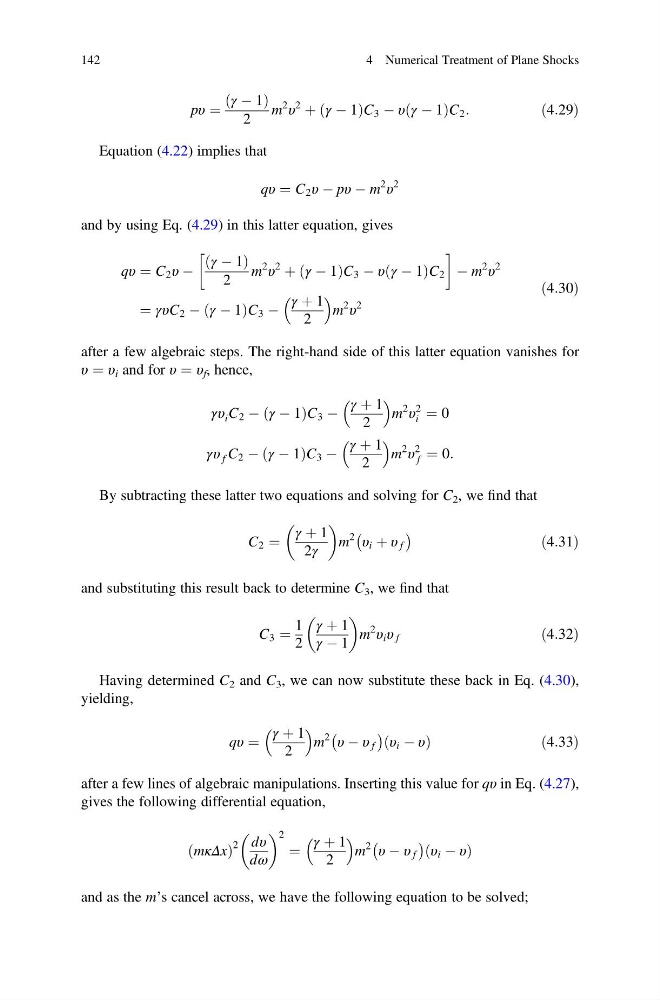
pυ ¼
γ À 1
ð
Þ
2
m
2
υ
2
þ γ À 1
ð
ÞC 3 À υ γ À 1
ð
ÞC 2 :
ð4:29Þ
Equation (4.22) implies that
qυ ¼ C 2 υ À pυ À m
2
υ
2
and by using Eq. (4.29) in this latter equation, gives
qυ ¼ C 2 υ À
γ À 1
ð
Þ
2
m
2
υ
2
þ γ À 1
ð
ÞC 3 À υ γ À 1
ð
ÞC 2
!
À m
2
υ
2
¼ γυC 2 À γ À 1
ð
ÞC 3 À
γ þ 1
2
m
2
υ
2
ð4:30Þ
after a few algebraic steps. The right-hand side of this latter equation vanishes for
υ ¼ υ i and for υ ¼ υ f , hence,
γυ i C 2 À γ À 1
ð
ÞC 3 À
γ þ 1
2
m
2
υ
2
i ¼ 0
γυ f C 2 À γ À 1
ð
ÞC 3 À
γ þ 1
2
m
2
υ
2
f ¼ 0:
By subtracting these latter two equations and solving for C 2 , we find that
C 2 ¼
γ þ 1
2γ
m
2
υ i þ υ f
À
Á
ð4:31Þ
and substituting this result back to determine C 3 , we find that
C 3 ¼
1
2
γ þ 1
γ À 1
m
2
υ i υ f
ð4:32Þ
Having determined C 2 and C 3 , we can now substitute these back in Eq. (4.30),
yielding,
qυ ¼
γ þ 1
2
m
2
υ À υ f
À
Á υ i À υ
ð
Þ
ð4:33Þ
after a few lines of algebraic manipulations. Inserting this value for qυ in Eq. (4.27),
gives the following differential equation,
mκΔx
ð
Þ
2 dυ
dω
2
¼
γ þ 1
2
m
2
υ À υ f
À
Á υ i À υ
ð
Þ
and as the m’s cancel across, we have the following equation to be solved;
142
4 Numerical Treatment of Plane Shocks
γ À 1
ð
Þ
2
m
2
υ
2
þ γ À 1
ð
ÞC 3 À υ γ À 1
ð
ÞC 2 :
ð4:29Þ
Equation (4.22) implies that
qυ ¼ C 2 υ À pυ À m
2
υ
2
and by using Eq. (4.29) in this latter equation, gives
qυ ¼ C 2 υ À
γ À 1
ð
Þ
2
m
2
υ
2
þ γ À 1
ð
ÞC 3 À υ γ À 1
ð
ÞC 2
!
À m
2
υ
2
¼ γυC 2 À γ À 1
ð
ÞC 3 À
γ þ 1
2
m
2
υ
2
ð4:30Þ
after a few algebraic steps. The right-hand side of this latter equation vanishes for
υ ¼ υ i and for υ ¼ υ f , hence,
γυ i C 2 À γ À 1
ð
ÞC 3 À
γ þ 1
2
m
2
υ
2
i ¼ 0
γυ f C 2 À γ À 1
ð
ÞC 3 À
γ þ 1
2
m
2
υ
2
f ¼ 0:
By subtracting these latter two equations and solving for C 2 , we find that
C 2 ¼
γ þ 1
2γ
m
2
υ i þ υ f
À
Á
ð4:31Þ
and substituting this result back to determine C 3 , we find that
C 3 ¼
1
2
γ þ 1
γ À 1
m
2
υ i υ f
ð4:32Þ
Having determined C 2 and C 3 , we can now substitute these back in Eq. (4.30),
yielding,
qυ ¼
γ þ 1
2
m
2
υ À υ f
À
Á υ i À υ
ð
Þ
ð4:33Þ
after a few lines of algebraic manipulations. Inserting this value for qυ in Eq. (4.27),
gives the following differential equation,
mκΔx
ð
Þ
2 dυ
dω
2
¼
γ þ 1
2
m
2
υ À υ f
À
Á υ i À υ
ð
Þ
and as the m’s cancel across, we have the following equation to be solved;
142
4 Numerical Treatment of Plane Shocks