

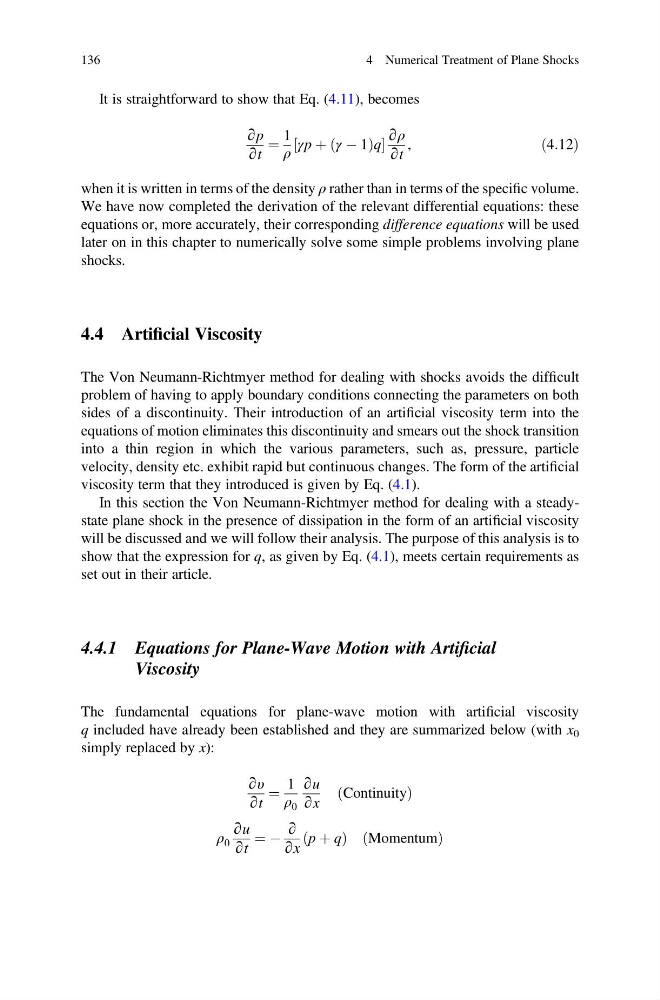
It is straightforward to show that Eq. (4.11), becomes
∂p
∂t
¼
1
ρ
γp þ γ À 1
ð
Þq
½
∂ρ
∂t
,
ð4:12Þ
when it is written in terms of the density ρ rather than in terms of the specific volume.
We have now completed the derivation of the relevant differential equations: these
equations or, more accurately, their corresponding difference equations will be used
later on in this chapter to numerically solve some simple problems involving plane
shocks.
4.4 Artificial Viscosity
The Von Neumann-Richtmyer method for dealing with shocks avoids the difficult
problem of having to apply boundary conditions connecting the parameters on both
sides of a discontinuity. Their introduction of an artificial viscosity term into the
equations of motion eliminates this discontinuity and smears out the shock transition
into a thin region in which the various parameters, such as, pressure, particle
velocity, density etc. exhibit rapid but continuous changes. The form of the artificial
viscosity term that they introduced is given by Eq. (4.1).
In this section the Von Neumann-Richtmyer method for dealing with a steadystate plane shock in the presence of dissipation in the form of an artificial viscosity
will be discussed and we will follow their analysis. The purpose of this analysis is to
show that the expression for q, as given by Eq. (4.1), meets certain requirements as
set out in their article.
4.4.1 Equations for Plane-Wave Motion with Artificial
Viscosity
The fundamental equations for plane-wave motion with artificial viscosity
q included have already been established and they are summarized below (with x 0
simply replaced by x):
∂υ
∂t
¼
1
ρ 0
∂u
∂x
Continuity
ð
Þ
ρ 0
∂u
∂t
¼ À
∂
∂x
p þ q
ð
Þ Momentum
ð
Þ
136
4 Numerical Treatment of Plane Shocks
∂p
∂t
¼
1
ρ
γp þ γ À 1
ð
Þq
½
∂ρ
∂t
,
ð4:12Þ
when it is written in terms of the density ρ rather than in terms of the specific volume.
We have now completed the derivation of the relevant differential equations: these
equations or, more accurately, their corresponding difference equations will be used
later on in this chapter to numerically solve some simple problems involving plane
shocks.
4.4 Artificial Viscosity
The Von Neumann-Richtmyer method for dealing with shocks avoids the difficult
problem of having to apply boundary conditions connecting the parameters on both
sides of a discontinuity. Their introduction of an artificial viscosity term into the
equations of motion eliminates this discontinuity and smears out the shock transition
into a thin region in which the various parameters, such as, pressure, particle
velocity, density etc. exhibit rapid but continuous changes. The form of the artificial
viscosity term that they introduced is given by Eq. (4.1).
In this section the Von Neumann-Richtmyer method for dealing with a steadystate plane shock in the presence of dissipation in the form of an artificial viscosity
will be discussed and we will follow their analysis. The purpose of this analysis is to
show that the expression for q, as given by Eq. (4.1), meets certain requirements as
set out in their article.
4.4.1 Equations for Plane-Wave Motion with Artificial
Viscosity
The fundamental equations for plane-wave motion with artificial viscosity
q included have already been established and they are summarized below (with x 0
simply replaced by x):
∂υ
∂t
¼
1
ρ 0
∂u
∂x
Continuity
ð
Þ
ρ 0
∂u
∂t
¼ À
∂
∂x
p þ q
ð
Þ Momentum
ð
Þ
136
4 Numerical Treatment of Plane Shocks