

∂e
∂t
¼ À p þ q
ð
Þ
∂υ
∂t
Energy
ð
Þ
e ¼
pυ
γ À 1
Caloric equation of state
ð
Þ
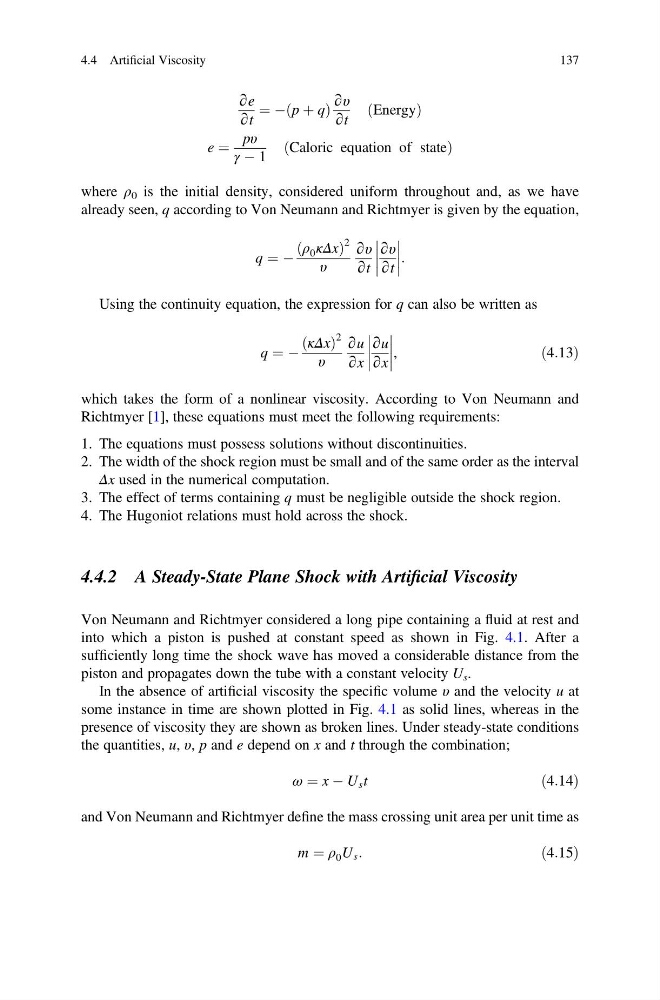
where ρ 0 is the initial density, considered uniform throughout and, as we have
already seen, q according to Von Neumann and Richtmyer is given by the equation,
q ¼ À
ρ 0 κΔx
ð
Þ
2
υ
∂υ
∂t
∂υ
∂t
:
Using the continuity equation, the expression for q can also be written as
q ¼ À
κΔx
ð
Þ
2
υ
∂u
∂x
∂u
∂x
,
ð4:13Þ
which takes the form of a nonlinear viscosity. According to Von Neumann and
Richtmyer [1], these equations must meet the following requirements:
1. The equations must possess solutions without discontinuities.
2. The width of the shock region must be small and of the same order as the interval
Δx used in the numerical computation.
3. The effect of terms containing q must be negligible outside the shock region.
4. The Hugoniot relations must hold across the shock.
4.4.2 A Steady-State Plane Shock with Artificial Viscosity
Von Neumann and Richtmyer considered a long pipe containing a fluid at rest and
into which a piston is pushed at constant speed as shown in Fig. 4.1. After a
sufficiently long time the shock wave has moved a considerable distance from the
piston and propagates down the tube with a constant velocity U s .
In the absence of artificial viscosity the specific volume υ and the velocity u at
some instance in time are shown plotted in Fig. 4.1 as solid lines, whereas in the
presence of viscosity they are shown as broken lines. Under steady-state conditions
the quantities, u, υ, p and e depend on x and t through the combination;
ω ¼ x À U s t
ð4:14Þ
and Von Neumann and Richtmyer define the mass crossing unit area per unit time as
m ¼ ρ 0 U s :
ð4:15Þ
4.4 Artificial Viscosity
137
∂t
¼ À p þ q
ð
Þ
∂υ
∂t
Energy
ð
Þ
e ¼
pυ
γ À 1
Caloric equation of state
ð
Þ
where ρ 0 is the initial density, considered uniform throughout and, as we have
already seen, q according to Von Neumann and Richtmyer is given by the equation,
q ¼ À
ρ 0 κΔx
ð
Þ
2
υ
∂υ
∂t
∂υ
∂t
:
Using the continuity equation, the expression for q can also be written as
q ¼ À
κΔx
ð
Þ
2
υ
∂u
∂x
∂u
∂x
,
ð4:13Þ
which takes the form of a nonlinear viscosity. According to Von Neumann and
Richtmyer [1], these equations must meet the following requirements:
1. The equations must possess solutions without discontinuities.
2. The width of the shock region must be small and of the same order as the interval
Δx used in the numerical computation.
3. The effect of terms containing q must be negligible outside the shock region.
4. The Hugoniot relations must hold across the shock.
4.4.2 A Steady-State Plane Shock with Artificial Viscosity
Von Neumann and Richtmyer considered a long pipe containing a fluid at rest and
into which a piston is pushed at constant speed as shown in Fig. 4.1. After a
sufficiently long time the shock wave has moved a considerable distance from the
piston and propagates down the tube with a constant velocity U s .
In the absence of artificial viscosity the specific volume υ and the velocity u at
some instance in time are shown plotted in Fig. 4.1 as solid lines, whereas in the
presence of viscosity they are shown as broken lines. Under steady-state conditions
the quantities, u, υ, p and e depend on x and t through the combination;
ω ¼ x À U s t
ð4:14Þ
and Von Neumann and Richtmyer define the mass crossing unit area per unit time as
m ¼ ρ 0 U s :
ð4:15Þ
4.4 Artificial Viscosity
137