

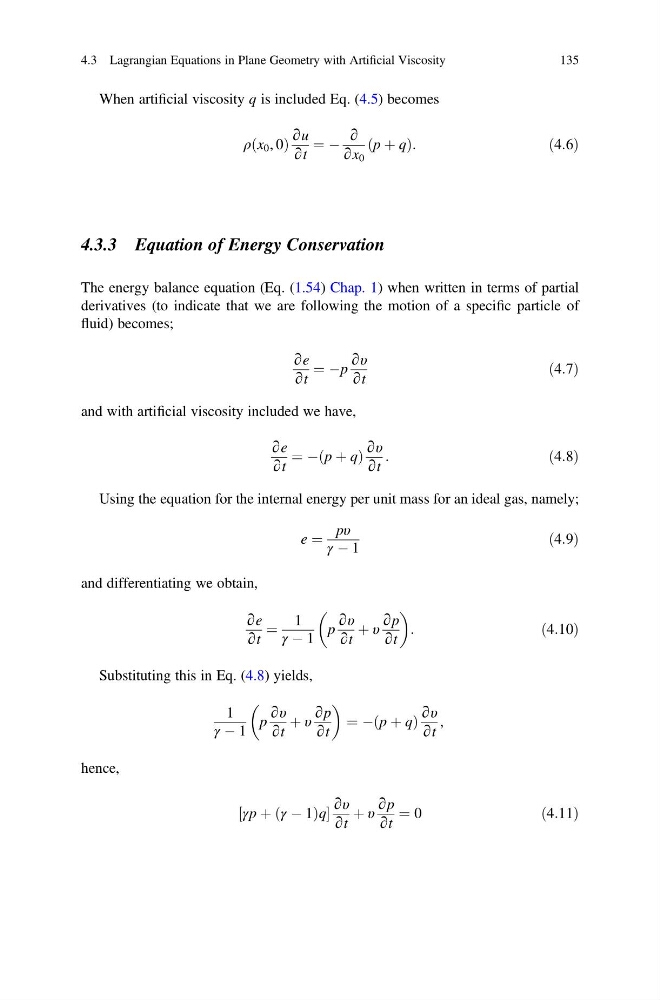
When artificial viscosity q is included Eq. (4.5) becomes
ρ x 0 , 0
ð
Þ
∂u
∂t
¼ À
∂
∂x 0
p þ q
ð
Þ:
ð4:6Þ
4.3.3 Equation of Energy Conservation
The energy balance equation (Eq. (1.54) Chap. 1) when written in terms of partial
derivatives (to indicate that we are following the motion of a specific particle of
fluid) becomes;
∂e
∂t
¼ Àp
∂υ
∂t
ð4:7Þ
and with artificial viscosity included we have,
∂e
∂t
¼ À p þ q
ð
Þ
∂υ
∂t
:
ð4:8Þ
Using the equation for the internal energy per unit mass for an ideal gas, namely;
e ¼
pυ
γ À 1
ð4:9Þ
and differentiating we obtain,
∂e
∂t
¼
1
γ À 1
p
∂υ
∂t
þ υ
∂p
∂t
:
ð4:10Þ
Substituting this in Eq. (4.8) yields,
1
γ À 1
p
∂υ
∂t
þ υ
∂p
∂t
¼ À p þ q
ð
Þ
∂υ
∂t
,
hence,
γp þ γ À 1
ð
Þq
½
∂υ
∂t
þ υ
∂p
∂t
¼ 0
ð4:11Þ
4.3 Lagrangian Equations in Plane Geometry with Artificial Viscosity
135
ρ x 0 , 0
ð
Þ
∂u
∂t
¼ À
∂
∂x 0
p þ q
ð
Þ:
ð4:6Þ
4.3.3 Equation of Energy Conservation
The energy balance equation (Eq. (1.54) Chap. 1) when written in terms of partial
derivatives (to indicate that we are following the motion of a specific particle of
fluid) becomes;
∂e
∂t
¼ Àp
∂υ
∂t
ð4:7Þ
and with artificial viscosity included we have,
∂e
∂t
¼ À p þ q
ð
Þ
∂υ
∂t
:
ð4:8Þ
Using the equation for the internal energy per unit mass for an ideal gas, namely;
e ¼
pυ
γ À 1
ð4:9Þ
and differentiating we obtain,
∂e
∂t
¼
1
γ À 1
p
∂υ
∂t
þ υ
∂p
∂t
:
ð4:10Þ
Substituting this in Eq. (4.8) yields,
1
γ À 1
p
∂υ
∂t
þ υ
∂p
∂t
¼ À p þ q
ð
Þ
∂υ
∂t
,
hence,
γp þ γ À 1
ð
Þq
½
∂υ
∂t
þ υ
∂p
∂t
¼ 0
ð4:11Þ
4.3 Lagrangian Equations in Plane Geometry with Artificial Viscosity
135