

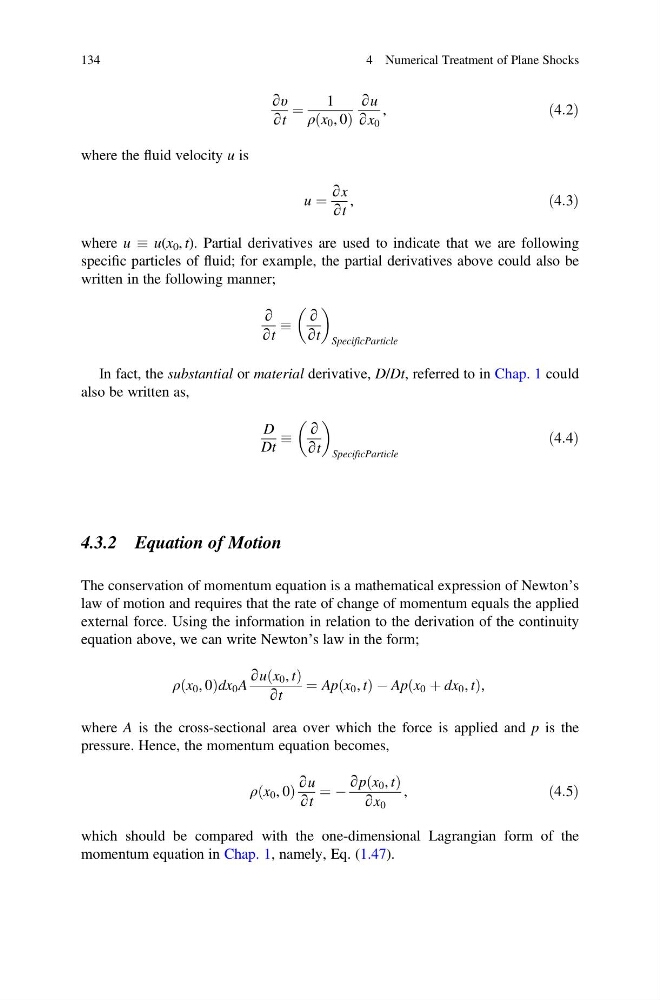
∂υ
∂t
¼
1
ρ x 0 , 0
ð
Þ
∂u
∂x 0
,
ð4:2Þ
where the fluid velocity u is
u ¼
∂x
∂t
,
ð4:3Þ
where u u(x 0 , t). Partial derivatives are used to indicate that we are following
specific particles of fluid; for example, the partial derivatives above could also be
written in the following manner;
∂
∂t
∂
∂t
SpecificParticle
In fact, the substantial or material derivative, D/Dt, referred to in Chap. 1 could
also be written as,
D
Dt
∂
∂t
SpecificParticle
ð4:4Þ
4.3.2 Equation of Motion
The conservation of momentum equation is a mathematical expression of Newton’s
law of motion and requires that the rate of change of momentum equals the applied
external force. Using the information in relation to the derivation of the continuity
equation above, we can write Newton’s law in the form;
ρ x 0 , 0
ð
Þdx 0 A
∂u x 0 , t
ð
Þ
∂t
¼ Ap x 0 , t
ð
ÞÀAp x 0 þ dx 0 , t
ð
Þ ,
where A is the cross-sectional area over which the force is applied and p is the
pressure. Hence, the momentum equation becomes,
ρ x 0 , 0
ð
Þ
∂u
∂t
¼ À
∂p x 0 , t
ð
Þ
∂x 0
,
ð4:5Þ
which should be compared with the one-dimensional Lagrangian form of the
momentum equation in Chap. 1, namely, Eq. (1.47).
134
4 Numerical Treatment of Plane Shocks
∂t
¼
1
ρ x 0 , 0
ð
Þ
∂u
∂x 0
,
ð4:2Þ
where the fluid velocity u is
u ¼
∂x
∂t
,
ð4:3Þ
where u u(x 0 , t). Partial derivatives are used to indicate that we are following
specific particles of fluid; for example, the partial derivatives above could also be
written in the following manner;
∂
∂t
∂
∂t
SpecificParticle
In fact, the substantial or material derivative, D/Dt, referred to in Chap. 1 could
also be written as,
D
Dt
∂
∂t
SpecificParticle
ð4:4Þ
4.3.2 Equation of Motion
The conservation of momentum equation is a mathematical expression of Newton’s
law of motion and requires that the rate of change of momentum equals the applied
external force. Using the information in relation to the derivation of the continuity
equation above, we can write Newton’s law in the form;
ρ x 0 , 0
ð
Þdx 0 A
∂u x 0 , t
ð
Þ
∂t
¼ Ap x 0 , t
ð
ÞÀAp x 0 þ dx 0 , t
ð
Þ ,
where A is the cross-sectional area over which the force is applied and p is the
pressure. Hence, the momentum equation becomes,
ρ x 0 , 0
ð
Þ
∂u
∂t
¼ À
∂p x 0 , t
ð
Þ
∂x 0
,
ð4:5Þ
which should be compared with the one-dimensional Lagrangian form of the
momentum equation in Chap. 1, namely, Eq. (1.47).
134
4 Numerical Treatment of Plane Shocks