

M r
M
2
r À 1
¼
M i
M
2
i À 1
ffiffiffiffiffiffiffiffiffiffiffiffiffiffiffiffiffiffiffiffiffiffiffiffiffiffiffiffiffiffiffiffiffiffiffiffiffiffiffiffiffiffiffiffiffiffiffiffiffiffiffiffiffiffiffiffiffiffiffiffiffi ffi
1 þ
2 γ À 1
ð
Þ M
2
i À 1
À
Á γ þ
1
M
2
i
γ þ 1
ð
Þ
2
v
u
u
t
,
ð3:54Þ
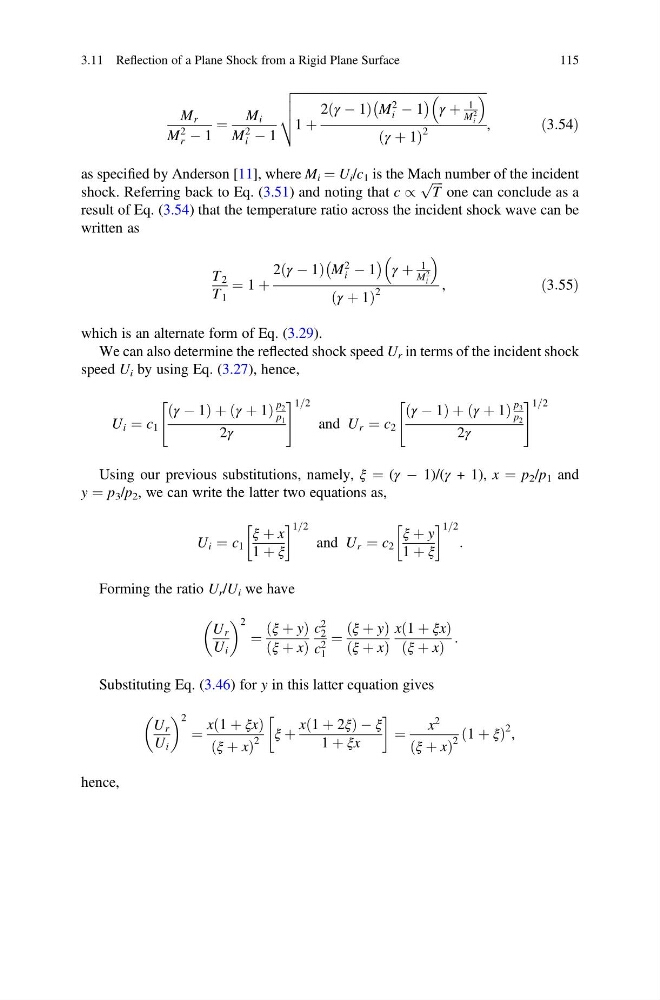
as specified by Anderson [11], where M i ¼ U i /c 1 is the Mach number of the incident
shock. Referring back to Eq. (3.51) and noting that c /
ffiffiffi ffi
T
p
one can conclude as a
result of Eq. (3.54) that the temperature ratio across the incident shock wave can be
written as
T 2
T 1
¼ 1 þ
2 γ À 1
ð
Þ M
2
i À 1
À
Á γ þ
1
M
2
i
γ þ 1
ð
Þ
2
,
ð3:55Þ
which is an alternate form of Eq. (3.29).
We can also determine the reflected shock speed U r in terms of the incident shock
speed U i by using Eq. (3.27), hence,
U i ¼ c 1
γ À 1
ð
Þþ γ þ 1
ð
Þ
p 2
p 1
2γ
"
# 1=2
and U r ¼ c 2
γ À 1
ð
Þþ γ þ 1
ð
Þ
p 3
p 2
2γ
"
# 1=2
Using our previous substitutions, namely, ξ ¼ (γ À 1)/(γ + 1), x ¼ p 2 /p 1 and
y ¼ p 3 /p 2 , we can write the latter two equations as,
U i ¼ c 1
ξ þ x
1 þ ξ
! 1=2
and U r ¼ c 2
ξ þ y
1 þ ξ
! 1=2
:
Forming the ratio U r /U i we have
U r
U i
2
¼
ξ þ y
ð
Þ
ξ þ x
ð
Þ
c
2
2
c 2
1
¼
ξ þ y
ð
Þ
ξ þ x
ð
Þ
x 1 þ ξx
ð
Þ
ξ þ x
ð
Þ
:
Substituting Eq. (3.46) for y in this latter equation gives
U r
U i
2
¼
x 1 þ ξx
ð
Þ
ξ þ x
ð
Þ
2
ξ þ
x 1 þ 2ξ
ð
ÞÀξ
1 þ ξx
!
¼
x
2
ξ þ x
ð
Þ
2
1 þ ξ
ð
Þ
2 ,
hence,
3.11 Reflection of a Plane Shock from a Rigid Plane Surface
115
M
2
r À 1
¼
M i
M
2
i À 1
ffiffiffiffiffiffiffiffiffiffiffiffiffiffiffiffiffiffiffiffiffiffiffiffiffiffiffiffiffiffiffiffiffiffiffiffiffiffiffiffiffiffiffiffiffiffiffiffiffiffiffiffiffiffiffiffiffiffiffiffiffi ffi
1 þ
2 γ À 1
ð
Þ M
2
i À 1
À
Á γ þ
1
M
2
i
γ þ 1
ð
Þ
2
v
u
u
t
,
ð3:54Þ
as specified by Anderson [11], where M i ¼ U i /c 1 is the Mach number of the incident
shock. Referring back to Eq. (3.51) and noting that c /
ffiffiffi ffi
T
p
one can conclude as a
result of Eq. (3.54) that the temperature ratio across the incident shock wave can be
written as
T 2
T 1
¼ 1 þ
2 γ À 1
ð
Þ M
2
i À 1
À
Á γ þ
1
M
2
i
γ þ 1
ð
Þ
2
,
ð3:55Þ
which is an alternate form of Eq. (3.29).
We can also determine the reflected shock speed U r in terms of the incident shock
speed U i by using Eq. (3.27), hence,
U i ¼ c 1
γ À 1
ð
Þþ γ þ 1
ð
Þ
p 2
p 1
2γ
"
# 1=2
and U r ¼ c 2
γ À 1
ð
Þþ γ þ 1
ð
Þ
p 3
p 2
2γ
"
# 1=2
Using our previous substitutions, namely, ξ ¼ (γ À 1)/(γ + 1), x ¼ p 2 /p 1 and
y ¼ p 3 /p 2 , we can write the latter two equations as,
U i ¼ c 1
ξ þ x
1 þ ξ
! 1=2
and U r ¼ c 2
ξ þ y
1 þ ξ
! 1=2
:
Forming the ratio U r /U i we have
U r
U i
2
¼
ξ þ y
ð
Þ
ξ þ x
ð
Þ
c
2
2
c 2
1
¼
ξ þ y
ð
Þ
ξ þ x
ð
Þ
x 1 þ ξx
ð
Þ
ξ þ x
ð
Þ
:
Substituting Eq. (3.46) for y in this latter equation gives
U r
U i
2
¼
x 1 þ ξx
ð
Þ
ξ þ x
ð
Þ
2
ξ þ
x 1 þ 2ξ
ð
ÞÀξ
1 þ ξx
!
¼
x
2
ξ þ x
ð
Þ
2
1 þ ξ
ð
Þ
2 ,
hence,
3.11 Reflection of a Plane Shock from a Rigid Plane Surface
115